
Calculating ROI on a Swiss Rental Property: The Investor’s 2026 Guide
99% of real estate investors surveyed in March 2026 still view Switzerland as the ultimate “safe haven,” yet many struggle to reconcile this reputation with a national average gross rental yield of just 2.91%. You’ve likely felt the tension between the security of the Swiss market and the complexity of its shifting regulatory landscape, especially following the April 15, 2026, Lex Koller revision proposals. Accurately calculating ROI on a swiss rental property requires moving beyond simple spreadsheets to account for cantonal tax variations that can reach 46% and transaction costs up to 5%.
We understand that your goal isn’t just to own a piece of the Alps; it’s to ensure your luxury asset performs with the same precision as a Swiss timepiece. This guide provides a clear framework for mastering these nuances, from leveraging 1.45% fixed mortgage rates to identifying the “Swiss Premium” in short-term rental yields. You’ll discover how to transform a static investment into a high-yield hospitality asset through meticulous management and local expertise. We’ll explore the logistics of net yields and the peace of mind that comes from a bespoke management partnership.
Key Takeaways
- Learn to balance immediate rental yields with long-term capital appreciation to define true success in the stable Swiss market.
- Master the precise formulas for calculating ROI on a swiss rental property, moving from initial gross estimates to accurate net profitability.
- Understand how the “Swiss Premium” and luxury positioning allow your asset to command higher rates than standard market averages.
- Navigate the 2026 regulatory environment, including Lex Koller and Lex Weber, to protect your property’s resale value and operational flexibility.
- Discover how bespoke management transforms a static residence into a high-performance hospitality brand that optimizes every aspect of your yield.
The Fundamentals of ROI in the Swiss Real Estate Market
Investing in the Swiss landscape is an exercise in precision and patience. When you begin calculating ROI on a swiss rental property, it is essential to look beyond the simple monthly cash flow. In this sophisticated market, a true Return on Investment (ROI) is a delicate balance of consistent rental yields and long-term capital appreciation. While other global markets offer volatile highs and lows, Switzerland provides a rhythmic stability that preserves wealth across generations. This unique environment requires a mindset focused on total asset performance rather than short-term gains.
The market outlook for 2026 remains remarkably resilient. As of May 2026, 10-year fixed mortgage rates are ranging from 1.2% to 2.05%, with many institutional offers available at 1.45%. These favorable financing conditions, paired with a projected 3.1% increase in transaction prices for single-family homes, create a robust foundation for capitalization rates. Investors aren’t just buying square footage; they’re securing a position in a supply-constrained market where the national vacancy rate sits at a tight 1.0%.
To visualize how these financial variables interact within a property portfolio, watch this practical guide on property calculations:
Stability vs. Yield: The Swiss Investment Philosophy
The “Safe Haven” status of Swiss real estate isn’t merely a marketing phrase; it’s a statistical reality. While emerging markets might boast double-digit nominal yields, those figures often crumble under currency devaluation and political unrest. In contrast, the Swiss Franc’s strength ensures that your “real” yield remains protected. Even with a national average gross rental yield of 2.91% in early 2026, the underlying asset value continues to climb. The Swiss Premium is a combination of location, quality, and legal security. This premium acts as an insurance policy for your capital, ensuring that your luxury villa remains a high-performing asset even during global shifts.
Defining Success: What Constitutes a ‘Good’ Return in 2026?
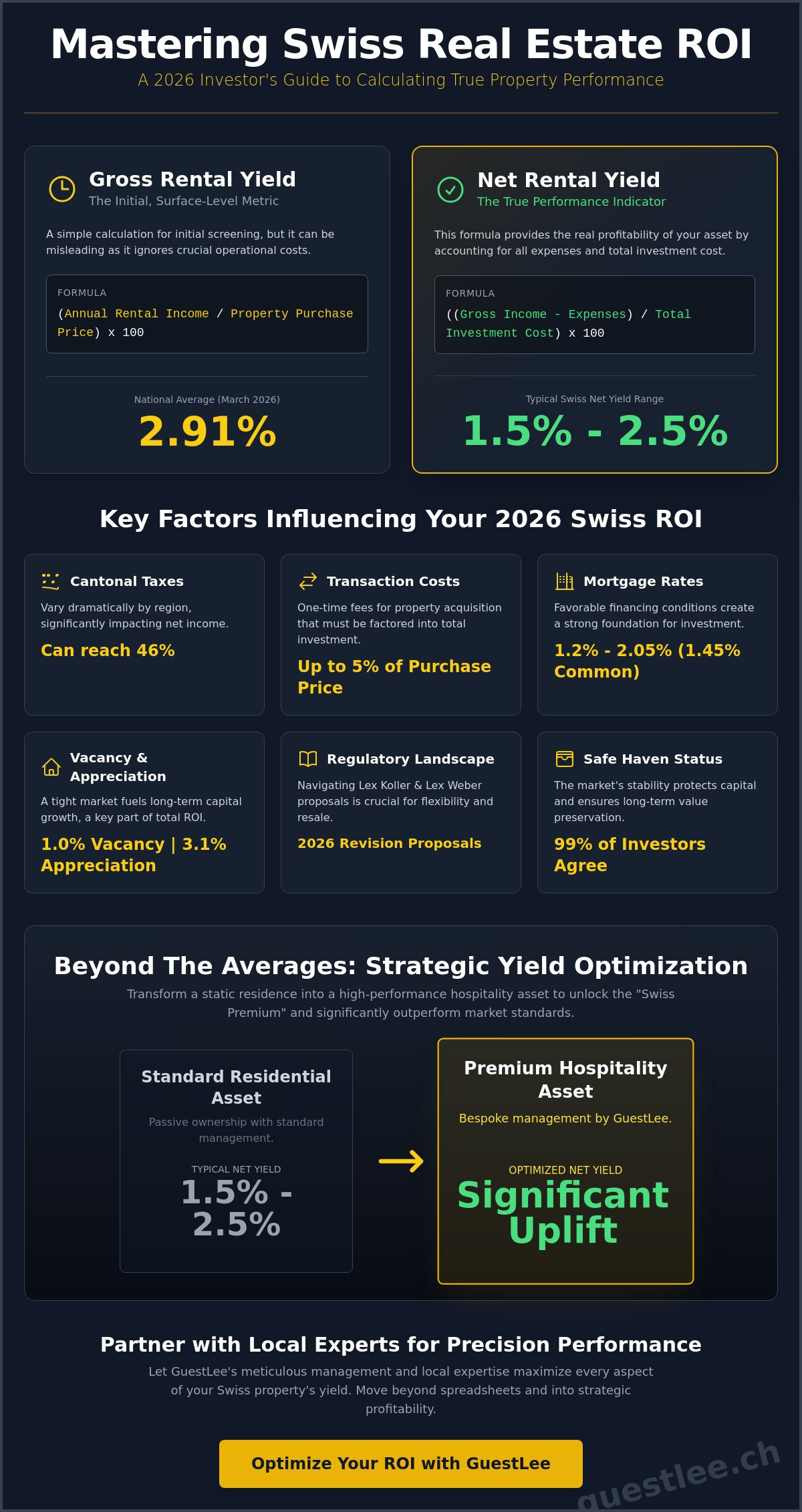
Success in the current climate is defined by outperforming the national averages. While standard residential net yields typically hover between 1.5% and 2.5%, luxury vacation rentals managed with bespoke attention often command a significant uplift. With inflation for 2026 forecast at a negligible 0.3%, rental contract indexation remains stable and predictable. Sophisticated owners now focus on “Total Shareholder Return,” which combines the annual net income with the 2.8% to 3.1% annual appreciation seen in premium condominiums and homes. By partnering with experts at Guestlee, investors can transition from passive ownership to active yield optimization, ensuring every meticulous detail contributes to the bottom line.
Essential Formulas: Calculating Gross and Net Rental Yields
When you’re calculating ROI on a swiss rental property, the first step is often the most deceptive. Most investors begin with the Gross Rental Yield, a simple formula that divides your annual rental income by the property’s purchase price. While this serves as an efficient initial screening tool, it’s essentially a vanity metric. In a market where the national average gross yield sits at 2.91% as of March 2026, relying solely on this figure ignores the intricate layers of Swiss fiscal responsibility. It doesn’t account for the 1.5% to 5% in transaction costs that vary significantly from one canton to another.
The true indicator of your asset’s health is the Net Rental Yield. This formula subtracts all operating expenses and taxes from your gross income before dividing by the total investment cost. For properties that require a bespoke renovation or a premium interior setup to reach luxury standards, we utilize “Yield on Cost.” This metric ensures that every Franc spent on meticulous upgrades is justified by a proportional increase in rental command. For those seeking a professional evaluation of these variables, Guestlee’s asset management team provides bespoke projections tailored to your specific canton.
Calculating Net Yield: Accounting for Swiss Operating Expenses
A sophisticated net yield calculation must incorporate the “Unterhaltskosten,” or maintenance costs, alongside insurance and property taxes. In high-tax cantons like Geneva or Vaud, marginal tax rates for high earners can reach 46%, which directly impacts your net-net return. Beyond the obvious bills, several “hidden” costs often surprise international investors. Compliance with Swiss Federal Office of Housing (BWO) standards is non-negotiable and requires consistent attention to detail. Common overlooked expenses include:
- BWO energy efficiency and safety compliance standards.
- Notary fees, which range from 0.1% to 1% of the purchase price.
- Land registry fees, typically between 0.1% and 0.3%.
- Cantonal property transfer taxes, which are 0% in Zurich but 3% in Geneva.
Return on Equity (ROE): The Impact of Financing
While rental yields provide a snapshot of property performance, Return on Equity (ROE) reveals the power of your personal capital. With 10-year fixed mortgage rates as low as 1.45% in May 2026, Swiss financing acts as a powerful lever. Sophisticated investors often utilize a Loan-to-Value (LTV) ratio of 60% to 75% for luxury acquisitions, allowing them to amplify their returns on the actual cash invested. ROE is the most critical metric for the sophisticated private investor because it measures the efficiency of your liquid capital rather than just the performance of the underlying brick and mortar. By focusing on ROE, you can better compare your Swiss real estate performance against other global asset classes.
Beyond the Formula: Factors Influencing Swiss Property Profitability
While the mathematical framework provides the skeleton of your investment, the true performance of an asset is dictated by the qualitative nuances of the Swiss market. When you’re calculating ROI on a swiss rental property, you must account for a regulatory environment that is currently in a state of significant transition. The proposed revision to the Lex Koller law, announced on April 15, 2026, suggests a tightening of rules for third-country nationals, which inherently increases the scarcity value of existing luxury inventory. Similarly, the Lex Weber regulations continue to cap second-home construction at 20% in most communes. This artificial supply constraint acts as a powerful driver for capital appreciation, ensuring that your property remains a coveted piece of a limited collection.
Sustainability has also moved from a peripheral concern to a core financial metric. In 2026, adhering to Minergie standards is essential for yield protection. With 94% of real estate investors now feeling the pressure to meet Environmental, Social, and Governance (ESG) criteria, energy-efficient properties command higher resale values and lower operational overhead. These certifications serve as a badge of “Swiss Quality,” justifying premium rental price points that standard properties simply cannot reach. By treating your property as a high-performance hospitality asset, you can legally navigate the strict rent controls that often limit the growth of traditional long-term leases.
The Impact of Luxury Positioning on Occupancy
High-end properties demonstrate a unique resilience to economic shifts. In the first quarter of 2026, luxury assets in the Swiss Alps and lakeside regions maintained higher occupancy rates than their mid-tier counterparts. This resilience stems from the “exclusive discovery” experience that affluent travelers seek. Bespoke interiors and meticulous curation don’t just enhance the aesthetic; they justify nightly rates that often sit 40% above the market average. Professional storytelling and premium photography are no longer optional. They are the tools that reduce vacancy rates and build the brand of your property, a service that Guestlee executes with a refined, concierge-level touch.
Navigating Maintenance and Compliance Standards
Swiss precision is a double-edged sword for the unprepared investor. The maintenance required to preserve a luxury asset’s value is rigorous. We advocate for a proactive management style that prevents “yield erosion” caused by emergency repairs or compliance failures. Professional building assessments are a standard requirement in the Swiss market, ensuring that every mechanical and structural detail meets local codes. This meticulous attention to detail protects the property’s long-term value, ensuring that when it comes time to exit the investment, the asset retains the “Swiss Premium” that attracted you in the first place. This “Invisible Expert” approach allows you to enjoy the rewards of ownership without the logistical burden of daily compliance.
Strategic Optimization: Boosting ROI Through Premium Management
Traditional long-term leases in the Swiss market offer a steady, predictable rhythm, but they often face a ceiling due to strict rental regulations and tenant protections. When you are calculating ROI on a swiss rental property, you’ll find that these conventional models typically result in net yields between 1.5% and 2.5%. For the sophisticated investor, shifting toward a luxury short-term rental model transforms the asset from a static lease into a high-performance hospitality brand. This transition allows for a significant uplift in yield by tapping into the “Swiss Premium” that affluent travelers are eager to pay for an unforgettable, curated stay.
The key to this optimization lies in treating your property not just as real estate, but as a brand. In the 2026 landscape, a property’s reputation is built on meticulous attention to detail, from bespoke welcome experiences to seamless concierge services. This level of care fosters guest loyalty and drives premium nightly rates that far exceed standard market averages. By positioning your villa as an exclusive discovery rather than a mere accommodation, you create a value proposition that is resilient against broader economic fluctuations. It’s about moving beyond the property’s physical attributes to sell a lifestyle of comfort and local expertise.
Modern yield management also requires sophisticated financial tools. We utilize dynamic pricing strategies to maximize Revenue Per Available Room (RevPAR), adjusting rates in real-time based on local events, seasonal demand, and the 2026 inflation forecast of 0.3%. This precision ensures that your asset is never undervalued during peak periods like the World Economic Forum or the height of the ski season. It is a meticulous approach that balances high occupancy with price integrity, ensuring your net return is consistently optimized without compromising the asset’s prestige.
Achieving these results requires a partner who understands the intersection of real estate and luxury hospitality. Our bespoke property management services handle every logistical complexity behind the scenes, from guest screening to rigorous maintenance compliance. This “Invisible Expert” approach provides you with peace of mind while your asset works harder for you. It is the difference between simply owning a property and commanding a high-yield investment that reflects the global gold standard of Swiss quality.
Partnering for Performance: How GuestLee Maximizes Your Swiss Asset
The journey of calculating ROI on a swiss rental property often begins with complex spreadsheets, but it concludes with the human element of hospitality. While the formulas we’ve discussed provide the necessary map, GuestLee serves as your expert navigator through the intricacies of the luxury market. We position ourselves as the “Invisible Expert,” a partner who meticulously handles the intersection of real estate investment and high-end service. Our role is to ensure that the “Swiss Quality” you’ve invested in is reflected in every guest interaction, protecting your property’s value while driving superior net yields.
Our GuestLee property management services are designed to remove the friction from ownership. We manage the seamless transition from property acquisition or setup to a fully operational, high-occupancy rental. By handling the logistical complexities behind the scenes, we provide you with the peace of mind that comes from knowing your asset is in the hands of professionals who treat it with the same care as a private home. This meticulous approach ensures that your investment remains a source of pride rather than a source of stress.
The GuestLee Approach: Meticulous Management for Superior Yields
Optimization is a continuous process rather than a one-time setup. We employ bespoke marketing strategies that target discerning global travelers, ensuring your property is seen by those who value exclusivity. Our guest screening process is rigorous; it preserves the integrity of your home while maintaining the high standards expected in the Swiss luxury sector. This meticulous attention to detail results in the consistent 5-star reviews necessary to sustain premium rates year-round. For a deeper look into how we navigate these operations, explore our Definitive Guide to Property Management Services in Switzerland.
Future-Proofing Your Investment in 2026
The landscape of 2026 requires more than just traditional service; it demands technological precision. GuestLee utilizes advanced tech stacks that provide you with transparent reporting and real-time ROI tracking. You can monitor your property’s performance with the same clarity you expect from any other high-end financial asset. We ensure that every guest touchpoint reinforces the “Swiss Premium,” fostering long-term appreciation in a market where 99% of investors still prioritize stability. By integrating modern tools with traditional hospitality values, we future-proof your asset against market shifts.
Your property deserves a management strategy as refined as its architecture. Contact GuestLee to discuss your bespoke property management strategy and discover how we can elevate your Swiss investment to its maximum potential.
Securing Your Legacy in the Swiss Market
Mastering the nuances of calculating ROI on a swiss rental property allows you to look past the standard 2.91% national gross yield and target the superior returns found in the luxury segment. By navigating the April 2026 Lex Koller updates with professional foresight, you transform a static residence into a high-performance hospitality asset. Success requires a meticulous balance between the security of a 1.0% national vacancy rate and the dynamic revenue potential of short-term luxury stays.
Our team brings Swiss-standard precision to every facet of asset management, ensuring your property remains a global gold standard for quality and service. We handle the complexities of compliance and guest curation so you can enjoy the peace of mind that comes from a truly seamless investment. Now is the time to elevate your portfolio beyond traditional expectations. Optimize your Swiss property yield with GuestLee’s bespoke management and experience the difference of a partnership built on excellence. Your journey toward an optimized, high-yield luxury asset begins with a single, sophisticated conversation.
Frequently Asked Questions
What is a realistic net rental yield for a luxury property in Switzerland?
A realistic net rental yield for a luxury property in Switzerland typically ranges between 1.5% and 2.5% after all operational costs and taxes are deducted. While the national average gross yield was 2.91% in the first quarter of 2026, premium assets often outperform these figures through higher occupancy and superior nightly rates. Achieving the upper end of this range requires a meticulous approach to expense management and the optimization of property performance.
How do Swiss taxes affect the ROI for foreign property owners?
Swiss taxes significantly influence the final outcome when calculating ROI on a swiss rental property, as rental income is taxed as part of your total global income. Combined federal, cantonal, and municipal tax rates can reach 46% for high earners in cantons like Geneva or Vaud. Additionally, real estate capital gains tax rates decrease with the length of ownership, incentivizing long-term holds rather than short-term flips to avoid rates as high as 50%.
Is it more profitable to rent my Swiss villa short-term or long-term in 2026?
Short-term luxury rentals are generally more profitable in 2026 because they allow owners to command premium hospitality rates that bypass traditional residential rent controls. While long-term leases offer stability, they are often indexed to inflation rates as low as 0.3%, which limits potential growth. A managed luxury villa can leverage dynamic pricing to capitalize on peak seasons, resulting in a higher net yield compared to a static annual lease.
What are the main “hidden costs” that investors forget when calculating Swiss property ROI?
Investors frequently overlook transaction costs that range from 1.5% to 5% of the purchase price depending on the specific canton. Notary fees between 0.1% and 1%, along with land registry fees up to 0.3%, must be factored into the initial capital outlay. Ongoing costs like Swiss Federal Office of Housing (BWO) compliance and meticulous maintenance, known as Unterhaltskosten, are also essential variables that can erode net returns if not properly projected.
How does the “Lex Weber” law impact my ability to generate rental income?
The Lex Weber law restricts the construction of second homes to 20% of the total housing stock in any given commune, which creates a structural supply shortage. While this limits your ability to purchase new-build inventory in certain alpine regions, it simultaneously protects the resale value and rental demand for existing properties. This scarcity is a primary driver behind the 3.1% price increase forecast for single-family homes in 2026.
Can professional property management actually increase my net ROI despite the fees?
Professional management can increase your net ROI by optimizing Revenue Per Available Room (RevPAR) through sophisticated dynamic pricing and bespoke marketing. While management fees are an added expense, the resulting increase in occupancy and the ability to command premium rates often more than offsets the cost. Meticulous guest screening and proactive maintenance also prevent the yield erosion typically caused by property damage or emergency structural repairs.
How do Minergie standards impact the resale value and rental yield of a property?
Minergie standards enhance the overall return on a swiss rental property by significantly reducing long-term utility costs and meeting the ESG criteria demanded by 94% of modern investors. Properties with these energy-efficiency certifications often command a higher resale premium because they are seen as future-proofed against tightening environmental regulations. This certification acts as a badge of quality that justifies higher rental price points in a competitive luxury market.
What is the “Yield on Cost” and why is it important for Swiss renovations?
Yield on Cost is a metric that calculates your return based on the total investment, including both the purchase price and any subsequent renovation expenses. This is particularly important for Swiss properties undergoing bespoke upgrades to reach luxury standards. It ensures that the capital spent on meticulous architectural or interior improvements is generating a proportional increase in rental income, providing a clearer picture of the project’s true profitability.

Article by
Giacomo Esposito