Legal Requirements for Short-Term Rentals in Switzerland: The 2026 Compliance Guide
Did you know that with a vacancy rate of just 0.34 percent in Geneva, your luxury residence is one of the most sought-after assets in Europe, yet a single oversight regarding the May 2026 registration deadline could put that entire revenue stream at risk? Understanding the legal requirements for short-term rentals switzerland is no longer just about administrative diligence; it’s the foundation of protecting your property’s prestige and performance. As the regulatory landscape shifts toward mandatory registration numbers and stricter cantonal oversight, maintaining a compliant portfolio requires a sophisticated, proactive approach.
You’ve likely felt the weight of conflicting rules between federal mandates and local cantonal decrees, especially when handling the nuances of guest police reporting or the 90-day rental limit in Geneva. It’s natural to feel concerned that these evolving complexities might overshadow the rewards of owning a high-end holiday home. We believe that professional asset management should feel as effortless as a concierge service, where every detail is handled with quiet confidence and meticulous care.
This guide offers a refined roadmap to secure your investment through 2026 and beyond. We’ll explore the essential steps for seamless compliance, from managing the CHF 3.75 Geneva tourist tax to ensuring every foreign guest is registered with precision. You’ll gain a clear understanding of how to transform regulatory hurdles into a hallmark of quality, ensuring your property remains a high-performing asset in the Swiss market.
Key Takeaways
- Master the multi-layered legal requirements for short-term rentals switzerland to ensure your property adheres to federal, cantonal, and municipal standards without disruption.
- Navigate the critical 90-day threshold and zoning restrictions to prevent your luxury home from being classified as a commercial entity unexpectedly.
- Streamline your financial obligations by implementing precise protocols for the Taxe de Séjour and managing VAT thresholds for high-performing assets.
- Protect your investment with specialized insurance and fire safety standards that exceed basic homeowner coverage for the short-term market.
- Discover how professional property management mitigates compliance risks, allowing you to enjoy the rewards of ownership while every administrative detail is handled with precision.
The Multi-Layered Framework of Swiss Short-Term Rental Law
The Swiss legal system for property owners is a masterpiece of decentralized complexity, requiring a discerning eye to navigate successfully. It operates across three distinct tiers: federal, cantonal, and municipal. This structure ensures that local communities retain control over their character, but it also means that the legal requirements for short-term rentals switzerland can change as you cross a cantonal border. Success requires precision. Understanding this hierarchy is the first step in ensuring your luxury villa remains a compliant and prestigious asset.
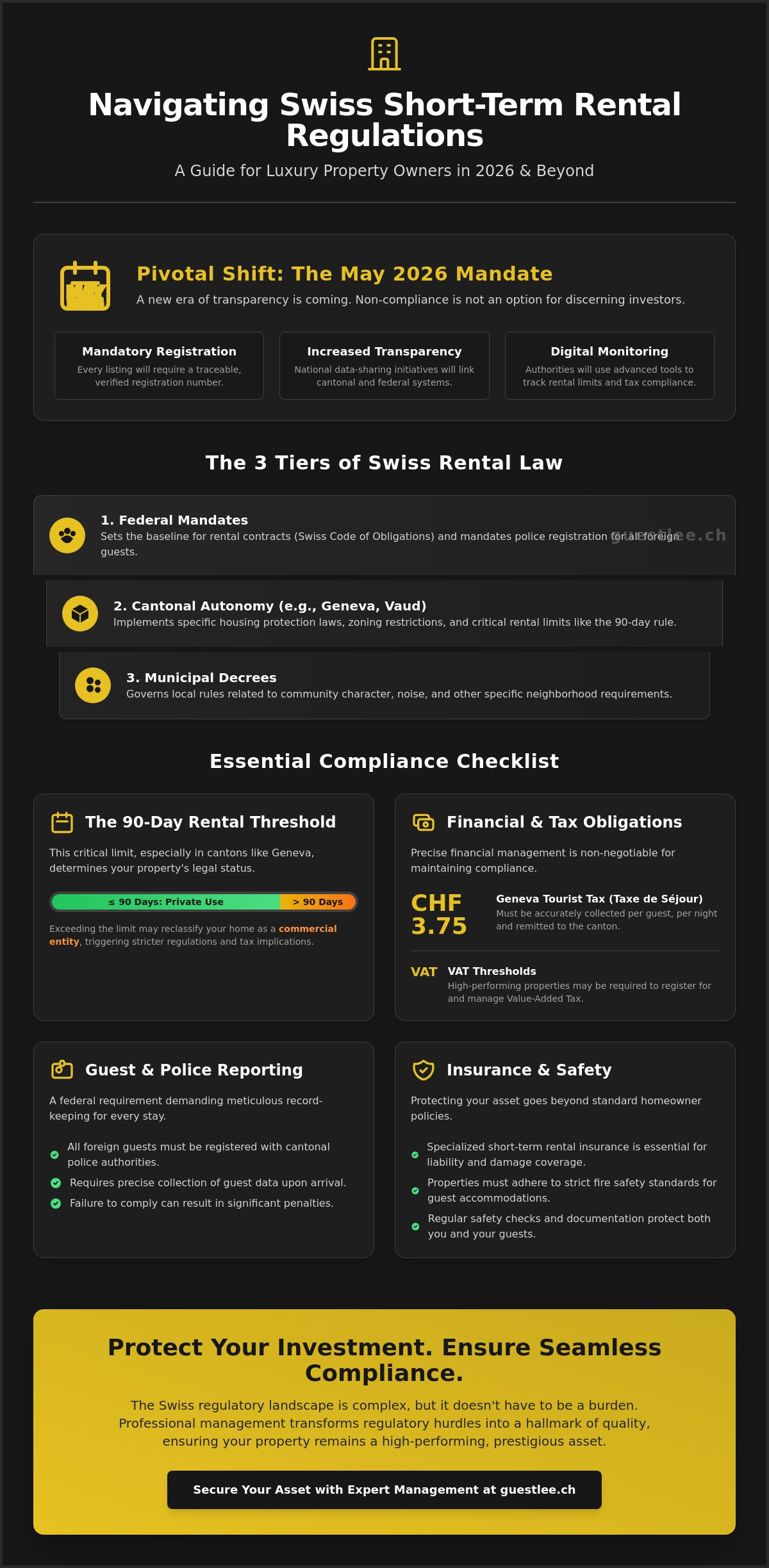
2026 represents a pivotal moment in this legal journey. National data-sharing initiatives and the introduction of mandatory registration schemes are bringing a new level of transparency to the market. For the sophisticated investor, this shift isn’t a hurdle but an opportunity to demonstrate the high standards of their property management. Distinguishing between a private hospitality arrangement and a regulated commercial activity is now more critical than ever, as authorities use digital tools to monitor the 90-day limits and tax compliance with unprecedented precision.
To gain a clearer perspective on how these layers interact and affect your hosting strategy, watch this expert overview:
Federal Mandates vs. Cantonal Autonomy
At the federal level, the Swiss Code of Obligations sets the baseline for rental contracts, ensuring a standard of fairness and clarity that mirrors the nation’s reputation for reliability. Federal law also mandates the registration of foreign guests with police authorities, a task that requires meticulous attention to detail to maintain the security of your residence. However, the Short-term rental regulations and legal requirements for short-term rentals switzerland often diverge sharply at the cantonal level. While federal law provides the skeleton, cantons like Geneva or Vaud add the muscle, implementing specific housing protection measures and zoning laws that dictate exactly how often a property can be shared with guests.
Many owners find that partnering with a refined provider like GuestLee simplifies these complexities. Professional management ensures that your property adheres to the specific tax and reporting standards of its canton, protecting your investment from the risks of non-compliance. This personalized approach allows you to enjoy the rewards of ownership while the intricate logistical details are handled with quiet confidence and meticulous regional standards.
The Evolution of Housing Protection (Lex Airbnb)
The Lex Weber, or Second Homes Act, remains a cornerstone of Swiss property law. It specifically limits the construction of new secondary residences in many municipalities to 20 percent of the total housing stock. For owners of existing luxury villas, this regulation often enhances the value of their asset by restricting market supply. Yet, it also places these properties under closer scrutiny. Recent shifts toward stricter primary residence protections mean that high-demand urban zones are increasingly prioritizing long-term residents over occasional visitors.
In May 2026, the introduction of mandatory registration numbers across many cantons ensures that every listing is traceable and verified. This shift transforms compliance from a back-office task into a visible mark of a property’s legitimacy. Within these protection frameworks, luxury properties are categorized by their usage patterns. Staying within the 90-day threshold often preserves the property’s status as a private residence, whereas exceeding this limit may trigger a reclassification to commercial use, requiring specialized authorizations and a different set of tax obligations.
Essential Compliance: Permits, Registration, and the 90-Day Rule
The introduction of mandatory registration numbers in May 2026 marks a significant shift in how property owners must approach their hospitality ventures. This isn’t merely a minor administrative task; it’s a fundamental pillar of the legal requirements for short-term rentals switzerland. From this date, every online listing must prominently display a unique identifier granted by local authorities. Failing to do so doesn’t just risk a warning. It can lead to immediate delisting from major platforms and substantial financial penalties that can reach into the tens of thousands of francs. This level of transparency ensures that every guest experience is backed by a property that meets rigorous national standards.
Zoning restrictions play an equally critical role in your compliance strategy. Before welcoming your first guest, you must ensure your residence is legally permitted for short-term occupancy. In high-demand zones, authorities are increasingly vigilant about preserving housing stock for long-term residents. If your property is incorrectly categorized, you may face a forced cessation of all rental activities. For owners who value their peace of mind, engaging with expert property management provides a seamless way to verify these details without the burden of navigating local bureaucracy alone.
Securing Your Mandatory Registration Number
Obtaining your unique ID is a structured process that demands precision. First, you must verify your property’s eligibility with the local building and planning department to ensure no restrictive covenants are in place. Once confirmed, you’ll submit an official ‘usage change’ or rental application to your specific commune. This step often requires documentation regarding safety standards and tax status. Finally, once your application is approved, you must integrate your ID into all marketing materials. This number serves as a digital seal of approval, signaling to both guests and authorities that your villa is a fully compliant, high-end asset.
Navigating the 90-Day Limit in 2026
The 90-day threshold is the defining line between a private residence and a commercial hospitality business. In the Canton of Geneva, for example, Geneva’s short-term rental laws now allow for a maximum of 90 nights per calendar year. This limit is calculated on a strict calendar year basis, resetting every January 1st. It’s designed to balance the vibrant tourism market with the needs of local residents.
Maximizing your yield within this 90-day window requires a sophisticated strategy. By focusing on peak seasonal events and high-demand windows, you can ensure your property performs at its peak without crossing into the commercial category. While some exemptions exist for properties used for specific diplomatic or cultural purposes, most luxury owners find that meticulous tracking is the best defense against non-compliance. It’s about quality over quantity, ensuring every night booked contributes to the long-term value of your prestigious Swiss home.
Financial and Administrative Obligations for Property Owners
Managing a prestigious estate in Switzerland requires a meticulous approach to administrative duties that extends far beyond simple bookkeeping. The legal requirements for short-term rentals switzerland mandate a rigorous protocol for guest identification and fiscal reporting. One often overlooked aspect is the mandatory registration of foreign guests with cantonal police authorities. For owners of high-end villas hosting high-profile individuals, this process must be handled with absolute discretion and precision. It’s a legal duty that ensures national security standards are met while providing a seamless, secure arrival experience for every visitor.
Financial transparency is equally vital, particularly regarding the ‘Proportional Profit’ rule. In Switzerland, if you are subletting a property, you’re legally restricted from generating excessive profit over your own rental costs. This rule protects the housing market’s integrity and requires hosts to be precise in their pricing strategies. Additionally, if your annual rental income exceeds the CHF 100,000 threshold, you must register for and pay Value Added Tax (VAT). This transition to a VAT-registered entity is a clear signal of a high-performing, professional asset that operates at the gold standard of Swiss hospitality.
Tourist Tax and Guest Card Management
The Taxe de Séjour is a cornerstone of regional tourism funding, and its collection is a primary responsibility for any host. Rates vary significantly across the country. In Geneva, the official rate is CHF 3.75 per person, per night. Accurately reporting and remitting these funds is a critical part of the 2026 compliance guide for property owners. We believe in turning this administrative step into a curated benefit. By providing guests with ‘Guest Cards’ tied to these tax payments, you offer them seamless access to local transport and exclusive cultural discounts, elevating their stay from a simple visit to a refined exploration.
Income Tax and Financial Transparency
Every franc of rental revenue must be transparently declared on your Swiss tax returns, whether you’re a local resident or an international investor. For non-residents, this often involves a limited tax liability focused specifically on the property’s earnings. The Swiss system allows for the deduction of various operational expenses, including maintenance, insurance, and professional fees. For a sophisticated look at how these obligations fit into your broader portfolio, our Luxury Real Estate Switzerland guide offers a comprehensive view of exclusive property investment. By maintaining impeccable financial records, you ensure your asset remains a secure, high-performing centerpiece of your investment strategy.
Risk Management: Insurance, Safety, and Asset Protection
The protection of a luxury residence in Switzerland demands a security strategy as refined as the property itself. While many owners rely on standard homeowner policies, these often contain specific exclusions for commercial activities. Once you welcome paying guests, your residence undergoes a legal shift in the eyes of insurers. The legal requirements for short-term rentals switzerland dictate that owners maintain specialized liability coverage to address risks unique to the hospitality sector. Standard policies frequently fail to cover accidental damage caused by guests or the significant loss of income that follows a property being rendered temporarily uninhabitable.
Data privacy is another cornerstone of modern asset protection, particularly when hosting high-profile individuals who value absolute discretion. Switzerland’s Federal Act on Data Protection (FADP) requires meticulous handling of sensitive guest information. From the moment of police registration to the final check-out, every data point must be stored with absolute security. Failing to meet these standards doesn’t just invite legal repercussions; it compromises the reputation of your home as a safe sanctuary for global travelers. Ensuring your digital systems are as secure as your physical ones is a hallmark of a professional rental operation.
Specialized Short-Term Rental Insurance
A comprehensive hospitality policy serves as a silent guardian of your investment. These specialized products are designed to bridge the gap left by residential insurance, offering robust protection against malicious damage and theft. In the Swiss market, a high-end policy should also include “loss of rent” coverage. This ensures your financial performance remains steady even if an unforeseen event requires a temporary halt to bookings. It’s about creating a safety net that allows you to focus on the experiential side of hospitality while the financial risks are expertly mitigated behind the scenes.
Operational Compliance and Safety Standards
Maintaining a luxury villa involves a legal ‘duty of care’ that requires regular, documented maintenance. Cantonal safety regulations are strict, particularly concerning fire prevention. Owners must ensure that smoke detectors, fire extinguishers, and first aid kits are not only present but regularly inspected by certified professionals. Emergency exits must be clearly marked and unobstructed, mirroring the standards of five-star boutique hotels. These protocols are not mere suggestions; they are foundational to your legal standing in the event of an incident.
Adhering to these operational standards is essential for both compliance and guest peace of mind. For a deeper look at maintaining these meticulous regional standards, explore The Definitive Guide to Property Management Services in Switzerland for 2026. By integrating these safety protocols into your weekly management routine, you fulfill the legal requirements for short-term rentals switzerland while enhancing the perceived value of your home. If you’re ready to secure your property’s future with professional oversight, contact GuestLee to discuss our bespoke management solutions today.
Seamless Compliance Through Professional Management
The weight of the legal requirements for short-term rentals switzerland can feel like a full-time occupation for even the most organized property owner. As we’ve explored, the landscape is defined by a rigorous May 2026 registration deadline and the meticulous tracking of the 90-day limit. These aren’t just administrative suggestions; they’re the pillars of a secure investment. For the discerning owner, managing these details from afar often leads to unnecessary anxiety. Cantonal authorities expect absolute precision in reporting and prompt tax remittance, leaving no room for the errors that often accompany self-management.
Professional management transforms these complex administrative burdens into a streamlined, invisible process. By delegating the logistical intricacies to a trusted partner, you ensure that your asset remains a compliant, high-performing investment without sacrificing your personal time. This transition from owner-operator to professional oversight isn’t just about risk mitigation. It’s about maintaining the gold standard of Swiss hospitality, where every detail behind the scenes is as flawless as the guest experience itself. Precision is mandatory, and we provide the quiet confidence that your property is always ahead of the curve.
Why Professional Oversight Beats Self-Management
Self-management frequently results in fragmented data and missed reporting windows, which can trigger the financial penalties we’ve discussed. A professional model automates guest reporting and tax collection, ensuring 100% accuracy for every booking. We maintain deep-rooted relationships with local communes and cantonal authorities, allowing us to navigate subtle shifts in municipal expectations before they become hurdles. Discover the GuestLee Switzerland premier service model to see how we elevate property care into a sophisticated asset management strategy.
GuestLee: Your Guardian in Swiss Regulatory Excellence
At GuestLee, we act as the dedicated guardian of your regulatory standing. We’ve already begun handling the May 2026 registration transition for our clients, securing mandatory IDs and integrating them seamlessly into all marketing platforms. Every guest stay is documented and reported with Swiss precision, providing a transparent audit trail that satisfies the most rigorous cantonal inspections. This level of detail ensures that your home remains a prestigious, worry-free asset.
The legal landscape will continue to evolve well beyond 2026. We’re already monitoring the projected 2027 and 2028 shifts in national transparency standards to ensure your portfolio remains future-proof. By staying ahead of these regulatory curves, we protect the long-term value of your villa. This proactive stance allows your property to remain a leading light in the Swiss luxury market, defined by its impeccable legal standing and its commitment to excellence. Your peace of mind is our highest priority, handled with the meticulous care your investment deserves.
Securing Your Legacy in the New Era of Swiss Hospitality
The evolution of the Swiss rental landscape toward the May 2026 registration deadline signals a market that values transparency and professional standards above all else. By mastering the legal requirements for short-term rentals switzerland, you don’t just avoid penalties; you position your residence as a verified, high-end destination for the world’s most discerning travelers. Success in this regulated environment depends on a meticulous approach to every detail, from the 90-day limit to specialized asset protection.
Since 2016, GuestLee has served as a dedicated guardian of Swiss excellence, specializing in the management of prestigious homes and luxury asset protection. We handle the entire lifecycle of your property’s compliance, from initial commune registration to the precise reporting of every guest departure. Let us transform these administrative complexities into a seamless, high-performing strategy for your portfolio. Secure your property’s future with GuestLee’s expert management and enjoy the rewards of ownership with complete peace of mind. Your villa’s potential is limitless when backed by a partner who values precision as much as you do.
Frequently Asked Questions
Do I need a commercial license to rent my villa short-term in Switzerland?
You typically don’t need a commercial license for casual hosting, but exceeding specific cantonal thresholds often triggers a reclassification of your property. In regions like Geneva, once you bypass the 90-day limit, your residence is considered a commercial entity and requires special authorization. It’s vital to check your local commune’s zoning laws to ensure your property is permitted for hospitality use before welcoming guests.
What is the 90-day rule for short-term rentals, and does it apply to all cantons?
The 90-day rule is a regulatory cap on the number of nights a property can be rented to tourists per calendar year. While it’s a strict standard in Geneva and Lucerne to protect local housing stock, it doesn’t apply uniformly across all 26 cantons. Some alpine regions offer more flexibility, while urban centers are increasingly adopting these limits to manage high demand and low vacancy rates.
How do I register my property for the mandatory 2026 registration number?
You obtain your mandatory identifier by submitting an application to your local municipal or cantonal housing department. This process confirms that your villa meets specific safety, zoning, and tax standards required by the state. Starting in May 2026, displaying this number is one of the essential legal requirements for short-term rentals switzerland, serving as a digital seal of legitimacy for every online listing.
Am I legally required to report guest details to the Swiss police?
Yes, Swiss federal law mandates that all hosts register the identities of foreign guests with cantonal police authorities. This requirement ensures national security standards are maintained and facilitates the accurate collection of regional tourist taxes. For owners of prestigious estates, handling this sensitive data with absolute discretion and precision is a hallmark of professional property management.
Can my landlord or homeowners’ association (PPE) ban short-term rentals?
Your landlord or the Propriété par Étages (PPE) regulations can absolutely restrict or prohibit short-term rental activities. Tenants are legally required to obtain written permission from their landlord before subletting a property to travelers. Similarly, homeowners should carefully review their association’s bylaws, as many luxury developments include clauses designed to preserve the exclusivity and quiet nature of the residence.
What taxes am I responsible for as a short-term rental owner in Switzerland?
You’re responsible for collecting the Taxe de Séjour from guests and declaring all rental revenue on your Swiss income tax return. If your annual turnover from short-term bookings exceeds CHF 100,000, you must also register for and pay Value Added Tax (VAT). These fiscal duties are managed at the cantonal level, meaning rates and reporting deadlines will vary depending on your property’s specific location.
Is short-term rental insurance mandatory under Swiss law?
While specialized insurance isn’t always a federal mandate, standard homeowner policies almost always exclude coverage for commercial guest activities. Relying on basic insurance leaves you vulnerable to significant financial loss in the event of guest injury or malicious damage. A hospitality-specific policy is a sophisticated necessity that ensures your high-value asset and its income stream remain protected against the unexpected.
How do housing protection laws (Lex Airbnb) affect my rental income potential?
Housing protection laws can limit your income potential by capping the total number of nights you can rent your property to short-term guests. These regulations, often referred to as ‘Lex Airbnb’, are designed to prevent the depletion of long-term housing stock in popular destinations. Navigating these legal requirements for short-term rentals switzerland allows you to strategically target high-yield seasonal windows, ensuring your property remains a high-performing asset within the allowed limits.

Article by
Giacomo Esposito