
The 2026 Owner’s Guide to Short-Term Rental Laws in Switzerland
In the refined world of Swiss luxury real estate, a registration number is no longer a mere administrative detail; it is the new hallmark of professional integrity and elite stewardship. You’ve likely felt the growing complexity of managing a high-end property as federal mandates and cantonal nuances shift. It’s natural to feel a sense of urgency regarding the May 2026 registration requirements or the tightening of Lex Koller restrictions. This owner’s guide to short-term rental laws switzerland is designed to replace that uncertainty with the quiet confidence of a perfectly managed asset.
We understand that your primary focus is preserving the prestige of your home while maximizing its financial performance. We promise to provide a clear, sophisticated roadmap that ensures your property remains compliant, protected, and profitable in this evolving market. This guide previews the essential 2026 mandates, from the 90-day rental caps in cities like Geneva and Lucerne to the specific VAT obligations and digital guest reporting systems that define modern Swiss hospitality standards.
Key Takeaways
- Master the multi-tiered Swiss legal landscape by aligning your property with federal, cantonal, and municipal zoning requirements.
- Secure your property’s future by preparing for the May 2026 federal registration mandate, an essential step in this owner’s guide to short-term rental laws switzerland.
- Protect your rental yields by identifying the specific thresholds for VAT and professional income tax classification in your specific canton.
- Ensure comprehensive protection for your luxury asset by addressing the gap between standard insurance and the specific demands of short-term hospitality.
- Streamline your operations through professional management solutions that automate guest reporting and maintain your reputation for excellence.
Navigating the Multi-Tiered Legal Framework of Swiss Short-Term Rentals
Switzerland’s reputation as a premier destination for global travelers is built on a foundation of meticulous order and regional autonomy. For the discerning investor, understanding the hierarchy of governance is the first step in protecting a luxury asset. It’s not merely about following rules; it’s about positioning your property within a framework designed to preserve the very charm that makes Tourism in Switzerland a global gold standard for hospitality. This owner’s guide to short-term rental laws switzerland provides the clarity needed to transform legal complexity into a competitive advantage.
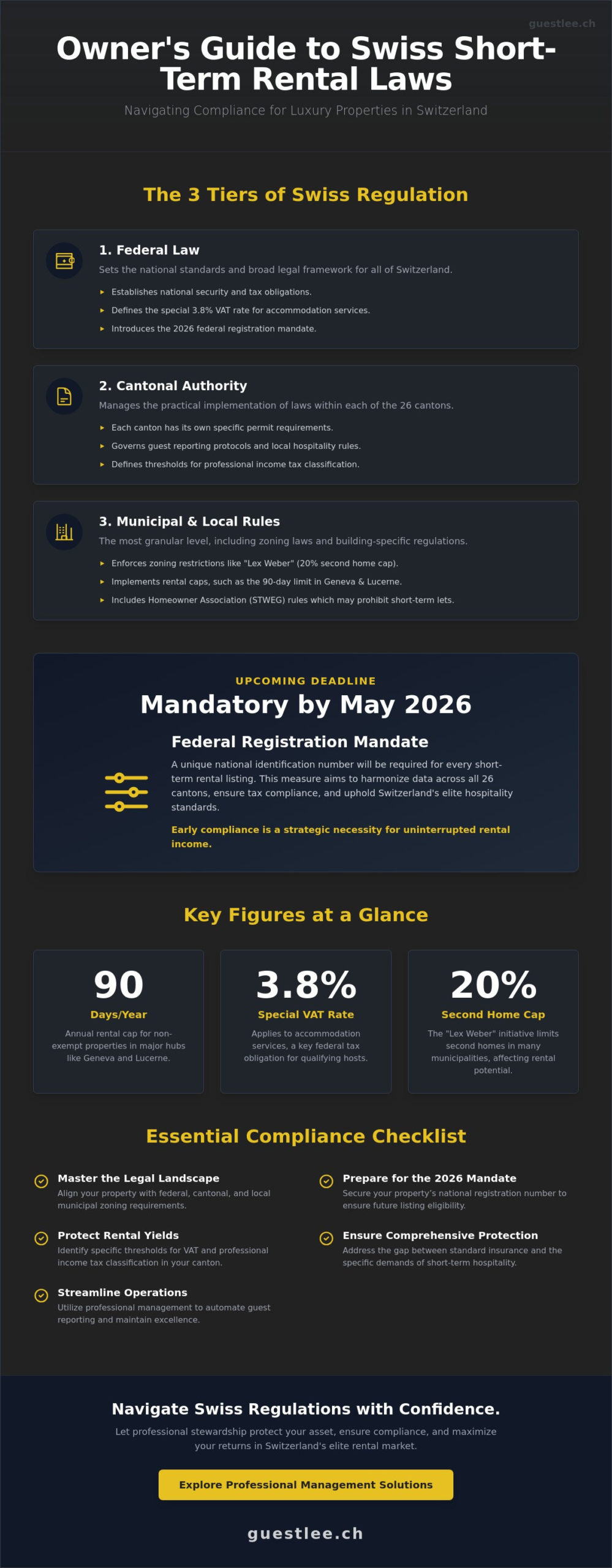
The legal structure is multi-tiered and requires a precise approach. Federal law provides the broad brushstrokes, such as the special 3.8% VAT rate for accommodation services. However, the specific permissions required to operate a luxury villa rental reside with the cantons and local municipalities. This regional sovereignty means that a strategy successful in Zurich might face different constraints in the Valais Alps. Professional stewardship begins with recognizing that compliance is a local endeavor supported by national standards of excellence.
To better understand the nuances of these regulations, watch this host’s success guide:
Federal vs. Cantonal Authority
While the Swiss Confederation sets national standards for security and tax obligations, cantonal authorities manage the practicalities of hospitality. Each canton has its own permit requirements and reporting protocols. A thorough permit review is your primary safeguard against administrative friction. It ensures your property is recognized as a legitimate contributor to the local economy. In high-end markets, this distinction between professional hospitality and casual letting is vital for maintaining the property’s reputation and long-term value.
Zoning and Residential Restrictions
Zoning serves as the most significant hurdle for any rental strategy. The “Lex Weber,” or the Second Home Initiative, limits the construction and use of second homes in many municipalities to 20% of the total housing stock. If your property falls under these restrictions, its rental potential may be strictly defined. Additionally, major hubs like Geneva and Lucerne have implemented 90-day annual caps for short-term rentals in non-exempt units. Beyond municipal law, you must scrutinize your property title and homeowner association (STWEG) regulations. Some shared luxury buildings explicitly prohibit short-term usage to maintain the privacy of residents. Partnering with a firm that offers expert Property Management Services can help you navigate these layers with precision and ease.
The 2026 Federal Registration Mandate and Guest Reporting
As Switzerland embraces digital modernization, the regulatory environment is becoming more streamlined yet more stringent. Starting in May 2026, a new federal mandate requires every short-term rental listing to feature a unique national identification number. This isn’t just a bureaucratic hurdle; it’s a measure to ensure that all properties meet the high standards expected of Swiss hospitality. For those following this owner’s guide to short-term rental laws switzerland, securing this number is the next essential step in maintaining a compliant and prestigious portfolio. This system creates a transparent marketplace, protecting both the integrity of your investment and the safety of the guests you welcome.
The introduction of this national identifier aims to harmonize data across all 26 cantons. By centralizing registration, the Swiss authorities can better monitor housing stock and ensure that tax obligations are met consistently. For the property owner, this means your residence will be officially recognized within the federal infrastructure, reinforcing its status as a high-end asset. Digital platforms will soon require this number before any listing can go live, making early compliance a strategic necessity for uninterrupted rental income.
Steps to Obtain Your Federal Registration Number
The process of securing your identifier is designed for precision. First, you must verify your property details with the Federal Statistical Office (FSO). This ensures your asset is correctly categorized within the national building and dwellings register. Once verified, you’ll apply through the national portal to receive your unique number. This identifier must be clearly displayed on every digital marketing platform where your property appears. It serves as a digital seal of authenticity for prospective guests, signaling that your home is a legitimate, professionally managed residence. If the administrative process feels daunting, our team at GuestLee can handle these technical filings on your behalf, ensuring your listings remain active and uninterrupted.
Guest Reporting and Privacy Standards
Reporting guest arrivals is a long-standing legal obligation under the Foreign Nationals Act, but the methods are evolving. Every host must collect guest identification and complete the ‘Bulletin d’arrivée’ forms for each stay. These records are vital for the ‘Police des Étrangers’ and local tourism boards. However, luxury property management requires a delicate balance between legal duty and guest privacy. You must handle sensitive data in strict accordance with Swiss Data Protection laws, ensuring that personal information is stored securely and used only for its intended legal purpose. Digital reporting platforms are now the standard, allowing for seamless data transmission that doesn’t disrupt the guest’s arrival experience. Meticulous record-keeping protects your property value and reinforces your reputation as a trustworthy host.
Financial Compliance: Understanding Taxes and Obligations
Achieving financial efficiency requires a meticulous understanding of the Swiss fiscal landscape. While previous sections addressed administrative registration, this owner’s guide to short-term rental laws switzerland now turns to the precision of tax management. In Switzerland, hospitality is treated with the same rigor as any other elite asset class. Ensuring your luxury villa remains a high-yield investment means navigating a multi-layered tax system that includes local tourism levies, value-added tax, and cantonal income assessments. This financial discipline is what separates a casual host from a professional property investor.
The standard VAT rate for accommodation services in Switzerland is 3.8 percent, a preferential rate designed to support the excellence of the tourism sector. However, registration for VAT becomes mandatory once your global turnover reaches CHF 100,000. For owners of high-revenue luxury villas, this threshold is often reached quickly. Precision in these filings is essential, as the general VAT rate for other services stands at 8.1 percent. Maintaining accurate records ensures you benefit from the lower accommodation rate while remaining fully compliant with federal standards.
Tourism and Accommodation Taxes
The Taxe de Séjour is a fundamental component of the Swiss tourism model. These funds are reinvested into the world-class infrastructure that supports the prestige of your property’s location. Rates vary significantly by canton. In Geneva, the tourist tax is set at CHF 4.25 per person per night. In the city of Bern, the combined cantonal and municipal tax can vary between CHF 2.50 and CHF 6.00. Lucerne is also adjusting its framework, with its cantonal tourist tax expected to rise to CHF 1.10 per night in 2026. While guests typically pay these fees, the owner is the legal guarantor of collection. Automating this through Property Management Services ensures that every franc is accounted for without disrupting the guest experience.
Income Tax and Wealth Tax Considerations
Your short-term rental income must be declared on your annual Swiss tax return, where it’s assessed alongside your global wealth. If your rental activity is classified as “professional” rather than private wealth management, the tax structure shifts. This classification often depends on the level of services provided and the frequency of guest turnover. Fortunately, many expenses are deductible, including property maintenance, insurance premiums, and professional management fees. For cross-border owners, the interplay between Swiss law and international treaties requires sophisticated navigation. Consulting with a local tax expert is a prudent step to protect your net yields, which for residential properties typically range from 2.5 percent to 3.5 percent.
Protecting Your Asset: Insurance and Residential Rules
Securing a federal registration number is a vital administrative step, but safeguarding the physical and legal integrity of your property requires a deeper level of foresight. In the luxury segment, a single oversight regarding building bylaws or insurance coverage can jeopardize both your reputation and your investment’s value. This owner’s guide to short-term rental laws switzerland emphasizes that true asset protection goes beyond mere compliance; it involves creating a secure environment where guests feel cared for and neighbors feel respected. Meticulous attention to these details ensures that your property remains a welcomed part of the local community.
Legal distinctions between subletting and owner-led rentals are often misunderstood. Under Swiss law, a tenant who wishes to sublet must obtain explicit consent from their landlord. However, as a property owner, your primary legal hurdle is the Homeowner Association, known as the STWEG. Even if cantonal law permits short-term stays, the specific regulations of your building may impose stricter limits. Navigating these internal rules with diplomacy and precision is essential for a sustainable rental strategy.
STWEG and Building Regulations
Before welcoming your first guest, you must conduct a thorough review of the ‘Règlement de copropriété’. This document governs the shared life of the building. If the board is cautious about short-term rentals, presenting a professional management plan can alleviate their concerns. High-end guests expect discretion, and your house rules should reflect this. Addressing potential friction points early, such as noise levels in common areas or specific parking protocols, preserves the tranquil atmosphere of the residence. Clear communication with the building board demonstrates that your rental activity is a professional operation, not a casual endeavor.
Specialised Short-Term Rental Insurance
Standard homeowner insurance is typically designed for primary occupancy and often falls short during a short-term rental stay. To truly protect your asset, you need a policy that specifically covers commercial hospitality risks. This includes robust liability coverage for guest injuries and protection against accidental property damage that standard policies might exclude. Additionally, consider loss of income protection, which safeguards your revenue if a legal or environmental disruption prevents stays. It is also a mark of excellence to ensure that any management partner you work with carries their own professional indemnity insurance. Our Property Management Services include a comprehensive audit of your current coverage to ensure every high-end feature of your home is fully protected under the latest Swiss standards.
Professional Management: Ensuring Seamless Compliance
The complexity of Swiss regulations, from zoning restrictions to the new May 2026 federal mandates, requires a level of oversight that goes beyond the capacity of most private owners. This final chapter of our owner’s guide to short-term rental laws switzerland explores how professional stewardship transforms these legal hurdles into a seamless, high-performance investment. By delegating the intricate details of compliance to a dedicated partner, you ensure that your property remains a sanctuary of luxury rather than a source of administrative stress. Professional management provides the quiet confidence that every detail, no matter how small, is handled with Swiss precision.
A sophisticated management firm acts as your legal ‘Representative of Record’ before cantonal and municipal authorities. This role is vital when dealing with the ‘Police des Étrangers’ or local tax offices. It means that all legal correspondence, guest data reporting, and permit renewals are managed by experts who understand the nuances of the local landscape. This professional distance protects your privacy while ensuring that your property meets the 5-star hospitality criteria often required for high-end rental permits in prestigious Swiss communes.
The Value of a Local Management Partner
Swiss laws are famously decentralized, and regulations can shift at the municipal level with little warning. A local partner provides real-time monitoring of these changes, ensuring your property is never at risk of non-compliance. From automating the digital guest registration workflow to managing the ‘Bulletin d’arrivée’ forms, every touchpoint is designed to be effortless for the owner. We handle all guest communication and legal documentation, allowing you to enjoy the rewards of ownership without the logistical burden. Discover how our property management services in Switzerland provide the security and excellence your asset deserves.
Maximising Yield while Minimising Risk
True profitability in the luxury market is achieved through a balance of strategic marketing and meticulous risk management. Professional marketing ensures your listings adhere to national standards, including the mandatory display of your federal registration number. Our pricing strategies are data-driven, accounting for all local tax obligations and the 3.8 percent VAT rate to ensure your net yields remain competitive. For a deeper look into how we position exclusive properties for success, refer to our Ultimate Guide to Luxury Villa Rentals. By aligning your property with the highest standards of Swiss law and hospitality, you protect its long-term value and enhance its reputation among the world’s most discerning travelers.
Securing the Legacy of Your Swiss Investment
The evolution of the Swiss rental market toward digital registration and refined tax standards represents a new era of professional hospitality. Success in this environment depends on a proactive approach to the May 2026 mandates and a deep respect for regional zoning nuances. This owner’s guide to short-term rental laws switzerland has provided the essential roadmap to navigate these shifts while preserving the prestige of your residence. By mastering these regulations, you transform potential administrative burdens into a clear competitive advantage.
True luxury management is about more than just bookings; it’s about the meticulous guardianship of your property’s reputation and financial health. As experts specialized in Luxury Villa Rentals, we offer comprehensive handling of Swiss legal compliance and a proven track record in high-end hospitality. We handle every complexity behind the scenes so you don’t have to. We invite you to Secure your property’s future with GuestLee’s expert management.
Your investment represents a standard of excellence that we are honored to uphold. We look forward to ensuring your property remains both a compliant asset and a world-class destination for years to come.
Frequently Asked Questions
Do I need a specific permit to rent my Swiss villa on Airbnb in 2026?
Yes, you generally need a permit, though the specific requirements depend on your property’s canton and municipality. While there’s no single national permit, local authorities in regions like Geneva and Lucerne enforce strict zoning and time limits. This owner’s guide to short-term rental laws switzerland highlights that luxury villas often require specific categorization to operate legally. Always verify your local “Règlement” to ensure your hospitality strategy aligns with regional standards.
What is the new Federal Registration Number required for Swiss rentals?
The Federal Registration Number is a mandatory unique identifier that must be displayed on all booking platforms starting in May 2026. This mandate aims to centralize data across the Confederation, ensuring every listing meets national standards for safety and taxation. You obtain this number by verifying your property with the Federal Statistical Office. It serves as a digital seal of authenticity, signaling to guests that your home is a legitimate, professionally managed residence.
How much is the tourist tax for short-term rentals in Switzerland?
Tourist tax rates are set at the cantonal and municipal levels, ranging significantly across Switzerland. For instance, Geneva charges CHF 4.25 per person per night, while the city of Bern varies between CHF 2.50 and CHF 6.00 based on the accommodation type. Lucerne is expected to increase its cantonal tax to CHF 1.10 in 2026. These funds are reinvested into local tourism infrastructure, maintaining the high standards that define the Swiss travel experience for your guests.
Can my building’s homeowner association ban short-term rentals?
Yes, your building’s homeowner association, known as the STWEG, has the legal authority to restrict or ban short-term rentals through its internal regulations. Even if cantonal laws are permissive, the “Règlement de copropriété” is binding for all co-owners. It’s vital to review these documents or engage in a diplomatic dialogue with the board. Presenting a professional management plan can often reassure neighbors about noise control and common area usage, preserving the harmony of the residence.
Are there limits on how many days per year I can rent my property?
Time limits exist in several major Swiss hubs to manage housing availability. In Geneva and Lucerne, short-term rentals are generally capped at 90 days per year for non-exempt residential units. These restrictions are designed to balance the needs of the local housing market with the benefits of tourism. This owner’s guide to short-term rental laws switzerland recommends checking municipal zoning laws, as some alpine regions may have different allowances under the Lex Weber framework.
What are the penalties for non-compliance with Swiss rental laws?
Non-compliance with Swiss rental laws can result in substantial financial penalties and the immediate suspension of your property listings. Authorities are increasingly using digital tools to track unregistered properties and unpaid tourism taxes. Beyond fines, repeated violations can damage your professional reputation and lead to long-term prohibitions on rental activity. Meticulous adherence to federal and cantonal mandates is the only way to protect your asset’s value and ensure its continued profitability.
Do I need to report every guest to the local police?
Yes, reporting every guest is a legal obligation under the Federal Act on Foreign Nationals. You must collect guest identification and submit the “Bulletin d’arrivée” to the local cantonal authorities or police. Most regions have transitioned to digital reporting systems to streamline this process. While it’s a mandatory security measure, professional management ensures this data is handled with the highest privacy standards, maintaining the seamless, welcoming atmosphere expected in the luxury segment.
How does professional property management help with legal compliance?
Professional management firms act as your legal “Representative of Record,” assuming the burden of administrative compliance on your behalf. They automate guest registration, manage precise tax collections, and monitor shifting regional laws in real-time. This partnership ensures your villa meets the meticulous standards of Swiss hospitality while maximizing your rental yield. By handling the complexities of the 2026 mandates, they allow you to enjoy the rewards of ownership with complete peace of mind.

Article by
Giacomo Esposito