Is Renting My Swiss Chalet a Good Investment in 2026? A Sophisticated Investor’s Analysis
In an era of shifting global markets, the defining question for property owners has become more nuanced: is renting my swiss chalet a good investment 2026, or has the window for premium returns finally narrowed? You likely recognize that a home in the Alps is more than just real estate. It’s a sanctuary of wealth and a legacy for your family. However, with the Swiss Federal Council proposing tighter Lex Koller regulations and the ongoing debate surrounding Eigenmietwert, the path to maintaining a high-performing asset feels increasingly complex.
We understand that your time is your most precious commodity and that managing a luxury property shouldn’t feel like a second career. This sophisticated analysis provides the clarity you need to manage the financial landscape of 2026 with confidence. You’ll discover the current reality of rental yields in prime locations like Verbier and St. Moritz, alongside a professional framework for strategic management. We’ll explore how to balance meticulous regional standards with a seamless hospitality experience, ensuring your chalet remains a source of both pride and significant financial performance.
Key Takeaways
- Understand how the Weber Law cements the finite status of Alpine properties, ensuring your chalet remains a rare and appreciating legacy asset.
- Analyze net yield potential and updated tax implications to decide if renting my swiss chalet is a good investment 2026 for your diversified portfolio.
- Learn to navigate the evolving Lex Koller regulations, utilizing Switzerland’s protectionist legal moat as a foundation for long-term market stability.
- Discover why transition to professional, concierge-style management is vital for maintaining the meticulous regional standards that drive high occupancy.
- Gain a framework for transforming your property into a high-performing asset that balances emotional sanctuary with disciplined financial efficiency.
The 2026 Swiss Alpine Market: Why Scarcity is Your Greatest Asset
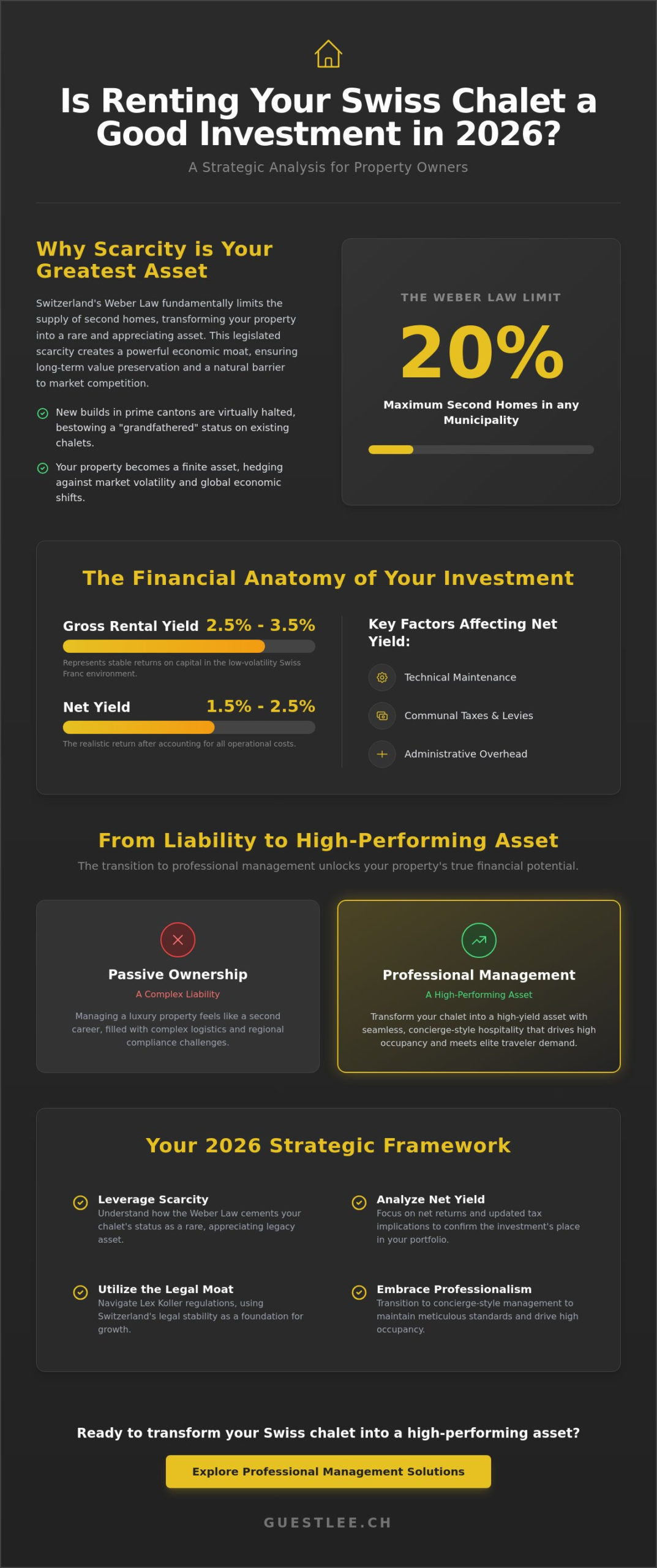
The Swiss Alpine market in 2026 operates under a unique set of constraints that serve as a powerful economic moat for existing owners. Unlike other luxury destinations where development continues unabated, Switzerland’s strict adherence to the Weber Law ensures that second homes cannot exceed 20% of the total housing stock in any given municipality. This legislation has effectively turned the Swiss chalet into a finite asset. For the sophisticated property owner, this scarcity is the ultimate hedge against market volatility, ensuring that capital preservation remains the bedrock of their portfolio. Many owners are currently asking: is renting my swiss chalet a good investment 2026, or should I maintain it solely for private use?
To gain a deeper perspective on the current climate, this video offers a detailed look at the 2026 investment landscape:
As global investors seek stability, the Alpine region stands out as a premier safe haven. The combination of political neutrality and meticulous legal structures, such as Lex Koller and Foreign Ownership regulations, creates a predictable environment where property values are shielded from the erratic swings seen in other international markets. When evaluating whether is renting my swiss chalet a good investment 2026, it’s helpful to view the property through a dual-focus lens. It serves as a cherished family legacy while simultaneously functioning as a high-performing financial instrument that benefits from a global flight to quality.
Understanding the 20% Rule and Market Saturation
The reality of 2026 is that new-build chalets have become an endangered species in premium cantons like Valais and Graubünden. As municipalities hit their 20% saturation point, the construction of new holiday homes has largely ground to a halt. This has bestowed a “grandfathered” status upon existing properties, significantly elevating their desirability on the secondary market. Investors aren’t just buying wood and stone; they’re acquiring a rare permit that is no longer being issued, which underpins long-term value preservation and creates a natural barrier to entry for competitors.
The Shift Toward High-Yield Luxury Hospitality
We’ve observed a distinct evolution in traveler behavior. In 2026, the global elite are increasingly bypassing traditional five-star hotels in favor of the privacy and curated seclusion of a managed chalet. This shift is driven by a desire for work-from-anywhere capabilities and a preference for bespoke hospitality that only a private residence can provide. By positioning your property within this high-end rental market through professional Property Management Services, you transition from a passive owner to a participant in a thriving hospitality ecosystem that values precision and regional excellence.
The Financial Anatomy of Your Investment: Yields, Taxes, and 2026 Changes
Analyzing the fiscal health of an Alpine asset requires a shift from speculative gains to disciplined yield management. In 2026, gross rental yields in prime locations like Verbier and St. Moritz typically range between 2.5% and 3.5%. While these figures may appear modest compared to high-risk equities, they represent a remarkably stable return on capital when adjusted for the low-volatility environment of the Swiss franc. The real question for the owner is: is renting my swiss chalet a good investment 2026 when considering the net return? After accounting for technical maintenance, communal taxes, and administrative overhead, net yields generally settle between 1.5% and 2.5%.
This performance is underpinned by robust demand across the national tourism sector. According to official Swiss tourism statistics, the luxury segment continues to outpace standard lodging, driven by a global clientele that prioritizes privacy and security. For the investor, this translates into high occupancy rates that can significantly offset the carry costs of a second home. Successful owners in 2026 are those who view their property not just as a residence, but as a high-performing hospitality product.
The Impact of Eigenmietwert Abolition for Rental Owners
The most significant fiscal shift in 2026 is the progress toward abolishing Eigenmietwert, the “imputed rental value” that has historically taxed owners on the notional income they would receive if they rented their property to themselves. For those focused on the rental market, this change simplifies the tax landscape. It eliminates a layer of phantom income, allowing you to focus on actual net profits. Under Swiss law, several expenses remain deductible from your gross rental income to help optimize your final tax bill:
- Technical maintenance and necessary repairs that preserve property value
- Insurance premiums and communal utility charges
- Local property taxes and administrative costs
- Interest on mortgages, within specific federal and cantonal limits
Running Costs and Maintenance in the High Alps
Operating a chalet at 1,500 meters requires a level of technical precision that differs from urban real estate. Heating systems, snow clearance, and the wear of high-altitude weather demand proactive care. These aren’t just expenses; they’re investments in value retention. A property that shows signs of neglect quickly loses its appeal to the high-net-worth guests who drive premium nightly rates. Entrusting these details to professional Property Management Services ensures that every finish remains pristine, protecting your asset’s reputation and its long-term appreciation potential. This meticulous attention to detail is what separates a standard holiday home from a high-yielding legacy asset.
Navigating the Legal Moat: Lex Koller and Foreign Ownership in 2026
For the discerning investor, the true value of a Swiss asset often lies in the very regulations that appear most restrictive. While other global markets suffer from over-saturation and speculative bubbles, the Swiss regulatory environment acts as a sophisticated protectionist shield. Central to this is the Lex Koller legislation, which limits property acquisition by non-residents. Rather than a barrier, this law functions as a legal “moat,” ensuring that the market remains grounded in real value rather than artificial demand. When assessing if is renting my swiss chalet a good investment 2026, one must appreciate that these high barriers to entry preserve the exclusivity and price resilience of your holdings.
The 2026 landscape has introduced even more rigorous oversight. The Swiss Federal Council recently proposed tightening Swiss rules on foreign property ownership, with a focus on ensuring that Alpine homes contribute to the local economy. For many properties located in designated “tourist zones,” there is a structured obligation to make the residence available for short-term rental when not in personal use. This requirement perfectly aligns with the goals of an investor seeking to maximize yield while maintaining a private sanctuary. It transforms a potential legal hurdle into a mandated revenue stream, supported by a government that prioritizes high-end tourism over vacant secondary residences.
Permissions and Quotas: The 2026 Reality
Navigating the permit process requires an understanding of the current cantonal quotas. As of June 2026, the annual allowances for holiday home purchases by non-residents remain strictly controlled, and in some regions, quotas have been further reduced. For non-EU or EFTA nationals, the requirements are even more precise, often necessitating a permit even for primary residences. This scarcity of permits means that once an asset is secured, its value is fundamentally protected by the lack of comparable new inventory. It’s a signal of long-term stability that few other jurisdictions can match.
Resale Potential and Market Liquidity
The Swiss market is built for the patient investor. Legislation prevents the rapid flipping of properties, which in turn prevents the boom-and-bust cycles seen in the Mediterranean or North American mountain resorts. If you choose to sell, the capital gains tax is tiered to reward long-term stewardship; the longer you hold the asset, the lower the tax burden becomes. This structure encourages a legacy mindset, where the property is viewed as a multi-generational wealth vehicle. For a deeper dive into these strategic nuances, consult our Luxury Real Estate Switzerland: The 2026 Guide to Exclusive Property Investment. Ultimately, the question of whether is renting my swiss chalet a good investment 2026 is answered by this unique combination of legal security and enduring global demand.
Professional Management: The Difference Between a Liability and an Asset
In the high-stakes environment of 2026, the distinction between a property that drains resources and one that builds wealth lies in the caliber of its management. Many owners initially wonder: is renting my swiss chalet a good investment 2026 if I handle the logistics myself? The reality is that self-management has become a significant liability in the luxury sector. Today’s travelers don’t just seek a roof; they demand a flawlessly executed experience that mirrors the standards of a five-star hotel. When expectations are this high, a missed snow clearance or a delayed check-in doesn’t just result in a poor review. It actively erodes the legacy value of your asset.
The “GuestLee Standard” represents a shift from basic oversight to comprehensive asset stewardship. We merge meticulous technical maintenance with high-end hospitality to ensure your property remains in peak condition while generating optimal returns. By treating your chalet as a premium hospitality product rather than a passive building, we create a virtuous cycle of high occupancy and capital preservation. This professionalized approach is what transforms a seasonal home into a high-performing financial instrument that commands respect in any portfolio.
Optimizing Occupancy Through Strategic Marketing
Achieving consistent returns in 2026 requires more than a simple listing on a generic travel site. It demands a sophisticated digital presence and exclusive partnerships that place your property in front of the global elite. We utilize dynamic pricing models that adjust in real-time based on local demand, snow conditions, and regional events. This precision ensures you’re never leaving money on the table during peak weeks while remaining competitive during the quieter shoulder seasons. It’s about capturing the “work-from-anywhere” demographic that seeks longer, high-value stays throughout the year.
Seamless Operations and Preventive Maintenance
Managing a property at high altitude involves logistical complexities that urban managers often overlook. From specialized heating system calibrations to 24/7 guest support, every detail must be handled with Swiss precision. We prioritize preventive maintenance to catch minor issues before they become costly repairs, protecting the structural integrity of your building for decades to come. To understand the full scope of what’s required, explore The Definitive Guide to Property Management Services in Switzerland for 2026. Our goal is to handle every complexity behind the scenes so your only involvement is reviewing the performance reports. If you’re ready to elevate your property’s performance, consider our Property Management Services to secure your investment’s future.
Conclusion: Is Your Swiss Chalet a Good Investment for 2026?
The convergence of strict development limits and a robust legal framework has created a unique investment climate that rewards the patient, sophisticated owner. Throughout this analysis, we’ve seen how the Weber Law’s cap on second homes and the protective “moat” of Lex Koller work together to ensure that Swiss Alpine real estate remains a finite, appreciating asset. When you ask, is renting my swiss chalet a good investment 2026, the answer lies in the intersection of this inherent scarcity and your commitment to professionalized service. Switzerland isn’t merely a place to hold property. It’s a jurisdiction where scrutiny leads to stability, and where a well-managed home becomes a high-performing legacy for your family.
Our final verdict for the upcoming year is one of measured optimism. While the global economy faces ongoing shifts, the Swiss Alps continue to attract a “flight to quality” from international high-net-worth individuals. The abolition of Eigenmietwert and the rise of the work-from-anywhere elite have further solidified the case for active rental management. By transitioning your property from a private retreat to a curated hospitality experience, you don’t just offset costs. You actively grow the asset’s market value and reputation. Success in 2026 requires a partner who understands both the cold logic of the ledger and the warm, meticulous standards of regional hospitality.
The Strategic Decision Framework
To determine if your property is positioned for maximum performance in 2026, consider this final strategic checklist. A “yes” to these points indicates an asset ready to outperform the broader market:
- Location Premium: Is the property in a resort with year-round appeal and high-end infrastructure?
- Regulatory Compliance: Are all permits and rental obligations fully aligned with current cantonal laws?
- Turnkey Quality: Does the interior finish meet the 2026 standard for luxury “work-from-anywhere” stays?
- Operational Excellence: Is there a professional structure in place to handle 24/7 guest demands and preventive maintenance?
Partnering for Performance
At GuestLee, we act as the trustworthy guardian of both your property’s value and the guest’s travel experience. We handle every technical and logistical complexity behind the scenes so you can enjoy the benefits of ownership without the administrative burden. Our approach is designed to evoke a sense of security for you and a feeling of curated exploration for your guests. If you’re ready to transform your Alpine residence into a high-performing financial instrument, we invite you to explore our tailored management solutions at GuestLee for a bespoke asset performance analysis. Secure your legacy in the Alps with a partner dedicated to national standards of excellence.
Securing Your Position in the 2026 Alpine Market
Navigating the Swiss property landscape requires more than just capital; it demands a partnership rooted in regional precision and hospitality excellence. We’ve explored how the finite nature of mountain real estate and the evolving tax environment create a unique window for wealth preservation. Whether is renting my swiss chalet a good investment 2026 depends entirely on the transition from passive ownership to professionalized asset management. By aligning with a partner who understands the nuances of high-net-worth expectations, you ensure your property remains a source of both financial performance and personal pride.
Founded in 2016 with a commitment to Swiss standards of excellence, GuestLee provides comprehensive management from the initial setup to the final guest departure. Our team specializes in the stewardship of luxury assets, handling every logistical complexity so you don’t have to. It’s time to elevate your property’s potential and transform it into a high-performing legacy asset. Secure your Alpine legacy with GuestLee’s expert property management. Your sanctuary in the Alps is ready for its next chapter, and we’re here to guide every step of the journey with quiet confidence and meticulous care.
Frequently Asked Questions
Is it still possible for a foreigner to buy a chalet in Switzerland in 2026?
Yes, foreign nationals can still acquire property in Switzerland, provided the residence is located within a designated tourist zone and complies with Lex Koller regulations. You’ll need to secure a specific permit from the cantonal authorities, and quotas remain strictly limited to ensure market stability. The Federal Council has recently proposed tightening these rules for non-EU nationals, so professional legal guidance is more critical than ever.
What is the average rental yield for a luxury Swiss chalet?
In early 2026, the average gross rental yield for premium Alpine properties typically ranges from 2.5% to 3.5%. Once you account for management fees and technical maintenance, net yields generally sit between 1.5% and 2.5%. While these returns are conservative compared to other asset classes, they represent a highly stable and low-volatility investment within the secure Swiss financial ecosystem.
How does the abolition of Eigenmietwert affect my property investment?
The removal of the “imputed rental value” simplifies your fiscal obligations by eliminating the tax on the phantom income you would have earned by living in your own home. This change is particularly beneficial for those evaluating if is renting my swiss chalet a good investment 2026, as it clarifies the tax landscape. It allows you to focus purely on actual net rental profits while reducing the tax burden during your personal stay periods.
Are there restrictions on how many weeks I can use my chalet personally?
Personal use limits depend on the specific zoning of your property and any rental obligations attached to its permit. Many chalets in prime tourist areas are subject to “structured commercial use” rules, which require the home to be available for rent for a significant portion of the year. These regulations are designed to prevent “cold beds” and ensure that luxury residences contribute to the local hospitality economy.
What are the hidden costs of owning a rental property in the Swiss Alps?
Owners must account for cantonal wealth taxes, which typically range from 0.1% to 0.5%, alongside communal property taxes and tourism levies. High-altitude environments also demand specialized technical care, such as advanced heating system maintenance and snow clearance. These operational costs are essential for preserving the building’s structural integrity and its reputation as a five-star guest destination.
How do the Weber Laws impact the resale value of my property?
The Weber Law acts as a powerful driver of capital appreciation by capping second-home inventory at 20% of a municipality’s housing stock. This legislation has effectively ended new construction in most premium resorts, giving existing properties a rare “grandfathered” status. This artificial scarcity ensures that your asset remains part of a finite supply, supporting long-term price resilience even during periods of global market flux.
Can I manage my Swiss rental property remotely without a local partner?
While digital tools allow for remote oversight, the meticulous standards expected by high-net-worth travelers require a physical, professional presence. Managing logistical complexities like mountain weather emergencies or bespoke guest requests from a distance is rarely successful in the luxury segment. A local partner provides the precision and hospitality expertise necessary to maintain high occupancy and protect your property’s legacy value.
What is the minimum investment required for a premium Swiss chalet?
Entry-level prices for premium holiday homes in sought-after regions like Verbier start at approximately CHF 18,000 to CHF 28,000 per square meter in 2026. In elite destinations like St. Moritz, premium properties often exceed CHF 22,300 per square meter. These values reflect the enduring demand for Swiss Alpine real estate as a premier safe-haven asset for international investors.

Article by
Giacomo Esposito