
Long-Term vs Short-Term Rental Investment in Switzerland: The 2026 Strategy Guide
What if the perceived safety of a traditional lease is actually the greatest risk to your Swiss portfolio’s growth in 2026? While the Swiss market remains a global gold standard for stability, the environment for luxury property owners is shifting under the weight of tax reforms and tight regulatory frameworks. You likely recognize that maintaining a high-end residence requires a delicate touch, yet the choice between long-term vs short-term rental investment switzerland often feels like a difficult trade-off between hands-off security and the higher yields of the premium travel market.
We’ve designed this guide to resolve that tension. You’ll discover a definitive comparison of rental models specifically curated to maximize your returns while preserving the impeccable condition of your asset. We’ll examine the latest 2026 market yields, the implications of the SNB’s 0.0% policy rate, and how to manage the complexities of Lex Koller with quiet confidence. By the end of this analysis, you’ll have a clear roadmap for transforming your property into a high-performing investment that captures the 15% to 25% premiums found in the furnished luxury market, all while a sophisticated partner handles every logistical detail behind the scenes.
Key Takeaways
- Contrast the predictable nature of multi-year tenancies with the high-yield potential of the premium hospitality sector.
- Navigate the complexities of Lex Koller and evolving cantonal regulations to ensure your portfolio remains compliant and profitable.
- Analyze the true net performance of long-term vs short-term rental investment switzerland when factoring in the 2026 luxury premium.
- Identify the “Concierge Standard” necessary to maintain asset value while meeting the expectations of elite global travelers.
- Learn how to transition from active management to a seamless, passive ownership model through professional property services.
Understanding the 2026 Swiss Rental Landscape: Long-Term vs. Short-Term
Switzerland’s property market in 2026 remains a bastion of security. Yet, the strategy for deployment has never been more nuanced. Choosing between a long-term vs short-term rental investment switzerland requires balancing the quiet reliability of a multi-year lease against the vibrant, higher-yield potential of the luxury hospitality sector. While national vacancy rates hover around a tight 1%, the financial implications of each path are distinct. This is particularly true as investors navigate the SNB’s 0.0% policy rate and the scheduled abolition of the Swiss imputed rental value tax.
To better understand how these two models align with your personal financial objectives, watch this helpful overview:
Beyond the binary choice of days or years, 2026 has seen the rise of the “medium-term” corporate model. This hybrid approach caters to global professionals on three-to-six-month assignments. It offers a blend of higher nightly rates without the daily turnover of traditional tourism. It’s a sophisticated middle ground for those seeking to optimize occupancy in urban centers like Zurich or Geneva where demand for high-end, flexible housing remains structurally tense.
The Long-Term Stability Model
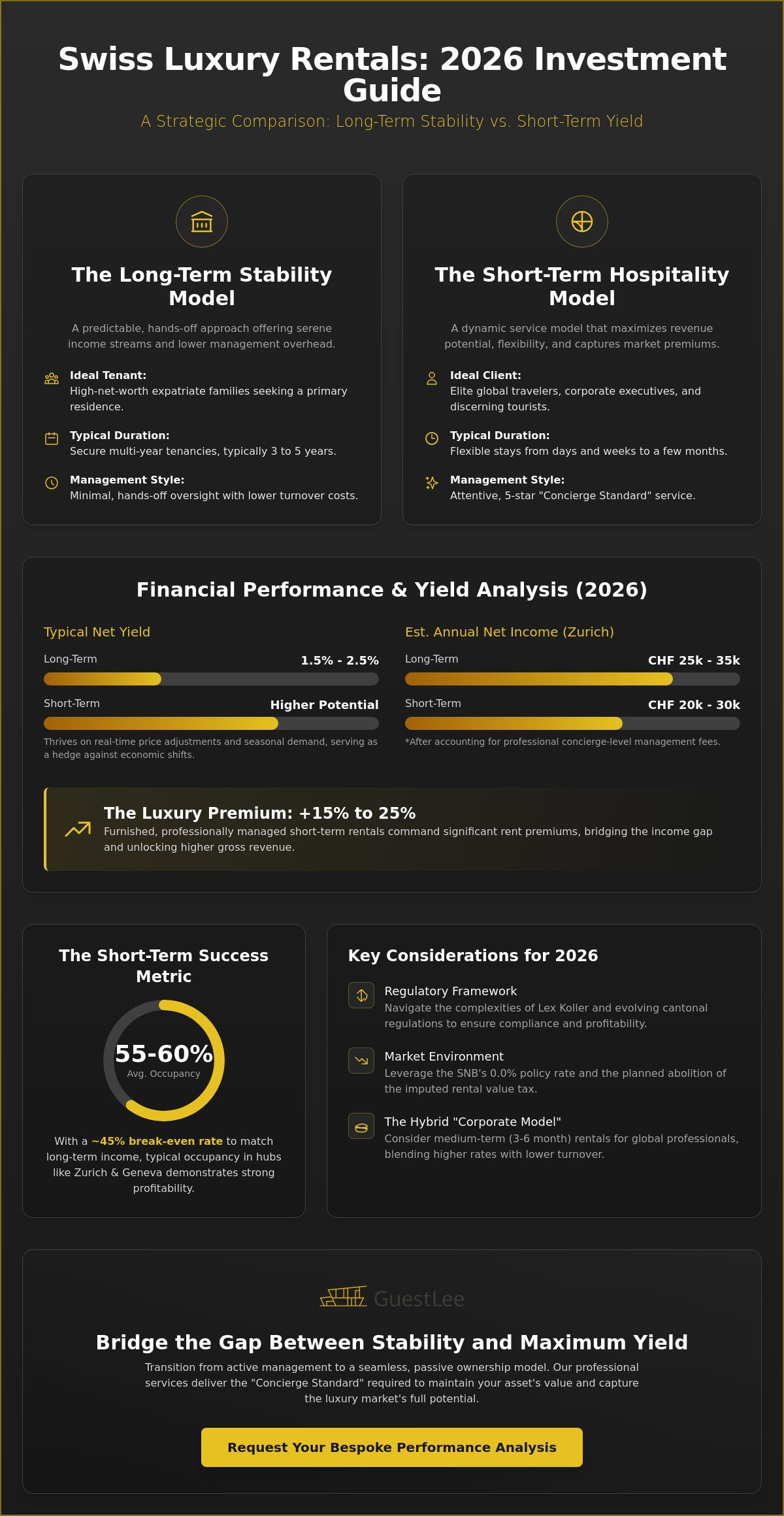
The typical Swiss long-term tenant for a luxury villa is often a high-net-worth expatriate family seeking a primary residence for three to five years. This model offers a serene, predictable income stream with minimal management overhead. It’s the quintessential strategy for the hands-off investor. Owners benefit from lower turnover costs and the legal clarity of the Swiss rental code. While it’s a passive approach, it lacks the agility to respond to the 5.4% rent increases recently observed in the Zurich region.
The Short-Term Hospitality Model
The short-term model transforms a property from a static asset into a dynamic service. It shifts the focus from renting a space to providing a curated experience. For the owner, this path offers unparalleled flexibility. You can reserve the home for personal use during the prestigious Swiss ski season or summer lake months. While it requires a more attentive, concierge-level management approach, the ability to capture seasonal premiums makes it a compelling choice. In markets like Geneva, furnished apartments command a 15% to 25% rent premium, rewarding those who prioritize gross revenue and asset liquidity.
Financial Performance and Yield Analysis in 2026
The financial architecture of a Swiss property investment requires a meticulous eye for detail. When evaluating long-term vs short-term rental investment switzerland, many owners are initially drawn to the high nightly rates of the hospitality model. According to official rental market statistics, the national average gross yield sits between 2.5% and 3.5%. However, luxury assets in prime corridors often defy these averages, commanding premiums that move the needle significantly for discerning investors. While a long-term lease offers a stable net yield of roughly 1.5% to 2.5%, the short-term model thrives on its ability to adjust pricing in real time, serving as a vital hedge in a shifting economic climate.
Success in the short-term sector hinges on the “Break-Even” occupancy rate. In major hubs like Zurich or Geneva, where average occupancy ranges from 55% to 60%, a luxury property typically needs to reach approximately 45% occupancy to match the net income of a traditional long-term tenant. For a high-end apartment in Zurich, a well-managed long-term rental might net between CHF 25,000 and CHF 35,000 annually. A comparable short-term unit may net slightly less, between CHF 20,000 and CHF 30,000, after management fees are deducted. This gap is often bridged by the 15% to 25% premium commanded by furnished, professionally curated spaces. If you are curious about how your specific residence might perform, you can request a bespoke yield assessment from our team.
Gross Revenue vs. Operational Expenses
The allure of higher gross revenue in short-term rentals is balanced by a more intensive cost structure. Owners must account for professional cleaning, high-end linen services, marketing across premium platforms, and all-inclusive utilities. In contrast, long-term rentals involve fewer daily costs but can lead to stagnant income in a market where Zurich rents recently climbed by 5.4%. Investing in luxury real estate Switzerland remains a robust strategy, provided the operational model matches the investor’s appetite for involvement.
The Tax and Maintenance Factor
Maintenance philosophies differ wildly between the two models. Short-term rentals undergo professional inspections after every stay, ensuring that minor issues are addressed before they become costly repairs. This “preventative” approach preserves the asset’s prestige better than a multi-year tenancy where wear and tear may go unnoticed for years. From a tax perspective, investors should consult with experts to distinguish between “private” and “professional” rental income. This distinction becomes even more critical as the abolition of imputed rental value approaches in 2028, fundamentally changing how deductions for maintenance and mortgage interest are handled.
Operational Realities: Managing 5-Star Expectations
Stepping beyond the financial spreadsheets, the daily reality of property ownership in the Swiss housing landscape is defined by the quality of the relationship between owner and occupant. When choosing between a long-term vs short-term rental investment switzerland, you aren’t just selecting a lease duration; you’re choosing a service level. In the luxury segment, the operational demands of short-term stays are significant, yet they offer a level of oversight that traditional tenancies often lack. The choice rests on whether you prefer the hands-off, legalistic framework of a long-term contract or the high-touch, hospitality-driven nature of premium rentals.
The Short-Term Concierge Burden
A luxury villa is more than an asset. It’s a sanctuary. Short-term guests paying premium rates expect more than just a key; they demand a 24/7 guestlee switzerland standard of service. This involves meticulous guest vetting, seamless arrivals, and immediate responses to any request, no matter how small. While this management overhead is higher, it creates a unique advantage for the property owner. Frequent turnover means the home is professionally cleaned and inspected every few days. Any minor scuff on a wall or a dripping faucet is corrected instantly. This constant attention effectively mitigates the fear of wear-and-tear that often plagues owners of high-end homes. Online reviews also play a critical role here. A property maintained to five-star standards doesn’t just attract better guests; it builds a digital reputation that enhances the long-term capital value of the residence.
The Long-Term Tenant Relationship
Switzerland is famously protective of its residents. Long-term leases are governed by strict regulations that can make terminating a contract difficult, even if you wish to sell the property or move back in. Rent increases are tied to a reference interest rate system, which can limit your ability to capitalize on market upswings like the 5.4% growth seen in Zurich recently. While a long-term tenant provides a sense of permanence, the lack of regular access can lead to hidden maintenance issues that only surface after years of occupancy. For the discerning investor, the passive nature of a long-term lease often comes at the cost of direct control over the property’s pristine condition. Professional management bridges this gap in the long-term vs short-term rental investment switzerland debate by providing a reliable guardian who handles these complexities behind the scenes, ensuring the asset remains a source of pride rather than a source of stress.
Navigating the 2026 Regulatory Framework
The Swiss regulatory environment is often described as a labyrinth, but for the informed investor, it’s simply a framework for excellence. Understanding the nuances of long-term vs short-term rental investment switzerland requires a deep dive into the two pillars of national property law: Lex Koller and Lex Weber. Lex Koller continues to restrict non-resident foreigners from acquiring residential property without specific permits, while Lex Weber limits the construction of second homes to 20% within any given municipality. These laws don’t just dictate who can buy; they fundamentally shape the supply of available rental stock and the prestige of the market in 2026.
In 2026, we’ve seen a growing trend of cantons, such as Geneva, enforcing strict annual night caps on short-term rentals. These regulations are designed to protect the local housing supply, but they can catch unprepared owners off guard. Zoning also remains a critical factor. Properties designated as primary residences face different rental restrictions compared to those in holiday zones. If you’re asking whether short-term rentals are still legal in prime Swiss zones, the answer is yes, provided you navigate the specific permits and local ordinances with meticulous precision. It’s about finding the alignment between your asset’s zoning and the canton’s vision for hospitality.
Federal vs. Cantonal Restrictions
A national investment strategy must be sensitive to local variations. While federal law sets the baseline, cantonal authorities have the final say on permit requirements for non-resident owners. This creates a patchwork of rules that can vary significantly between neighboring regions. For foreign investors, the 2026 legal outlook is stable but demands a high degree of administrative accuracy to avoid non-compliance. It’s no longer enough to simply own an asset; one must master the local legal geography to ensure long-term viability.
The Importance of Professional Compliance
This is where a partner providing property management services Switzerland becomes indispensable. We ensure every aspect of your investment aligns with current legislation, from tax filings to guest registrations. Operating luxury villa rentals Switzerland is a compliant and prestigious way to hold property, provided the management structure is robust. The risks of non-compliance in the Swiss legal system are significant, ranging from heavy fines to the forced sale of the asset. To ensure your portfolio remains secure and your reputation untarnished, you can consult our compliance specialists for a thorough review of your property’s legal standing.
The GuestLee Advantage: Bridging the Gap
Deciding between a long-term vs short-term rental investment switzerland often feels like a choice between two distinct worlds. On one side, you have the quiet predictability of a traditional lease. On the other, the vibrant revenue potential of the luxury travel market. GuestLee exists to dissolve this tension. We serve as the definitive bridge, providing property owners with the elevated yields of the short-term market while maintaining the effortless, passive experience of a long-term lease. Our approach is built on the belief that you shouldn’t have to choose between financial performance and the preservation of your home’s prestige.
At the heart of our service is an “Asset First” philosophy. While many management firms focus solely on occupancy rates, we prioritize the long-term value and condition of your residence. We understand that a luxury villa in the Swiss Alps or a refined apartment in Geneva is more than just a source of income. It’s a significant capital asset. By implementing rigorous maintenance schedules and high-end hospitality standards, we ensure that your property remains in peak condition, often surpassing the state it would be in under a multi-year tenancy. We handle the entire spectrum of management, from global marketing and guest curation to meticulous maintenance and local compliance.
Sophisticated Asset Management
The security of your investment begins with who enters the front door. We’ve developed a sophisticated vetting process that goes far beyond simple background checks. We curate a guest list of discerning travelers who respect the standards of a high-end home. This meticulous selection process is part of a rhythmic flow of management that remains steady, calm, and inviting. Behind the scenes, we handle the administrative and logistical complexities that often deter investors from the short-term market. Whether it’s navigating cantonal night caps or managing 24/7 guest requests, we act as the professional guardian of both your property value and your time.
Securing Your 2026 Investment
As we move through 2026, the Swiss market rewards those who can adapt with precision. Transitioning from a traditional lease to a managed short-term model is a strategic shift from emotional aspiration to concrete financial benefit. It allows you to reclaim the flexibility of your asset while capturing the 15% to 25% premiums inherent in the luxury furnished sector. The complexity of the long-term vs short-term rental investment switzerland debate is simplified when you have a partner who understands the national standards of excellence. To see how your residence fits into this high-yield landscape, you can request a professional management audit and discover the true potential of your Swiss portfolio.
Mastering the Future of Swiss Property Investment
The decision between rental strategies is no longer a simple matter of duration. It’s a strategic choice between passive ownership and active asset enhancement. We’ve explored how the 2026 landscape rewards those who move beyond traditional models to embrace managed excellence. Whether you choose to capture the significant premiums of the furnished luxury market or prefer the steady rhythm of a long-term lease, the priority remains the same: safeguarding your property’s prestige while ensuring it performs at its peak. Precision in management is the key to thriving in this structurally tense market.
Successfully navigating the long-term vs short-term rental investment switzerland requires a partner who understands the intricate balance of Swiss regulations and high-end hospitality. Founded in 2016, GuestLee specializes in luxury villa rentals and offers comprehensive Swiss property management designed for the discerning owner. We handle the complexities of Lex Koller and guest concierge services so you don’t have to. It’s time to transition your property into a seamless source of growth and security. You deserve a partner who values your asset as much as you do.
Partner with GuestLee to optimize your Swiss property investment today and experience the peace of mind that comes with professional guardianship. Your journey toward a refined and high-performing portfolio begins here.
Frequently Asked Questions
Is short-term rental more profitable than long-term in Switzerland in 2026?
Short-term rentals often generate higher gross revenue, particularly when leveraging the 15% to 25% premium commanded by high-end furnished apartments. However, net profitability in the long-term vs short-term rental investment switzerland debate depends on your ability to maintain occupancy levels above the 45% break-even point. While operational costs are higher for hospitality models, the flexibility to adjust nightly rates allows for better responsiveness to market shifts than fixed long-term leases.
What are the Lex Koller restrictions for foreign property investors?
Lex Koller restricts non-resident foreigners from acquiring residential real estate in Switzerland without a specific permit from cantonal authorities. These permits are typically reserved for properties in designated holiday zones or for individuals with a valid residence permit. For investors, this law emphasizes the importance of selecting properties in regions where secondary residence quotas haven’t yet been reached, ensuring legal compliance while maintaining the asset’s long-term liquidity and prestige.
How does the Swiss reference interest rate affect long-term rental income?
The Swiss reference interest rate serves as the legal foundation for rent adjustments in long-term tenancies. When this rate increases, landlords are permitted to raise rents proportionally; conversely, if it falls, tenants may request a reduction. This system provides a layer of stability but can limit an owner’s ability to capitalize on rapid market growth, making the fixed-income nature of long-term rentals less agile than the dynamic pricing found in short-term models.
Can I use my Swiss property for personal holidays if it is rented out?
You can absolutely enjoy your property for personal holidays if you opt for a short-term rental strategy. This flexibility is one of the primary reasons owners choose the hospitality model over a traditional lease. By blocking specific dates in the reservation calendar, you maintain full control over your residence for family visits or seasonal retreats. In contrast, a long-term lease grants the tenant exclusive use, preventing any personal access for the duration of the contract.
What is the typical vacancy rate for luxury Swiss properties?
Switzerland maintains a remarkably low national vacancy rate of approximately 1%, reflecting a structurally tense market with limited supply. In the luxury short-term sector, occupancy rates in major hubs like Zurich and Geneva typically range from 55% to 60%. While this implies periods where the property is unoccupied, the higher nightly rates during peak seasons often compensate for these gaps, providing a net income that rivals or exceeds traditional year-round tenancies.
Do I need a special permit to operate a short-term rental in Switzerland?
Permit requirements for short-term rentals are determined at the cantonal and communal levels rather than through a single federal law. Some cantons, such as Geneva, have introduced strict night caps and mandatory registration for properties rented on a short-term basis. It’s essential to verify local zoning laws to ensure your property is classified correctly for hospitality use. Professional management partners handle these administrative hurdles to ensure your investment operates within the 2026 legal framework.
How does professional property management impact my net rental yield?
Professional property management typically enhances net rental yield by optimizing occupancy and implementing dynamic pricing strategies that an individual owner might overlook. While there’s a management fee involved, the “Asset First” approach reduces long-term capital expenditure through preventative maintenance and rigorous guest vetting. By handling every logistical detail, a management partner transforms a complex operational task into a truly passive income stream, often resulting in superior financial performance over time.
What are the maintenance expectations for luxury tenants in Switzerland?
Elite tenants and guests expect a “Concierge Standard” where every detail is flawless. This includes immediate responses to maintenance requests, high-end appliance functionality, and pristine interior aesthetics. Meeting these expectations is vital for maintaining the five-star reviews that drive short-term demand. Regular inspections between stays ensure that the property is kept in a state of perpetual readiness, which serves to protect the prestige and capital value of your high-end Swiss asset.

Article by
Giacomo Esposito