Seasonal Rental Pricing Strategies in Switzerland: The 2026 Owner’s Guide
In the Swiss luxury sector, pricing is not a race to the bottom; it’s a precision-engineered reflection of seasonal scarcity and elite service standards. You likely understand the delicate balance of maintaining a premium brand while managing Switzerland’s high operational costs and evolving regional regulations, such as the 90-day rental limits now enforced in Lucerne and Geneva. It’s a complex landscape where the fear of “cheapening” your property with discounts often conflicts with the need for consistent performance. Discover how to master seasonal rental pricing strategies switzerland to maximize your luxury villa’s yield in 2026 without ever compromising its prestige.
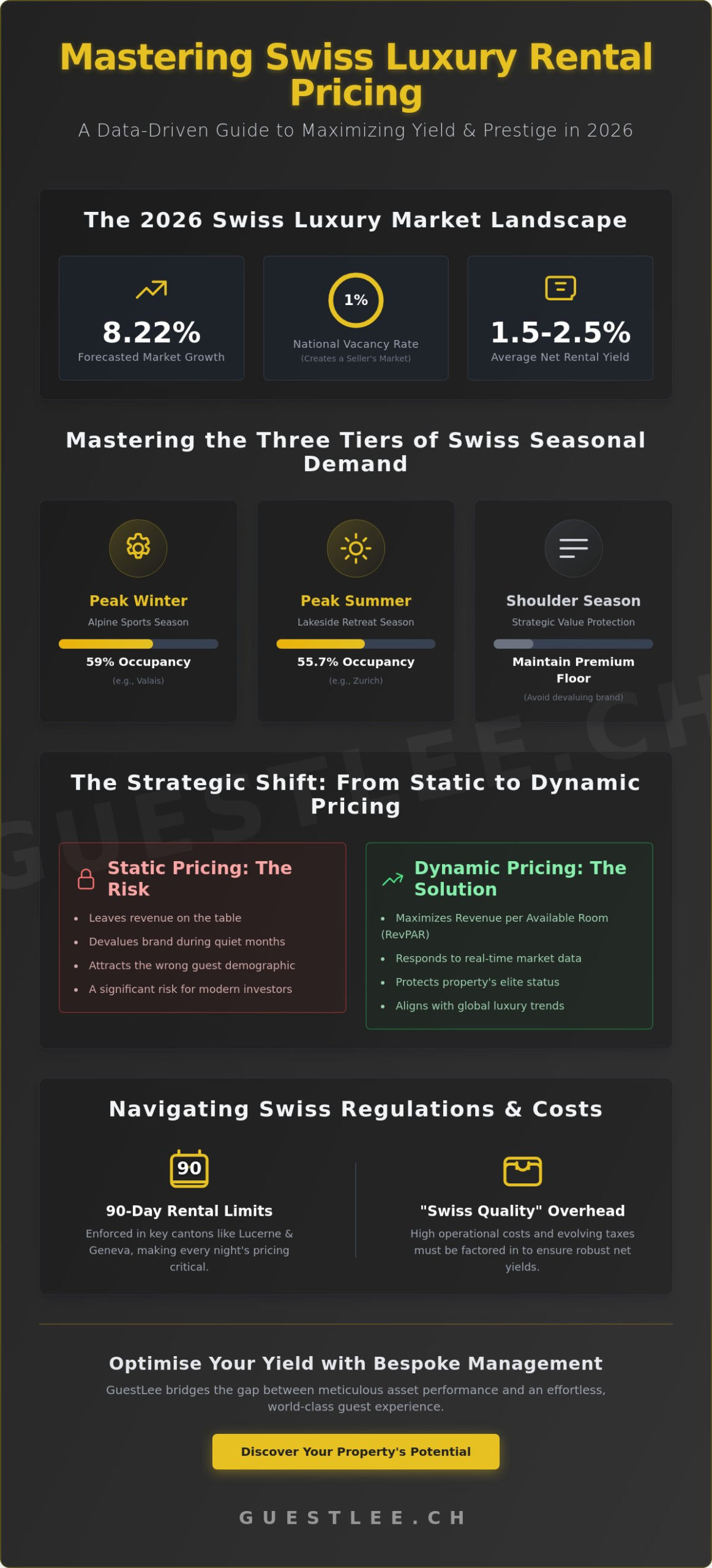
We’ll provide a sophisticated framework that respects your property’s inherent value while significantly increasing your RevPAR. By aligning your pricing with the meticulous standards of high-end regional hospitality, you can ensure your asset remains a secure and profitable investment. This guide explores the transition from static rates to dynamic, data-driven models that respond to the 8.22% growth forecast for Switzerland’s luxury market. We’ll examine how to navigate the 2026 regulatory environment and create a seamless connection between your financial goals and the curated experiences your guests desire.
Key Takeaways
- Identify the nuances of Switzerland’s dual-peak demand cycle to capitalize on both Alpine winter sports and summer lakeside retreats.
- Implement sophisticated seasonal rental pricing strategies switzerland to navigate regional stay limits while preserving your property’s long-term brand equity.
- Transition from static rates to real-time, dynamic adjustments that mirror global luxury trends and the exclusive nature of your estate.
- Factor in the “Swiss Quality” overhead to ensure your net yields remain robust despite high operational costs and evolving tax regulations.
- Discover how bespoke property management bridges the gap between meticulous asset performance and an effortless, world-class guest experience.
The Landscape of Swiss Luxury Rental Pricing in 2026
Seasonal pricing in Switzerland represents the strategic orchestration of rates to match the distinct rhythms of Alpine snow and lakeside summer sun. In 2026, this practice has evolved beyond simple calendar shifts. It’s now a sophisticated response to a Swiss tourism landscape that remains one of the world’s most resilient. For the luxury property owner, understanding seasonal rental pricing strategies Switzerland is no longer optional. It’s the difference between a static asset and a high-performing portfolio.
To better understand how modern data shapes these decisions, watch this helpful video:
Relying on a fixed price list is a significant risk for the modern investor. Switzerland’s economy remains a pillar of stability, yet the luxury market is increasingly dynamic. Owners who fail to adjust are essentially leaving revenue on the table during peak weeks or, worse, devaluing their brand during quieter months. There’s a direct correlation between the meticulous maintenance of your estate and the premium you can command; a property kept to the highest regional standards naturally supports a more aggressive pricing model.
Key Economic Drivers for 2026
Effective seasonal rental pricing strategies Switzerland rely on the current supply-demand imbalance to drive RevPAR while maintaining the property’s elite status. The Swiss reference interest rate continues to influence the broader real estate market, subtly shifting the cost of capital and the expectations for short-term returns. With a national rental vacancy rate of approximately 1.0% in early 2026, the market is exceptionally tight. This scarcity creates a definitive seller’s market for luxury rentals, where demand from high-net-worth individuals often outpaces the availability of truly exceptional homes. For 2026, the average net rental yield for residential property in Switzerland serves as a definitive benchmark for luxury assets, currently sitting between 1.5% and 2.5%.
The Premium Signal: Pricing as Brand Identity
In the luxury segment, price functions as a powerful psychological signal. Discerning guests often equate a higher rate with a guarantee of safety, privacy, and impeccable service. If you underprice during the shoulder season, you risk attracting a demographic that doesn’t align with your property’s long-term value or the expectations of your neighbors. Success requires finding the equilibrium between high-yield financial performance and the exacting standards of luxury property management services in Switzerland. By maintaining a premium floor even when demand fluctuates, you protect the exclusivity and long-term equity of your home for years to come.
Mastering the Three Tiers of Swiss Seasonal Demand
Swiss tourism doesn’t follow a linear path. Instead, it operates on a sophisticated dual-peak system that requires meticulous planning. Winter brings the global elite to snow-capped peaks in regions like the Valais, where occupancy rates reached 59% in early 2026. Summer shifts the focus to the pristine shores of Lake Geneva or the hiking trails of the Engadin, where Zurich saw peak occupancy hit 55.7% last year. Mastering seasonal rental pricing strategies switzerland requires a deep understanding of these cycles to ensure your property remains a high-yielding asset year-round.
Relying on official tourism accommodation data helps identify exactly when demand surges. In 2026, the most successful owners are those who view their calendar not as a block of dates, but as a series of high-value opportunities. With the 90-day rental limits now enforced in cantons like Lucerne and Geneva, every available night must be priced with precision. You aren’t just selling a room; you’re selling a window of Swiss excellence that is strictly limited by both nature and regulation.
The High Season: Capturing Peak Global Demand
During the high season, your strategy should focus on revenue protection and yield maximization. This involves implementing strict minimum stay requirements for the Christmas, New Year, and February half-term periods. By requiring a seven-night stay during these windows, you prevent fragmented bookings that leave unfillable gaps in your calendar. Premium event-based pricing is also essential; dates coinciding with world-class Swiss festivals or international summits should reflect the extreme scarcity of luxury inventory. You can justify these elevated rates by bundling high-end concierge services, such as private mountain guides or curated in-villa dining, ensuring the guest experience matches the investment. For a more tailored approach to these peak windows, professional property management services can help refine your specific rate card.
The Shoulder and Low Seasons: Maintaining Occupancy
The transitional months of April, May, and November offer a different kind of opportunity. Rather than competing on price, focus on experiential value. Transitioning from nightly rates to “weekly retreat” or “workation” packages can attract relocating executives or high-net-worth individuals seeking a quiet sanctuary. The 2026 trend toward digitalized guest journeys means these travelers often look for seamless, long-stay environments where they can lease before they buy. Flexible cancellation policies play a crucial role here; they provide the security needed to capture early-bird bookings for the following peak season. By targeting the discerning traveler who seeks Swiss tranquility away from the crowds, you maintain a steady RevPAR without ever compromising the prestige of your estate.
Sophisticated Pricing Models: Beyond Basic Rate Setting
Pricing in the elite Swiss market is less about following the herd and more about defining your own worth. While standard rental platforms might suggest matching a neighbor’s rate, a truly unique estate requires a more nuanced approach. Successful seasonal rental pricing strategies switzerland move away from reactive discounting and toward a value-driven narrative. By focusing on unreplicable features, such as a private spa overlooking the Matterhorn or historic architecture in the heart of Geneva, you position your property as a singular destination rather than a commodity.
Modern AI-driven tools offer incredible precision by adjusting rates in real-time based on local inventory and search volume. This allows you to capture sudden spikes in demand that static models miss. However, a “set and forget” mentality is dangerous for a luxury brand. It can lead to erratic price swings that confuse guests and erode the sense of stability they expect from high-end hospitality. Precision is the gold standard here.
Implementing Dynamic Pricing with a Human Touch
Automation should never come at the expense of your brand’s reputation for meticulous detail. While algorithms handle the heavy lifting of data analysis, every pricing adjustment must be overseen by an expert manager who understands the subtle shifts in local prestige. This hybrid approach ensures that “floor prices” always cover the significant operational costs inherent in the Swiss market. It’s essential to factor in high-end maintenance, premium labor, and the 3.8% VAT rate for accommodation services that remains in effect for 2026. Expert oversight prevents the software from “cheapening” the asset during a temporary dip in search volume.
Psychological Pricing for the Ultra-High-Net-Worth Guest
Discerning guests are often motivated by the “Prestige Pricing” effect. In the luxury segment, certain price thresholds, such as 10,000 CHF per week, act as a filter. They attract a specific clientele who value exclusivity over a bargain. These travelers don’t want to see a long list of add-on fees; they prefer all-inclusive, transparent rates that reflect an effortless lifestyle. These rental rate expectations are deeply influenced by current trends in luxury real estate Switzerland, where the rarity of the asset dictates the premium.
Finally, consider the “Anchor Price” strategy to manage your calendar effectively. By setting a high-season benchmark during peak weeks like Christmas or New Year, you make your shoulder season rates feel like an exclusive opportunity for the “inner circle” of travelers. This allows you to fill mid-week gaps with strategic adjustments without ever compromising the premium you command for weekends or holidays. It’s about maintaining the allure of the estate while optimizing every night of the year.
Navigating Swiss Regulations and Operational Costs
Mastering the financial potential of a property requires more than just high-level marketing; it demands a forensic understanding of the local legal landscape. In 2026, seasonal rental pricing strategies switzerland are increasingly shaped by “night caps,” which are strict annual limits on short-term stays. Several cantons, including Lucerne and Geneva, now enforce a 90-day per year limit to preserve local housing. This regulatory ceiling fundamentally changes your approach. When your inventory is capped at 90 nights, a volume-based strategy fails. Instead, you must implement a high-yield, premium-only model that extracts maximum value from every permitted date.
Ownership status also plays a role under Lex Koller regulations. As of April 2026, the Swiss Federal Council has proposed even tighter rules for third-country nationals, requiring permits for primary residences and mandatory sales within two years of departure. These shifts highlight the importance of a professional perspective to navigate ownership and rental compliance. Simultaneously, your nightly rate must seamlessly absorb the 3.8% VAT rate for accommodation services. This isn’t just a tax; it’s a component of the “Swiss Quality” overhead that includes some of the highest labor and maintenance standards in the world.
Regional Regulatory Nuances
Compliance is a pillar of the luxury experience. Guests at this level expect absolute transparency regarding mandatory Swiss tourist taxes. In Geneva, this fee stands at CHF 4.25 per person, per night, while Zermatt requires CHF 3.00. Rather than presenting these as hidden costs, integrate them into your initial quote as part of a comprehensive, high-end service. This approach satisfies the new EU Data Sharing Regulation, effective May 20, 2026, which mandates increased transparency and registration for all short-term hosts. By handling these administrative details behind the scenes, you reinforce the sense of security and precision that defines Swiss hospitality.
Protecting the Asset’s Yield
Calculating your true net yield requires looking past gross revenue. With Switzerland’s vacancy rate hovering at 1.0% in early 2026, the competition for high-end maintenance and cleaning staff is fierce. You must build a “Maintenance Reserve” into your seasonal rates to ensure the property remains in peak condition despite frequent guest turnover. While some owners hesitate at the cost of professional property management services, the resulting increase in RevPAR and the protection of your asset’s long-term value far outweigh the initial investment. A meticulous manager handles the complexities of guest registration and local security laws, allowing you to focus on the growth of your luxury portfolio.
Optimising Yield with GuestLee’s Bespoke Management
GuestLee stands at the intersection of professional asset management and elite hospitality. We understand that your property is more than just square footage; it’s a significant financial asset that requires a trustworthy guardian. Our approach to seasonal rental pricing strategies switzerland goes beyond simple algorithms. We blend meticulous Swiss precision with international luxury standards to create a dual-focus narrative. This ensures your ROI is maximized while your guests enjoy a curated, effortless stay that justifies a premium price point.
Every luxury villa rental in Switzerland possesses a distinct character that a generic software tool simply cannot quantify. Whether it’s a lakeside retreat in Montreux or a ski-in/ski-out chalet in Verbier, each property requires a bespoke price map. We don’t just set a rate; we design a revenue strategy that accounts for the specific, unreplicable features of your estate. From the moment of booking to the final departure, we ensure the guest experience is seamless, reinforcing the value of their investment and encouraging the repeat bookings that stabilize long-term yields.
A Personalized Approach to Revenue
GuestLee utilizes real-time market data to ensure your property outperforms static rental listings. While we leverage sophisticated technology, our human-led oversight is what truly sets us apart. We recognize that in the luxury sector, the “Concierge Factor” is a vital component of your pricing strategy. By offering world-class services, such as private chef arrangements or exclusive mountain access, we provide the tangible value that supports high-season rate increases. Our success stories in prime Swiss locations demonstrate that yield optimization is most effective when pricing is treated as a reflection of an elite lifestyle rather than a mathematical exercise.
Partnering for Long-Term Success
Partnering with GuestLee provides the peace of mind that your property’s value is being protected with the same care you would provide yourself. We handle every complexity behind the scenes, from regulatory compliance to meticulous maintenance, so you don’t have to. Our goal is to foster a long-term relationship built on transparency and performance. If you’re ready to move beyond basic rate setting and embrace a more sophisticated model, we invite you to begin with a professional assessment of your property’s true rental potential. Explore how GuestLee can elevate your property’s performance and secure your position in the competitive 2026 market.
Securing the Future of Your Swiss Luxury Asset
Success in Switzerland’s evolving landscape requires a shift from passive ownership to active, precision-driven asset management. You’ve seen how the 1.0% vacancy rate and regional stay caps necessitate a more rigorous approach to seasonal rental pricing strategies switzerland. By aligning your rates with the dual-peak demand of the Alps and the lakesides, you protect your property’s prestige while ensuring robust financial performance. It’s about finding the perfect equilibrium between elite service and investor ROI.
Founded in 2016, GuestLee brings deep regional expertise to the management of high-end luxury assets. We provide full-service management that spans from strategic marketing to a dedicated guest concierge. This allows you to enjoy the rewards of ownership without the operational burden. It’s time to transform your villa into a high-performing masterpiece that sets the gold standard for hospitality. Maximise your property’s potential with GuestLee’s expert management. Your estate deserves a partner who values precision as much as you do.
Frequently Asked Questions
What is the average rental yield for luxury properties in Switzerland in 2026?
The average gross rental yield for residential property in Switzerland in early 2026 is between 2.5% and 3.5%. For luxury assets, this figure reflects the enduring stability of the Swiss market, though net yields typically settle between 1.5% and 2.5% after accounting for operational costs. These benchmarks help owners evaluate the performance of their portfolios against meticulous national standards.
How do Swiss ‘night caps’ affect my short-term rental pricing strategy?
Local “night caps” of 90 days per year, currently enforced in cantons like Lucerne and Geneva, necessitate a shift toward a high-yield, premium-only pricing model. Because your inventory is limited by regulation, you must maximize the revenue for each permitted night. This involves prioritizing peak holiday windows and avoiding low-value bookings that consume your limited annual quota.
Is dynamic pricing appropriate for high-end luxury villas?
Dynamic pricing is highly effective for high-end villas when combined with expert human oversight to protect the property’s prestige. While algorithms respond to search volume and inventory shifts, a manual “floor price” ensures your rates never drop below a level that reflects your brand’s exclusivity. This hybrid approach is a cornerstone of effective seasonal rental pricing strategies switzerland.
How much should I increase my rates for the Swiss peak winter season?
Rate increases for the peak winter season, particularly during Christmas and the February half-term, reflect the extreme scarcity of luxury inventory. In regions like the Valais, where occupancy reached 59% in January 2026, owners frequently command significant premiums over shoulder season rates. These increases are justified by bundling bespoke concierge services that cater to the expectations of the global elite.
What are the common mistakes to avoid when pricing a Swiss holiday home?
The most frequent error is “underpricing” during the shoulder season, which can attract a demographic that doesn’t align with the property’s long-term value. Another mistake is failing to factor in the 3.8% VAT rate for accommodation or mandatory local tourist taxes. Neglecting these high operational costs can lead to a significant erosion of your actual net returns.
Can I legally rent out my property in Switzerland as a foreigner?
Foreigners can legally rent out property in Switzerland, provided the acquisition complied with the Lex Koller federal law. Generally, properties in designated tourist zones are available to non-residents, though quotas apply. It’s vital to stay informed about regulatory shifts, such as the tightened rules proposed in April 2026 regarding primary residence permits and mandatory sale periods.
How does professional property management impact my net rental income?
Professional property management typically increases net rental income by optimizing RevPAR through sophisticated seasonal rental pricing strategies switzerland. While management fees are a factor, the resulting higher occupancy during peak windows and the ability to command premium rates often outweigh the costs. Meticulous management also protects the asset’s long-term equity and ensures compliance with complex local laws.
What is the difference between gross and net yield in the Swiss market?
Gross yield is the total annual rental income divided by the property’s value, while net yield accounts for all operational expenses. In Switzerland, this includes high-end maintenance, cleaning, local taxes, and the 3.8% VAT rate. Understanding this difference is essential for property owners who prioritize sustainable financial performance over simple top-line revenue figures.

Article by
Giacomo Esposito