

Swiss Property Laws for Foreign Buyers: The 2026 Investor’s Guide
What if the legendary complexity of swiss property laws foreign buyers encounter is actually the very mechanism that protects your capital’s long-term appreciation? It’s a common sentiment among international investors that the Swiss market feels like a fortress, guarded by layers of permits and the looming 2026 proposals for even tighter limits on secondary residences. You’ve likely felt that familiar tension between the desire for a stable, premium asset and the fear of a legal misstep in a system that demands absolute precision.
We’re here to transform that uncertainty into a sense of peace of mind. This guide provides the meticulous clarity you need to secure a bespoke luxury investment while ensuring every detail aligns with federal mandates. We’ll show you how to master the acquisition process and optimize your property’s yield through professional management. You’ll gain a clear understanding of Lex Koller, a deep dive into Lex Weber’s 20% cap, and a seamless roadmap for your 2026 real estate journey.
Key Takeaways
- Demystify the 2026 Lex Koller updates to ensure your acquisition of a Swiss primary residence is handled with meticulous legal precision and foresight.
- Identify your specific buyer tier to leverage the “Swiss quality” standard of permit-based acquisition rights tailored to your residency status.
- Navigate the swiss property laws foreign buyers must respect, including the Lex Weber 20% second-home cap that creates a unique scarcity premium for luxury chalets.
- Master a bespoke roadmap for the Swiss acquisition process, from the initial reservation to the seamless oversight of a dedicated Notary Public.
- Secure your investment’s long-term optimization by adhering to post-purchase compliance and the 2026 mandate regarding the resale of unoccupied primary residences.
The Foundation: Understanding Lex Koller and the Swiss Regulatory Landscape
Swiss real estate represents a global gold standard for stability and prestige. At the heart of this market lies the Lex Koller, the federal act that serves as the primary gatekeeper for real estate acquisition by persons abroad. This legislation ensures that the Swiss landscape remains a sanctuary for residents while offering a structured, premium path for international investors. Understanding the nuances of swiss property laws foreign buyers must respect is the first step toward a seamless and secure acquisition.
To better understand this concept, watch this helpful video:
The authorization requirement is a mandatory permit issued by cantonal authorities that specific foreign buyers must obtain before finalizing a property purchase. This mechanism allows the federal government to prevent domestic housing shortages and curb artificial price inflation. By maintaining this equilibrium, Switzerland preserves a stable investment environment where property values remain resilient against global volatility, providing the peace of mind that GuestLee clients have come to expect.
The 2026 Legislative Updates
A significant shift arrives on 1 January 2026, introducing tighter requirements for non-EU/EFTA nationals. These individuals will soon require formal authorization for primary residences, a change designed to prioritize local housing needs. New consultation rules are also being finalized regarding commercial real estate exemptions, which may limit the types of business properties foreign entities can hold without oversight. Perhaps most critically, a mandatory sale clause will be enforced: owners who move away from Switzerland must sell their property within 24 months. For luxury investors, these shifts mean that a bespoke, long-term strategy is more vital than ever to ensure their assets remain optimized and compliant.
The Role of Cantonal Sovereignty
While federal law sets the frame, Switzerland’s 26 cantons possess significant implementation power. This decentralized approach means that swiss property laws foreign buyers encounter can vary wildly depending on the zip code. For example, holiday home quotas are strictly managed at the local level, with some alpine regions reaching their legal limits while others remain open to new applications. This regional complexity is why meticulous local expertise is non-negotiable. Whether you’re looking at a lakeside villa or a mountain retreat, the success of your investment depends on navigating these specific cantonal permits with Swiss precision. At GuestLee, we understand that every property journey is unique, requiring a curated approach to meet these rigorous standards.
Residency and Nationality: Who Can Acquire Swiss Property?
Understanding swiss property laws foreign buyers must navigate begins with a clear assessment of residency status. Switzerland maintains a meticulous, tiered system that aligns acquisition rights with the level of integration into Swiss society. This “Swiss quality” approach ensures that property ownership remains stable and beneficial for the local economy. At the pinnacle of this system are C Permit holders. These permanent residents enjoy the same rights as Swiss citizens; they can purchase any type of property, from commercial buildings to residential plots, without needing prior authorization. This status offers the ultimate peace of mind for long-term investors looking to anchor their wealth in a secure environment.
The landscape shifts for those with different residency statuses. UK nationals who established residency before December 31, 2020, benefit from the Acquired Citizens’ Rights agreement, maintaining their previous status. However, those arriving after this date are treated as third-country nationals. This distinction is a vital component of swiss property laws foreign buyers should understand before beginning their search. Our role is to act as the invisible expert, managing these logistical complexities so you don’t have to worry about the fine print of your acquisition. Whether you’re an investor or looking for a home, the process is designed to be a seamless transition when guided by local expertise.
EU/EFTA Nationals vs. Third-Country Citizens
EU and EFTA nationals holding a B Permit experience a relatively straightforward path. They can purchase a primary residence without authorization, provided they intend to live in the property. In contrast, third-country citizens face stricter regulations, requiring a permit for most purchases unless the home is their principal residence. Interestingly, certain serviced apartments are often exempt from these standard restrictions, offering a bespoke entry point into the market. This optimization allows for a premium lifestyle without the typical bureaucratic weight that often accompanies international real estate transactions.
The Non-Resident Buyer Perspective
For individuals living outside Switzerland, the Lex Koller legislation imposes annual quotas on holiday homes. The federal government currently allocates roughly 1,500 permits per year across all cantons for such purchases. Additionally, the Lex Weber law restricts second homes to a 20% cap of the total housing stock in any given commune. Non-EU nationals buying a principal residence must strictly occupy the home personally and cannot rent it out. This regulatory environment has fueled the demand for luxury villa rentals in Switzerland, as many prefer the flexibility of high-end stays before committing to a permanent acquisition. To ensure your investment yields the desired lifestyle, consider how bespoke property management can safeguard your future home.
The Lex Weber Rule: Restrictions on Second Homes and Holiday Villas
On March 11, 2012, the Swiss real estate landscape underwent a permanent transformation. The Lex Weber initiative introduced a strict 20% ceiling on second homes within any single municipality to preserve the aesthetic integrity of the Alps and prevent “cold beds.” While some initial observers feared this would stall the market, it has instead created a significant “scarcity premium.” Because new permits for second homes are virtually non-existent in high-demand resort towns, existing luxury chalets have become finite, protected assets. While the swiss property laws foreign buyers encounter may seem restrictive, they act as a safeguard for your investment’s long-term value by ensuring supply never outstrips the natural beauty of the region.
The dual focus of these laws is simple; they protect the alpine landscape while securing the exclusivity of your property. Buying in Switzerland isn’t impossible under these rules, but it requires a sophisticated approach to timing and local intelligence. Securing a home in a saturated market often means looking for specific property types that retain their “second home” status through historical grandfathering. This meticulous attention to detail is what separates a standard purchase from a truly curated luxury real estate Switzerland investment.
Navigating the 20% Threshold
Verifying a municipality’s current second-home percentage is the first logistical hurdle. Data from the Federal Office for Spatial Development (ARE) provides the official count, but the nuances lie in the property’s history. Properties constructed before the 2012 cutoff, frequently referred to as “old law” homes, carry a distinct advantage. These residences can often be sold and used as second homes even in communes that have already exceeded the 20% limit. This makes bespoke legal advice essential to avoid purchasing a primary residence that you cannot legally use for holidays, a common pitfall within the swiss property laws foreign buyers must navigate. Similar caution is advised in any complex market; for example, those looking at land in the U.S. often consult Coulee Land Company to understand the critical mistakes to avoid before finalizing a purchase.
Holiday Homes and Rental Potential
Lex Weber doesn’t just limit ownership; it fundamentally shapes the market for luxury travel in Switzerland. Since the supply of new holiday villas is so tightly controlled, the demand for high-end, compliant rentals remains consistently high. To successfully rent your property to tourists, you must adhere to specific cantonal regulations regarding “tourist beds” and local tax obligations. Managing these high-compliance assets requires a professional partner who understands the intersection of legal precision and premium hospitality. We focus on optimizing your yield and maintaining your home to the highest Swiss standards, ensuring your investment remains a source of peace of mind. Our role is to handle every complexity behind the scenes, from local registration to guest relations, so your property remains a seamless asset.
- Verify Status: Always confirm if a property is classified under “old law” or “new law” before signing.
- Analyze Yield: Limited supply in 20% zones often leads to higher rental demand during peak seasons.
- Compliance: Ensure your management partner is well-versed in local cantonal tourism taxes and reporting.
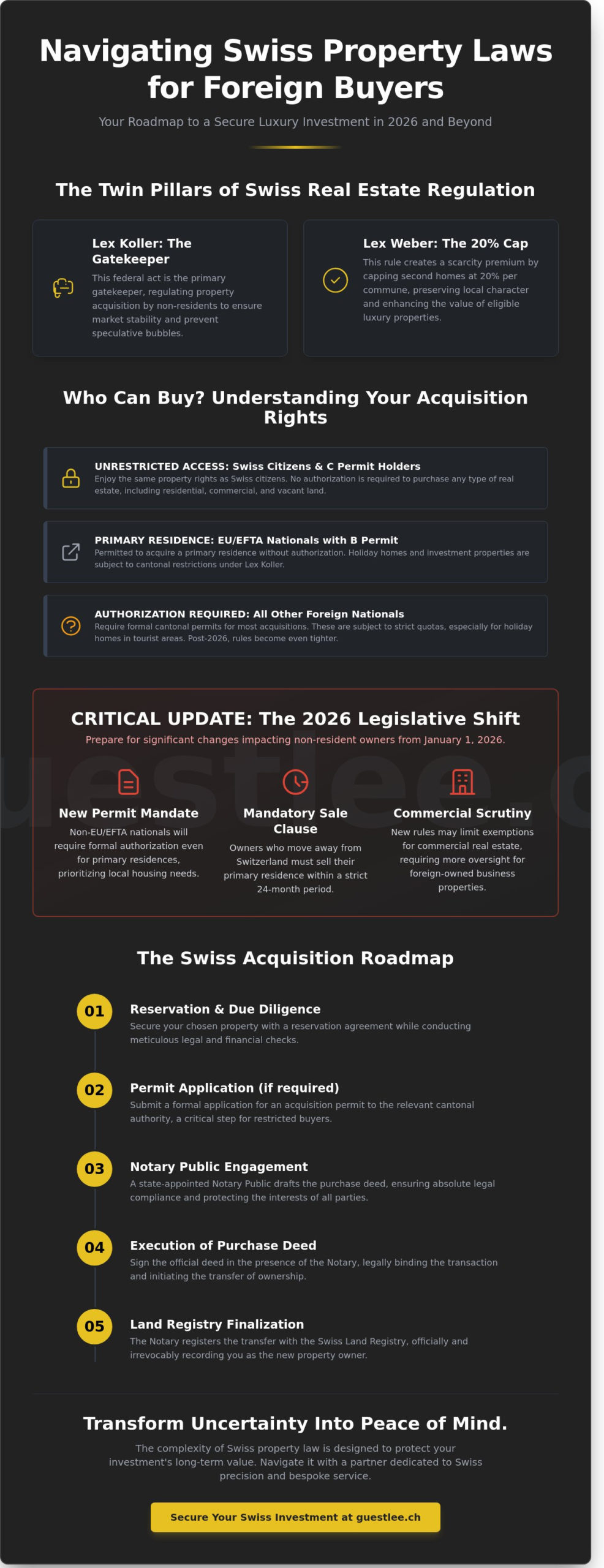
The Acquisition Process: A Step-by-Step Roadmap for Foreign Investors
Acquiring a residence in the Swiss Alps or along the shores of Lake Geneva begins with a formal reservation agreement. This initial step secures the property and typically requires a deposit, often 10% of the purchase price, held in a secure escrow account. It’s during this phase that the nuances of swiss property laws foreign buyers must navigate become most apparent. A Swiss Notary Public is appointed early in the process to ensure that every document meets the exacting standards of federal and cantonal law, providing a foundation of legal certainty.
When navigating swiss property laws foreign buyers often find that the “Authorization Application” is the most time-sensitive component for those subject to Lex Koller regulations. This stage involves submitting a comprehensive file to the cantonal authorities to obtain a permit for the purchase. Approval timelines generally span between 8 and 16 weeks depending on the specific canton. Once the permit is granted, the parties proceed to sign the final deed of sale. Swiss precision is the hallmark of this process; even minor discrepancies in documentation can result in administrative delays that push back closing dates by several months.
To navigate these complexities, many investors rely on Swiss Alpha Matrix, an independent advisory firm that provides specialized due diligence and project management for complex financial and investment programmes, ensuring that every detail of the acquisition is handled with the required precision.
The final legal transfer occurs upon entry into the Land Registry, known as the Grundbuch. While the signing of the deed grants certain contractual rights, the official registry entry is what confirms the buyer as the legal owner. This entry process is meticulous and follows a strict chronological order, reflecting the stability and transparency of the Swiss real estate market.
The Role of the Public Notary
In the Swiss system, the Notary Public functions as an independent officer of the law who represents both the buyer and the seller with total neutrality. They don’t just facilitate signatures; they manage the entire escrow process. All funds, from the initial deposit to the final purchase price, pass through the Notary’s professional account to guarantee financial security for both parties. This “Invisible Expert” works alongside your legal counsel to coordinate every detail, ensuring the contract reflects your bespoke requirements while remaining fully compliant with local statutes.
Financing and Tax Considerations
Financing a Swiss property as a non-resident requires a strategic approach to capital. Most Swiss lending institutions limit mortgages for foreign buyers to between 60% and 70% of the property’s value. You’ll also need to budget for closing costs, which include the Real Estate Transfer Tax and Notary fees. In cantons like Vaud or Valais, these costs typically range from 2.5% to 5% of the purchase price. For those looking to protect their investment and ensure their new asset performs at its peak, GuestLee Switzerland provides the premier standard in luxury property management and rentals. Our team manages the complexities of ownership so you can enjoy the rewards of a perfectly curated Swiss home.
Optimizing Your Investment: Post-Purchase Management and Compliance
Successfully acquiring a residence in the Swiss Alps or a lakeside villa in Geneva is a milestone, yet the journey continues through diligent ownership. Understanding swiss property laws foreign buyers must navigate after the closing date is vital for long-term security. A critical regulatory point involves the 2026 deadline. Owners who purchased property under the primary residence exemption but no longer occupy the home must list the asset for sale within twenty-four months of vacating. This specific rule ensures that local housing stock remains functional rather than purely speculative. To handle these complexities, a bespoke management plan acts as the definitive bridge between a simple purchase and a flourishing legacy. Professional property management isn’t merely a convenience; it’s the final, essential step in a sophisticated acquisition strategy.
Asset Protection and Maintenance
Maintaining the prestigious “Swiss quality” of a high-end villa requires meticulous attention to detail. Local regulations often mandate specific upkeep standards to preserve the aesthetic harmony of the commune. Beyond physical care, non-resident owners must manage recurring municipal charges and cantonal tax filings. For instance, property taxes in cantons like Valais or Vaud typically range from 0.05% to 0.15% of the property’s tax value. Our approach ensures these logistical burdens remain invisible. We handle everything from technical inspections to tax coordination, transforming your home into a hassle-free lifestyle asset that retains its premium valuation year after year. Precision is our standard.
Maximizing Occupancy and Yield
Strategic management allows your Swiss retreat to generate a significant return without compromising its integrity. For holiday homes governed by Lex Koller, owners can utilize short-term rental models, provided they adhere to the standard 180-day annual limit for guest stays in many tourist zones. We apply a luxury concierge philosophy to this process. This ensures that every guest experience mirrors the exclusivity of the property itself. This curated approach attracts a high-caliber clientele, optimizing your yield while you’re away. By blending professional asset oversight with warm hospitality, your investment becomes more than just real estate; it becomes a seamless experience. Visit GuestLee to discover how we manage your Swiss legacy with the precision and care it deserves.
Securing Your Swiss Real Estate Legacy in 2026
Navigating the nuances of swiss property laws foreign buyers must follow requires a sharp focus on two primary pillars. The 1983 Lex Koller legislation remains the definitive gatekeeper for international ownership, while the 2012 Lex Weber initiative maintains a strict 20% cap on second-home inventory in tourist communes. These regulations create a stable, low-volatility environment that rewards patient investors who prioritize compliance and long-term asset health. Success in this market depends on your ability to balance these legal requirements with high-quality maintenance to ensure your property retains its premium value. For a deeper understanding of how to position your portfolio within this framework, our comprehensive guide to luxury real estate Switzerland explores the architectural trends and wealth preservation strategies defining the 2026 gold standard.
Founded in 2016, GuestLee bridges the gap between complex regulation and effortless ownership with deep expertise in Swiss luxury hospitality. We specialize in high-end villa management and asset optimization, providing the meticulous Swiss precision needed to protect your investment. As your invisible expert, we handle every detail behind the scenes to deliver total peace of mind for owners and unforgettable experiences for guests. Discover Bespoke Property Management with GuestLee and let us transform your Swiss residence into a high-performing asset. Your future in the heart of Europe has never looked more promising.
Frequently Asked Questions
Can a non-resident foreigner buy an apartment in Switzerland?
Non-resident foreigners can purchase apartments in Switzerland, provided the property is located in a designated tourist zone. These areas are typically found in cantons like Valais, Vaud, or Graubünden. Each year, the Federal Office of Justice allocates approximately 1,500 permits across the country for these holiday home acquisitions. You’ll find that urban centers like Zurich or Geneva remain largely restricted for non-residents seeking residential property.
What is the Lex Koller law and how does it affect me?
The Lex Koller is a federal law that regulates the acquisition of real estate by persons abroad to prevent foreign over-investment in Swiss land. For you, this means you must obtain a specific permit from cantonal authorities before finalizing a purchase. It limits the living area of your holiday home to 200 square meters and the total plot size to 1,000 square meters. This regulation ensures a balanced property market for local residents.
Is it true that I must sell my Swiss home if I move to another country?
You aren’t required to sell your Swiss property if you relocate abroad after purchasing it as your primary residence. Once you’ve legally acquired the home while holding a B or C permit, it remains yours regardless of your future residency. However, if you bought the property specifically as a holiday home under a quota, different rules apply regarding its usage. Understanding the swiss property laws foreign buyers must navigate helps ensure your investment remains secure during life transitions.
How much deposit is required for a foreign buyer in Switzerland?
Foreign buyers typically need to provide a minimum down payment of 20% of the purchase price in cash. For non-residents, Swiss banks often request a higher equity stake of 40% to mitigate lending risks. If you’re buying a luxury villa for CHF 2,500,000, expect to have CHF 1,000,000 ready for the deposit and associated closing costs. These costs include notary fees which generally range from 2% to 5% depending on the canton.
Can I rent out my Swiss holiday home to tourists?
You can rent out your holiday home to tourists on a short-term basis for up to 11 months of the year. The Lex Koller stipulates that the owner or their family must use the property for at least three weeks annually. This arrangement allows you to optimize your property’s yield while you aren’t in residence. Our bespoke management services ensure your home meets the high standards of Swiss hospitality for every visiting guest, providing you with total peace of mind.
What happens if a municipality has reached its 20% second-home cap?
If a municipality reaches the 20% threshold established by the Lex Weber initiative in 2012, no new permits for second homes are issued. This restriction applies to over 400 communes across Switzerland where holiday homes are prevalent. You can still purchase existing second homes that were built or authorized before March 11, 2012. This cap maintains the character of local villages and protects the long-term value of your investment in these exclusive locations. For investors specifically targeting alpine properties, our detailed analysis of a luxury chalet for sale in Switzerland outlines the 2026 market trends and yield management strategies that turn scarcity into a long-term financial advantage.
Do UK citizens need a permit to buy property in Switzerland after Brexit?
UK citizens are now classified as third-country nationals and require a permit to purchase property, following the end of the transition period on December 31, 2020. This change means you no longer benefit from the same ease of acquisition as EU or EFTA citizens. You’ll need to navigate the standard swiss property laws foreign buyers face, which includes applying for cantonal authorization. This process ensures your purchase aligns with current bilateral agreements between Switzerland and the UK.
How long does the authorization process take for foreign buyers?
The authorization process for foreign buyers generally takes between two and four months to complete. This timeline depends on the efficiency of the specific cantonal land registry and the complexity of your application. Once the notary submits the request to the authorities, they’ll verify if the purchase fits within the annual quota. We provide meticulous guidance throughout this waiting period to ensure a seamless transition to your new Swiss lifestyle and a successful property acquisition.

Article by
Giacomo Esposito