

Swiss Real Estate Investment: The 2026 Strategic Guide to Luxury Assets
What if the very regulations that seem to guard the Swiss border are actually the architects of your portfolio’s long-term resilience? While many international investors see the Lex Koller and Weber Law as insurmountable barriers, they’re the foundation of a market defined by scarcity and enduring value. In 2026, achieving a superior return on investment swiss rental property requires moving beyond traditional residential models toward hospitality-driven luxury assets. You likely feel the weight of these legal complexities and the pressure of rising management overhead. We understand that your time is as valuable as your capital, and you seek the quiet confidence that comes with a perfectly managed estate.
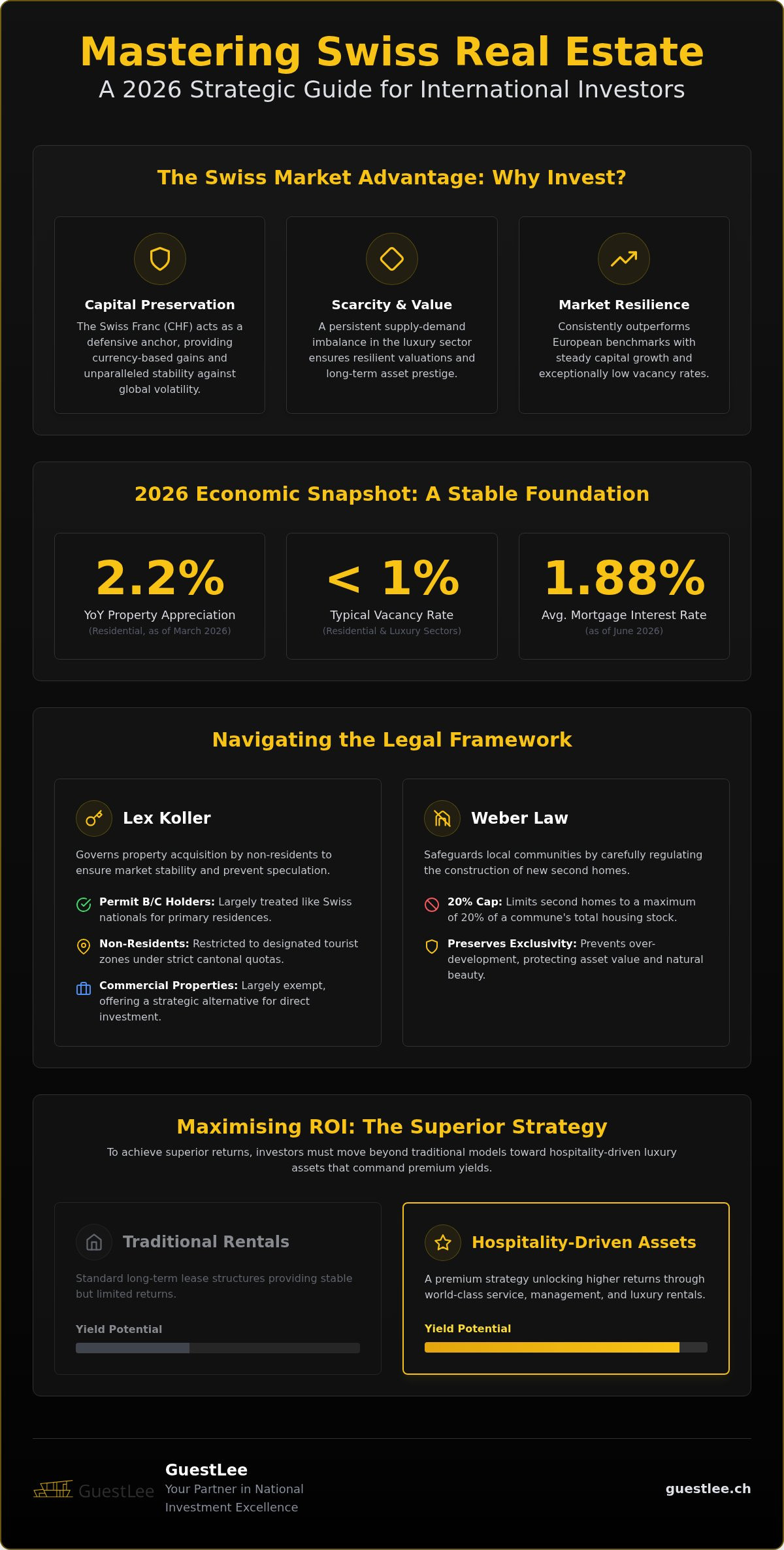
This strategic guide provides the clarity you need to master the 2026 market, where residential property appreciation reached 2.2% year-over-year by March. We’ll demystify the latest Lex Koller proposals and show you how a premium hospitality strategy can unlock yields that traditional rentals simply can’t match. You’ll discover how to secure high-performing assets and find a partner who handles every meticulous detail of national property management. By the end of this article, you’ll have a clear roadmap to transform a complex acquisition into a seamless, high-yield legacy.
Key Takeaways
- Understand the role of the Swiss Franc as a defensive anchor for capital preservation and currency-based gains in the 2026 market.
- Navigate the complexities of the Lex Koller and Weber Law with a strategic focus on compliant, high-scarcity luxury assets.
- Identify the specific advantages of a hospitality-driven model to maximize the return on investment swiss rental property over traditional lease structures.
- Discover the value of a full-service management partner who protects your asset’s long-term appreciation while delivering world-class service.
Understanding the Swiss Real Estate Investment Landscape in 2026
Swiss real estate serves as a sanctuary for discerning capital. As 2026 unfolds, global markets continue to grapple with volatility, positioning the national property market as a premier defensive play for the sophisticated investor. The strength of the Swiss Franc (CHF) acts as a primary driver for currency-based gains, providing a layer of protection that few other jurisdictions can offer. In the luxury sector, a persistent supply-demand imbalance keeps valuations resilient. High-net-worth individuals are searching for a level of quality that construction pipelines struggle to match, ensuring that your return on investment swiss rental property remains anchored in scarcity and prestige.
To better understand the viability of these assets in the current year, watch this helpful analysis:
The Resilience of the Swiss Market
The national residential and luxury sectors maintain remarkably low vacancy rates, often staying well below 1%. This scarcity is reinforced by the Lex Koller and Weber Law, which carefully regulate foreign acquisition and new second-home construction. Historically, Swiss property has outperformed European benchmarks by delivering consistent capital growth, with residential property appreciation reaching 2.2% year-over-year as of March 31, 2026. The Swiss Safe Haven effect in 2026 is defined by a unique combination of political neutrality, legal certainty, and a currency that acts as a global anchor. For those ready to explore specific holdings, our insights on Luxury Real Estate Switzerland offer a deeper perspective on current opportunities.
Economic Drivers for 2026
Economic stability remains the defining characteristic of the current landscape, bolstered by the SNB policy rate which held at 0.0% in May 2026. With average mortgage credit interest rates at 1.88% as of June, the environment for strategic acquisition is exceptionally favorable. These stable rates support national valuations and protect against the erratic shifts seen in other markets. Tangible Swiss assets function as a sophisticated inflation hedge, where capital preservation is the ultimate priority. Investors recognize that a well-positioned villa isn’t just a residence; it’s a meticulously managed financial asset. This focus on long-term security ensures that the return on investment swiss rental property continues to satisfy both the heart and the mind, providing a reliable stream of value in an unpredictable world.
The Legal Landscape: Lex Koller and Weber Law Restrictions
The legal framework in Switzerland isn’t a hurdle; it’s a sophisticated safeguard for your capital. Lex Koller governs how persons abroad acquire property, ensuring the market remains stable and locally anchored rather than subject to global speculation. As of July 2026, new proposals under consultation may require non-EU/EFTA nationals to obtain permits for primary residences and sell within two years if they relocate. If you hold a Permit B or C, your path to acquisition is significantly smoother, as you’re largely treated like a Swiss national for primary residences. However, for those looking to maximize the return on investment swiss rental property from abroad, understanding the nuances of holiday home quotas is essential.
Acquiring Property as a Foreign National
Non-residents are typically restricted to purchasing in designated tourist zones. Each canton receives a specific annual quota for holiday home permits, a system that prevents over-saturation and maintains the prestige of the region. It’s also vital to remember the resale restrictions. Generally, you can’t sell a holiday home within the first five years of ownership without a valid reason, such as financial hardship. This policy deters short-term speculation and protects long-term asset value. Interestingly, commercial properties are largely exempt from Lex Koller, offering a strategic alternative for those seeking Swiss exposure without residential permit constraints. To ensure your acquisition remains compliant while reaching its full potential, partnering with a specialist in Property Management Services provides the local oversight necessary for non-resident owners.
Navigating the Weber Law in 2026
The Weber Law, or the Second Home Initiative, limits second homes to 20% of the total housing stock in any given municipality. In 2026, this has led to a near-total freeze on new luxury second-home developments in prime Alpine regions. This artificial ceiling on supply has turned existing “grandfathered” properties into highly coveted assets. These homes, built before the law took effect, bypass current restrictions and command a significant premium. Strategic investors now focus on municipalities just below the 20% threshold or seek out these legacy estates to ensure high occupancy potential. This scarcity is a primary driver of the 2.2% year-over-year appreciation seen in the residential sector earlier this year. By acquiring a property in a restricted zone, you aren’t just buying a home; you’re securing a piece of a finite market that prioritizes quality over quantity.
Direct Ownership vs. Funds: Choosing Your Path
Choosing between direct ownership and real estate funds in 2026 isn’t just a financial decision; it’s a choice between active stewardship and passive participation. While indirect vehicles offer simplicity, they often lack the depth of value found in tangible luxury assets. Direct property ownership allows for a bespoke hospitality strategy that can significantly enhance the return on investment swiss rental property compared to institutional averages, which hovered around 6.6% for multi-family units in early 2026. This path requires more involvement, yet it yields a level of control and personal utility that a share certificate simply cannot replicate. Investors must weigh the high liquidity of funds against the scarcity-driven appreciation of a physical villa.
Taxation remains a critical differentiator for both national and international portfolios. Real estate investment funds are subject to a 35% withholding tax on dividends, whereas direct owners navigate cantonal wealth taxes ranging from 0.1% to 1%. With the abolition of the imputed rental value (Eigenmietwert) moving through its critical planning window in 2026, direct owners are positioned to benefit from a fundamental shift in the tax equation. This change makes the direct path increasingly attractive for those looking to preserve capital in a stable, tangible form while avoiding the fees and diluted returns of institutional management.
The Case for Direct Luxury Investment
Owning a physical asset provides a sense of security that digital or paper-based investments don’t match. In a world of market volatility, a luxury villa in a prime Swiss location stands as a resilient pillar of wealth. You gain the unique ability to utilize the property for personal retreats while generating premium income through high-end hospitality during peak seasons. The Control Premium in Swiss property ownership represents the quantifiable financial value of maintaining absolute authority over an asset’s hospitality standards and long-term preservation. This control ensures that every detail, from maintenance to guest experience, aligns with the highest standards of excellence, directly protecting the property’s market value.
Indirect Investment through Real Estate Funds
Real estate funds and REITs offer a lower barrier to entry, providing professional diversification across various sectors like office or retail. These vehicles operate under strict FINMA regulations, ensuring institutional-grade oversight and transparency. While they provide stable dividends, the growth potential is often capped by the performance of a broad portfolio. For instance, office property appreciation was limited to 0.6% year-over-year in early 2026, far trailing the luxury residential sector. Funds offer high liquidity, allowing you to exit a position with ease, but they don’t offer the inflation-hedging power or the 2.2% capital growth seen in direct residential holdings. For the HNWI, funds are a tool for diversification, while direct ownership remains the engine for significant wealth creation.
Maximising ROI: The Hospitality-Driven Investment Strategy
Traditional long-term leases in the national market often prioritize tenant security over owner yield. In 2026, the real opportunity lies in Hospitality-Integrated Assets. These are properties managed with the precision of a five-star hotel, designed to capture the premium rates of the short-term luxury market. By shifting toward a hospitality-driven model, you can significantly elevate the return on investment swiss rental property beyond the modest returns found in the standard residential sector. While multi-family units saw an average 3.1% cash flow return in early 2026, luxury assets managed for elite travelers often outperform these benchmarks by leveraging seasonal demand and exclusive service standards.
This strategy transforms a static real estate holding into a dynamic financial engine. It moves beyond the “set and forget” mentality of traditional rentals, which often struggle to keep pace with inflation or currency shifts. Instead, it treats the property as a premium service product. This approach doesn’t just increase immediate cash flow; it actively builds the brand of the property, making it a more desirable asset for future resale. In a market defined by scarcity, the ability to demonstrate a high-yield, hospitality-proven track record is a powerful differentiator for any portfolio.
Optimising Occupancy and Nightly Rates
Success in the luxury sector requires more than just a beautiful space. It demands dynamic pricing strategies that react to national events and seasonal shifts in real-time, ensuring your nightly rates are always optimized for the current market appetite. High-end concierge services are the silent engine behind this growth. When a guest experiences seamless arrivals and curated local exploration, they leave the five-star reviews that sustain premium nightly rates and drive repeat bookings. To understand the operational depth required for this level of performance, consult our Property Management Services in Switzerland.
Seamless Asset Management for Owners
Managing a luxury villa from afar can quickly become a burden of logistical complexities. Professional property management acts as a trustworthy guardian, handling everything from guest screening to meticulous maintenance behind the scenes. This isn’t just about convenience; it’s about protecting your capital. Meticulous care ensures the property remains in pristine condition, directly supporting the 2.2% annual appreciation seen in the wider market. Global marketing on exclusive platforms places your asset in front of the world’s most discerning travelers, ensuring occupancy remains high throughout the year. If you’re ready to transition your property into a high-performing luxury asset, explore how our Property Management Services can secure your financial legacy.
GuestLee: Your Partner in National Investment Excellence
GuestLee stands as the essential bridge where sophisticated real estate investment meets world-class hospitality. Since our founding in 2016, we’ve specialized in the entire lifecycle of high-end villas and apartments, acting as more than just a service provider. We are your Trustworthy Guardian. This philosophy means we treat your property with the same meticulous care you would yourself, ensuring that every guest interaction enhances the asset’s prestige. By handling everything from initial property setup to the final guest departure, we allow you to enjoy the rewards of ownership without the operational burdens that often accompany luxury holdings.
Our approach is rooted in the quiet confidence that comes from mastering regional standards. We understand that for a property to truly perform, it must offer a seamless blend of professional asset management and the warm, welcoming nature of a luxury concierge service. This dual-focus narrative ensures that while guests enjoy a curated exploration of the region, owners benefit from a property that is consistently protected and optimized for financial performance. It’s this commitment to excellence that makes us the preferred partner for non-resident investors seeking local expertise.
Professional Management as an Investment Shield
Swiss regulations and maintenance standards require a level of precision that can be daunting for international investors. Our team acts as a professional shield, navigating the complexities of local requirements so your portfolio remains compliant and thriving. We maintain a meticulous focus on both your financial objectives and the experiential desires of the modern traveler. This synergy is what ultimately drives a superior return on investment swiss rental property. When guests encounter a seamless, concierge-level experience, they’re willing to pay the premium rates that support your long-term yield. Explore our full suite of services on the GuestLee Switzerland Homepage to see how we protect both your property value and the guest journey.
Securing Your Swiss Legacy
Building a national portfolio of managed luxury assets is a journey that requires local expertise and a long-term vision. We don’t just manage homes; we secure legacies. Whether you’re looking into new real estate sales or optimizing an existing holding, our team provides the strategic oversight needed to navigate a market defined by scarcity. The next step for any serious investor is a comprehensive consultation and asset audit. This process allows us to identify untapped potential in your property and align it with the GuestLee Premier Standard. By entrusting your asset to a partner who understands the nuances of the 2026 market, you ensure that your Swiss investment remains a pillar of strength and a source of pride for years to come.
Securing Your Financial Legacy in the Heart of Europe
The path to a superior return on investment swiss rental property in 2026 is paved with strategic clarity and an uncompromising commitment to quality. By moving beyond traditional leasing and embracing a hospitality-integrated model, you position your portfolio to thrive within the unique constraints of the Swiss legal landscape. You’ve seen how market scarcity drives long-term value and how meticulous management protects it against global volatility. Realizing this vision requires more than just capital; it demands a partner who understands the delicate balance between professional asset protection and the warm, welcoming nature of luxury service.
At GuestLee, we offer bespoke management for high-net-worth property owners, ensuring your asset meets meticulous regional standards of accuracy while occupancy is optimized through our specialized hospitality expertise. We handle every complexity behind the scenes so you don’t have to. Partner with GuestLee for your Swiss real estate investment and transform your property into a high-performing legacy. The future of your Swiss holdings is bright, and with the right guardian by your side, your investment will remain a source of security and pride for generations to come.
Frequently Asked Questions
Can foreigners buy property for Swiss real estate investment in 2026?
Foreigners can indeed invest in the Swiss market, though the path depends on your residency status. Non-residents are typically invited to acquire holiday homes within specific tourist zones under a cantonal quota system. If you hold a Permit B or C, you’ll find the process for primary residences aligns more closely with that of Swiss nationals. Commercial real estate remains a versatile option for international capital, as it’s generally exempt from the most residential acquisition limits.
What is the average yield for luxury real estate investment in Switzerland?
The average total return for multi-family units was 6.6% in early 2026, combining cash flow and capital appreciation. Luxury assets often deliver more sophisticated results when integrated with a premium hospitality model. While traditional residential yields might hover around 3%, the luxury sector benefits from a 2.2% annual appreciation rate. This creates a balanced portfolio that prioritizes long-term security alongside consistent income, making it a premier choice for global wealth preservation and growth.
How does Lex Koller impact property investment for non-residents?
Lex Koller acts as a stabilizing force by regulating how non-residents acquire residential property. It ensures that the market isn’t subject to erratic global speculation, which in turn protects the value of your holdings. For the international investor, this means navigating a permit system and respecting minimum holding periods. These regulations might seem complex, but they’re the reason the Swiss market remains one of the most resilient and prestigious environments for luxury property ownership in the world.
Is it better to invest in direct property or a Swiss real estate fund?
Direct ownership is often the preferred route for those seeking to maximize the return on investment swiss rental property. While funds offer ease of entry and high liquidity, they don’t provide the personal utility or the 2.2% annual capital growth seen in direct luxury residential holdings. Owning a physical villa allows you to implement a bespoke hospitality strategy, capturing premium nightly rates that institutional funds, with their broader and often diluted portfolios, simply cannot match.
What are the annual taxes for owning investment property in Switzerland?
Owners should account for cantonal wealth taxes, which generally range between 0.1% and 1% depending on the specific location of the asset. Rental income is subject to income tax, with the maximum federal rate capped at 11.5%. A significant development for 2026 is the planned abolition of the imputed rental value. This change will fundamentally alter the tax landscape, making direct ownership even more efficient for those who prioritize capital growth and streamlined fiscal management over time.
How does professional property management improve investment ROI?
Professional management serves as a bridge between a static asset and a high-performing investment. By employing dynamic pricing and high-end concierge services, a manager can significantly improve the return on investment swiss rental property. Meticulous maintenance standards also ensure that the property’s physical condition remains pristine, which is essential for supporting long-term capital appreciation. This attentive oversight allows owners to enjoy the rewards of a luxury portfolio without the burden of day-to-day logistical complexities.
What is the Weber Law and how does it affect property values?
The Weber Law limits the proportion of second homes to 20% in any given municipality, effectively freezing new construction in many prime Alpine regions. This regulation has created a distinct scarcity that naturally pushes property values upward. Existing grandfathered homes that bypass these restrictions have become exceptionally valuable assets. For the strategic investor, this law ensures that supply remains capped, protecting your investment from the dilution that often occurs in less regulated international luxury markets.

Article by
Giacomo Esposito