
Choose a Swiss ski region by access, terrain and family needs
The biggest ski area isn’t automatically the best fit. To decide how to choose between different Swiss ski regions, weigh the journey, your group’s needs and the terrain you’ll genuinely enjoy, rather than relying on piste length alone.
Look beyond the map. For a family with beginners, easy practice areas and straightforward access may matter more than a vast ski network. Confident skiers may prioritise longer runs, varied difficulty or terrain parks. The journey from your arrival city can also affect how relaxed the first and last days feel.
This guide explains how to compare Swiss ski regions by family needs, access from major cities, terrain, difficulty and piste length. Use the practical criteria and examples, including Grindelwald, Zermatt, Laax and Gstaad, to narrow your options and choose a region that suits your group and the skiing you want.
Key Takeaways
- For a family trip, prioritise beginner areas that are easy to reach and comfortable for children to practise in.
- Compare the full journey from your arrival city, including the onward connection to the resort.
- Match terrain and piste difficulty to the least experienced skier in your group, not just the strongest.
- Use piste length to understand a region’s scale, then weigh it against the kind of skiing and trip experience you want.
1. Alternative Swiss resorts for families and beginners
For young beginners, compare the practice slope with the journey from accommodation. Wengen has a nursery slope in the village, while a magic carpet can make repeated practice easier than using a lift. Gstaad offers over 200 kilometres of slopes, with more than half suited to beginners. These options give families room to choose between a compact learning area and a broader network.
Grindelwald and Wengen also provide access to the Kleine Scheidegg beginner area. For confident skiers travelling with learners, consider Laax or Verbier: Laax’s four terrain parks contain more than 90 obstacles, while Verbier has 48 lifts. That contrast helps match different abilities without treating every family member as a beginner.
For snow reliability and altitude, compare higher terrain and snowmaking. Zermatt’s Matterhorn Glacier Paradise cable car station stands at 3,883 metres, and Saas-Fee’s slopes reach up to 4,000 metres. Wengen’s village nursery slope uses artificial snowmaking, offering a specific consideration for early-season family practice.
For après-ski, nightlife and activities beyond skiing, consider what your group wants after the lifts close. Grindelwald has an extensive public sports centre, offering an indoor activity option. Nightlife varies by resort, so compare the village atmosphere with the pace your family prefers.
Accommodation and dining costs vary by resort, season, location and style. A central stay or peak-season dates can affect your budget, and meal choices add another variable. Compare the full trip rather than relying on a single nightly or dining figure.
For timing, match your dates to altitude, snowmaking and expected demand. The week before Christmas, resorts can be busy, and accommodation in Swiss ski resorts is expected to be fully booked from 20 to 27 December. Families seeking quieter slopes can consider dates outside that period.
Plan transport and ski-pass access as carefully as the region itself. Wengen allows you to ski in and out of the village without walking or taking a bus. Before choosing a pass, check that its coverage includes the sectors your group wants to ski.
2. Choosing resorts by proximity to Zürich, Bern, Geneva or Lausanne
Start with your arrival city, then compare the full journey to each resort. Zürich, Bern, Geneva and Lausanne are useful starting points, but the shortest route on a map may not be the simplest trip. Include the final connection to the resort, luggage handling and your group’s arrival time.
For a concrete benchmark, Zermatt is 3.5 hours by train from Zurich Airport. This makes rail time part of the decision, rather than an afterthought. From Zürich, compare Zermatt with other candidate regions by total journey and transfers, not by distance alone. A useful way to approach how to choose between different Swiss ski regions is to assess the whole trip, not just the first train ride.
Use the same method when travelling from Bern, Geneva or Lausanne. Enter your actual departure point, such as Bern station or Geneva Airport, and compare routes to the accommodation area. The nearest rail stop may not be your final destination, so account for the remaining leg before choosing a region.
Compare routes against your group’s priorities. Families with children may prefer fewer changes and a straightforward arrival. Groups carrying ski equipment may value an easier transfer over a small saving in travel time. For a short break, weigh the journey against the number of full days available on the slopes.
Grindelwald has been described as having a shorter onward journey to Neuchâtel than some other ski destinations. The example illustrates why the best choice depends on where you start. If you’re deciding how to choose between different Swiss ski regions from Zürich, Bern, Geneva or Lausanne, compare your own departure point with each resort rather than relying on another traveller’s route ranking.
Before booking, make a simple shortlist: origin, total journey, transfers, arrival point and onward access to your stay. If your comparison is also helping you decide where to own a home, explore Swiss property opportunities as a related next step.
3. Comparing ski regions by terrain, difficulty, and piste length
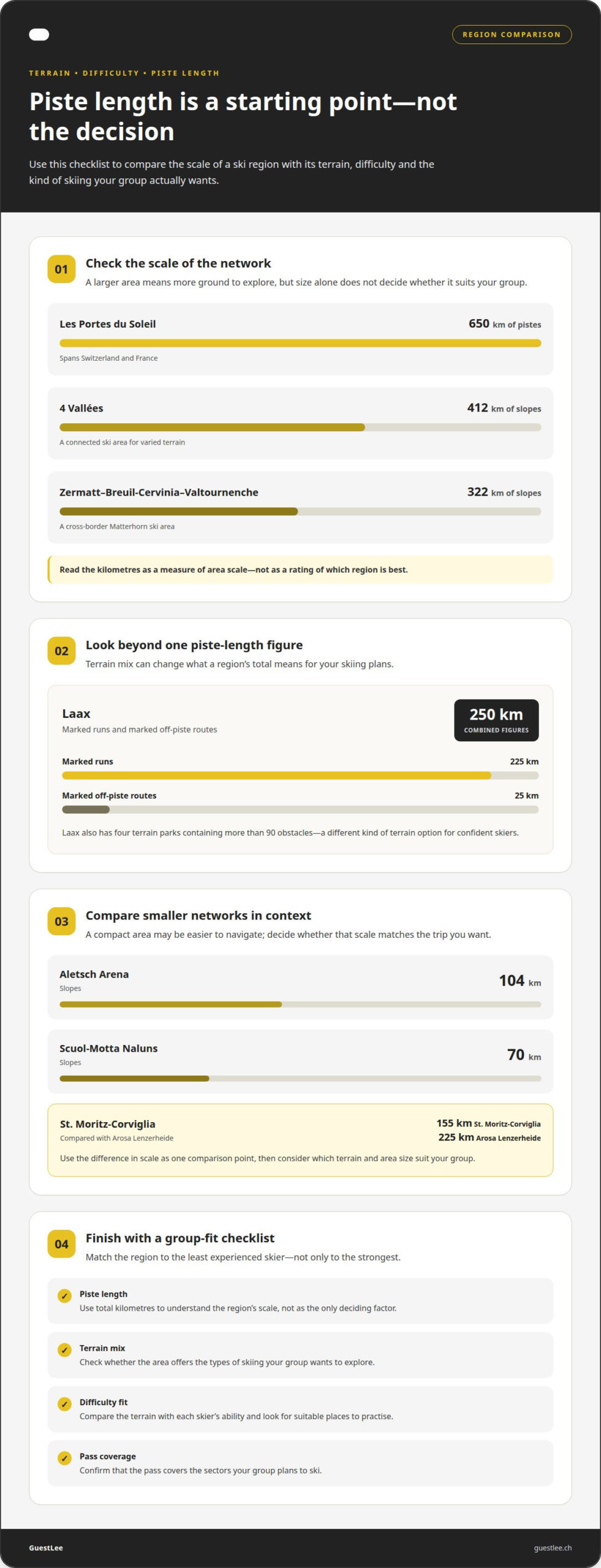
Begin with the area’s total piste length, then consider what that number represents. The 4 Vallées covers 412 kilometres of slopes, while the Zermatt-Breuil-Cervinia-Valtournenche Matterhorn ski area has 322 kilometres. Les Portes du Soleil spans Switzerland and France, with 650 kilometres of pistes. A larger network offers more ground to explore, but doesn’t automatically suit every skier.
Look at terrain mix alongside scale. Laax has 225 kilometres of marked runs and 25 kilometres of marked off-piste routes, giving confident skiers different ways to explore. For a more compact comparison, Aletsch Arena has 104 kilometres of slopes, while Scuol-Motta Naluns has 70 kilometres. Consider whether your group values variety across a large area or a smaller network that feels easier to navigate.
Difficulty matters more than headline distance. Compare the share of terrain suited to each skier’s ability and check where beginners can practise. A long piste network is most useful to confident skiers who plan to explore several sectors; newer skiers may prefer suitable runs close to their base.
These cover different periods, so compare each pass’s duration and area coverage with your itinerary instead of treating the figures as direct equivalents.
Use a simple shortlist: piste length, terrain mix, difficulty fit and pass coverage. For example, compare the 155 kilometres at St. Moritz-Corviglia with the 225 kilometres at Arosa Lenzerheide, then ask which scale and terrain better match your group’s skiing plans. That approach makes region size useful, rather than decisive on its own.
4. Main Swiss Ski Regions and Their Differences
Swiss ski regions often combine several resorts, so compare the linked area and its character. In Valais, the 4 Vallées offers a connected ski area for skiers seeking varied terrain. Zermatt’s Matterhorn ski area reaches 3,899 metres, and its Theodul Glacier offers skiing 365 days a year. These features distinguish the region for skiers drawn to extensive lift networks or high-altitude glacier terrain.
Graubünden offers a different set of choices. Arosa Lenzerheide has 225 kilometres of slopes, while Flims Laax Falera places 70% of its slopes between 2,000 and 3,000 metres above sea level. That elevation profile and the region’s varied resorts help distinguish Graubünden from destinations centred on a single village or mountain. Compare the base resort and terrain you’ll use most, rather than choosing by canton alone.
The Bernese Oberland is another useful comparison for travellers weighing resort atmosphere and access. Grindelwald and Wengen are within the Jungfrau ski area, while Gstaad offers a separate option in the wider region. To decide how to choose between different Swiss ski regions, consider whether your group wants to stay close to a particular village or explore a connected ski area. Those priorities can shape the feel of a trip as much as the region’s name.
Use three questions to narrow the map: do you want high-altitude skiing, a large linked network, or a particular village setting? Then compare relevant figures for the resorts you are considering. Lift and piste totals describe scale, but the best match depends on how your group wants to spend its days. Thinking about how to choose between different Swiss ski regions in terms of your group’s preferred experience makes the final shortlist more practical.
GuestLee
Once you’ve chosen a Swiss ski region, GuestLee can help with your stay or property plans. If you want a private base for your trip, explore our Luxury Villa Rentals. If you’re considering ownership, Real Estate Sales can support your next step, while Property Management Services can help owners manage a property. Each service suits a different stage of enjoying or owning a home in Switzerland, rather than choosing ski terrain.
Contact GuestLee to discuss the option that fits your plans.
Turn your regional choice into a trip that feels like yours
Choosing the right resort is only the beginning. Decide what you want your time off the slopes to feel like: quiet mornings, shared meals or evenings enjoying the mountain setting. That vision can guide the details of your stay and help make the trip feel cohesive from arrival to departure.
Knowing how to choose between different Swiss ski regions is about more than selecting a destination. Find a setting that suits the people travelling with you and the memories you hope to bring home. Once you’ve settled on a region, choose a base that supports the experience you have in mind.
Contact GuestLee to discuss a stay for your Swiss ski trip, and take the next step towards a mountain escape shaped around your plans.
Frequently Asked Questions
How Do You Choose Between These Four Resorts?
Choose according to your group, arrival point and preferred skiing experience. A family with mixed abilities might prioritise separate learning terrain and varied runs, while experienced skiers may favour challenging routes and a wider choice of sectors. Write down your group’s non-negotiables, then rule out resorts that make them difficult to meet.
What Makes Switzerland’s Best Ski Resorts Different?
Swiss resorts differ in village character, terrain, altitude, access and activities beyond skiing. A resort may centre on a traditional village, a large linked ski area or a high-altitude landscape. Decide whether your group values a quieter base, varied mountain days or convenient activities off the slopes. The best fit is the place whose everyday rhythm suits you, not simply the most famous name.
How do ski area size, terrain variety, and lift connections compare across Swiss regions?
Compare how the mapped ski area works, not just its total size. A connected network can let confident skiers explore different sectors, while less experienced visitors may prefer familiar routes near their base. Check how pistes connect with lift stations and whether returning to your accommodation means retracing a route. This practical map check shows whether a large area suits your group’s pace.
Which Swiss ski regions are best for beginners, families, and children?
Beginners and families often benefit from gentle practice terrain, clear meeting points and activities for non-skiing hours. A group with a young learner and confident adults, for example, may appreciate a resort where beginners can practise while others tackle more demanding pistes. Consider how easily everyone can regroup for lunch or at the end of the day, particularly if children tire at different times.
Which regions offer the best terrain for intermediate and advanced skiers?
Intermediate and advanced skiers should compare the character of the runs, not just the number of pistes. Look for sustained descents, varied slopes and terrain that matches your confidence. Skiers who enjoy exploring may prefer an area with several sectors, while those refining their technique may value repeatable runs. Treat marked off-piste routes as distinct from groomed pistes when comparing options.
How easy is it to reach Swiss ski regions by train, car, or airport transfer?
Access depends on your starting point, arrival time, luggage and the resort’s final connection. Train travel can simplify the journey between cities and mountain stations. Driving may suit groups carrying equipment, but the route and onward access still matter. For an airport transfer, consider the distance to your accommodation and how it fits your flight time. Compare the complete door-to-door journey, not just the first leg.

Article by
Giacomo Esposito