

Due diligence for buying Swiss real estate: costs and key checks
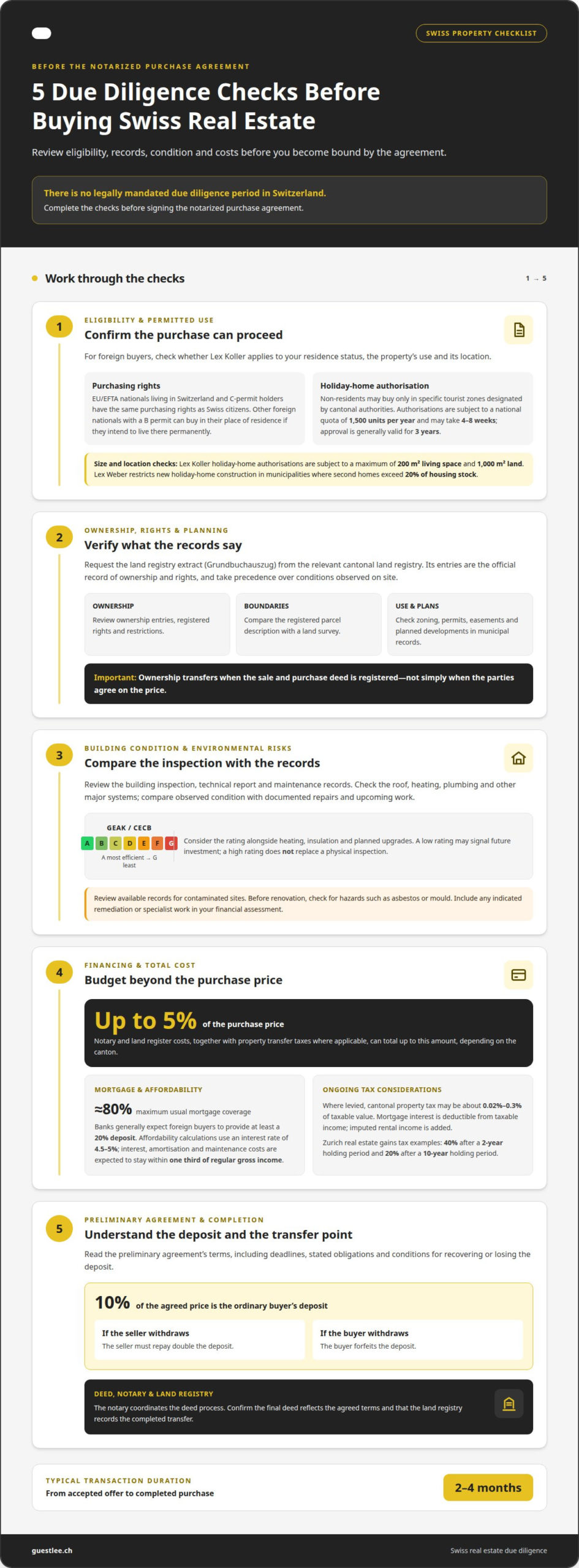
The purchase price is only the beginning of a sound Swiss property decision. Due diligence for buying Swiss real estate means examining the property’s legal position, physical condition, permitted use and ongoing financial commitments before you become bound by the notarized purchase agreement. Switzerland has no legally mandated due diligence period, so the checks need to be completed before signing.
It’s natural to focus on the property itself, but the costs around a purchase matter too. Notary and land register costs, together with property transfer taxes where applicable, can total up to 5% of the purchase price, depending on the canton.
This guide explains what a thorough review can cover, from ownership records, leases and zoning to building condition and environmental concerns. You’ll also learn which acquisition costs to account for and how the findings can shape a more informed decision about the property.
Key Takeaways
- Review ownership records, building condition, zoning and environmental risks before signing the notarized purchase agreement.
- Foreign buyers should establish whether Lex Koller applies to their situation and property before proceeding.
- Budget beyond the purchase price for canton-dependent transaction costs, including notary and land register fees and any applicable transfer tax.
- Read preliminary agreement terms carefully: the deposit and withdrawal conditions can affect what happens if either party backs out.
Energy efficiency certificates and contaminated land
Energy performance and land history can affect the purchase price, future obligations and renovation plans. Switzerland’s GEAK/CECB certificate rates a building from A, the most efficient, to G, the least efficient. Consider the rating alongside the condition of the heating system, insulation and any planned upgrades. A low rating may point to future investment needs, while a high rating does not replace a physical inspection.
For environmental risks, review available records for contaminated sites and arrange an assessment if the property’s history or condition warrants closer attention. Before renovation, check for hazards such as asbestos or mould. If the findings indicate remediation or specialist work, include those requirements in your financial assessment rather than relying on the asking price alone.
Verify zoning, building permits, easements and planned developments through the municipality’s planning and building records, then compare those records with the property documents. A land registry extract, or Grundbuchauszug, can be requested from the relevant cantonal land registry; review its ownership entries, registered rights and restrictions. Foreign buyers should also consider size limits: Lex Koller holiday-home authorizations are subject to a maximum of 200 m² of living space and 1,000 m² of land. Lex Weber restricts new holiday-home construction in municipalities where second homes exceed 20% of housing stock.
The land registry is Switzerland’s official record of ownership and rights, and its entries take precedence over conditions observed on site. Compare the registered parcel description with a land survey to verify boundaries. Check easements and other registered encumbrances for obligations that may affect access or use. Ownership transfers when the sale and purchase deed is registered, not simply when the parties agree on the price.
A straightforward Swiss property transaction commonly takes between two and four months from accepted offer to completed purchase. The notary coordinates the deed process, but registration marks the transfer of ownership. Confirm that the final deed reflects the agreed terms and that the land registry records the completed transfer.
What is due diligence in Swiss real estate?
Due diligence brings legal, financial and property checks together before you commit. For foreign buyers, eligibility under Lex Koller can determine whether a purchase may proceed.
Foreign Buyer Eligibility
Lex Koller is the federal law regulating Swiss property purchases by foreign non-residents. For a foreign buyer, due diligence for buying Swiss real estate includes checking whether residence status, property use and location allow the intended purchase. EU/EFTA nationals living in Switzerland and C-permit holders have the same purchasing rights as Swiss citizens. Other foreign nationals with a B permit can buy in their place of residence if they intend to live there permanently.
Cantonal Authorisation
Cantonal authorisation is permission required for certain foreign purchases under Lex Koller. Non-resident buyers may purchase holiday homes only in specific tourist zones designated by cantonal authorities, and authorisations are subject to a national quota of 1,500 holiday homes or serviced-apartment units per year. The authorisation process may take approximately 4-8 weeks, and approval is generally valid for three years. The canton and property category therefore shape timing and eligibility.
Financing and Mortgage Requirements
Mortgage affordability measures whether a buyer’s income and available equity support the purchase. As part of due diligence for buying Swiss real estate, assess the financing conditions alongside the proposed price and intended ownership. Swiss mortgages usually cover no more than about 80% of the purchase price; banks generally expect foreign buyers to provide at least a 20% deposit. Banks use an interest rate of 4.5 to 5 percent for affordability calculations and expect interest, amortisation and maintenance costs to stay within one third of regular gross income. Confirming lender conditions helps parties plan before completion.
Ownership and Sale Taxes
Ownership brings tax considerations that can affect annual costs and eventual sale proceeds. Cantons that levy property taxes may charge about 0.02% to 0.3% of taxable value. Mortgage interest is deductible from taxable income, while imputed rental income is added, according to the Federal Statistical Office. Zurich’s real estate gains tax examples are 40% after a two-year holding period and 20% after a ten-year holding period, so planned holding time matters.
Are there extra costs beyond the purchase price I should budget for?
In Switzerland, acquisition expenses depend partly on cantonal rules and the transaction structure. Notary fees and deed-registration charges are governed by cantonal regulations, while buyers typically cover acquisition expenses in most cantons. A preliminary agreement may also require a deposit, so check its amount and the terms for withdrawing before completion.
A Swiss preliminary agreement is ordinarily accompanied by a buyer’s deposit of 10% of the agreed price. If the seller withdraws after signing, the seller must repay double the deposit; if the buyer withdraws, the buyer forfeits it. Before signing, examine the agreement’s conditions for recovering or losing the deposit, including any deadlines and stated obligations.
When reviewing the building inspection, technical report and maintenance records, compare the observed condition with documented repairs and upcoming work. Check the roof, heating, plumbing and other major systems, then note defects or maintenance gaps that could affect future costs.
Swiss sellers are legally required to disclose known defects, and some commission pre-sale inspections to anticipate buyer concerns. Ask that inspection findings and relevant repair records are accurately reflected in the sale documents. Property agreements commonly exclude seller liability for defects unless the seller intentionally deceived the buyer, making written disclosures and a clear description of the property’s condition particularly important.
The sale and purchase agreement typically sets out the land description, purchase price, deposit, transfer date and special terms. It may also include conditions benefiting the buyer and seller warranties on matters such as leases, tax or environmental issues. The notarized agreement is legally binding. The notary handles the deed formalities, while registration completes the ownership transfer. For new construction, scrutinize the works contract and protections for advance payments: if a general contractor misuses an advance, the buyer may have to pay for the same service twice.
Real estate due diligence
For a Swiss condominium, due diligence should cover both the individual unit and the shared building. This broader review can reveal obligations or planned work that a unit inspection alone might miss.
Condominium Ownership Risks
Stockwerkeigentum is condominium ownership in which a buyer holds a unit alongside shared areas and building facilities. The unit’s condition and costs may depend on decisions affecting the entire property, not just the apartment. Review the co-ownership regulations, recent meeting minutes, budget and accounts to understand responsibilities, planned repairs and how shared expenses are managed.
Assess the unit’s intended use against building rules, zoning and any special restrictions. For example, planned renovations may require approval or affect shared areas. Review any existing leases or contracts tied to the property, as they may affect its use or income. If your status as a foreign buyer raises Lex Koller requirements, check eligibility before signing.
Condominium Due Diligence Steps
Start by reviewing available documents: co-ownership rules, meeting records, budgets, maintenance history and details of planned work. Compare these records with an inspection of the unit and shared spaces, including the roof, façade, heating and access areas. Record defects, repair needs and unclear obligations, then consider how they may affect your decision to buy.
Next, review zoning and permit records if renovation or a change of purpose is planned. Check leases, service agreements, insurance coverage, property tax history and outstanding taxes. Switzerland has no legally mandated due diligence period, so complete these checks before the notarized purchase agreement. Swiss real estate due diligence typically takes 6 to 10 weeks, depending on complexity and document availability. For a considered next step, review Swiss property purchase opportunities alongside the findings.
GuestLee: Real Estate Sales
Once your property checks are complete and you are ready to buy or sell in Switzerland, GuestLee’s Real Estate Sales service can support your next step. Due diligence findings can help you assess whether a property suits your intended use, ownership plans and financial expectations. If you are still evaluating a purchase, keep the legal, physical and financial review separate from the sales decision: each has a different purpose. For owners considering what comes next, GuestLee also offers Property Management Services and Luxury Villa Rentals.
For a considered conversation about a Swiss real estate transaction, contact GuestLee.
Make your next property decision with clarity
A considered purchase is about more than finding a home or investment that appeals today. It means understanding how the property fits your plans over time, including the maintenance it may need, how you intend to use it and which commitments you are prepared to take on. A disciplined approach to due diligence for buying Swiss real estate can help you make a more deliberate decision and identify what matters most before proceeding.
As you move forward, keep your priorities in view. The right property should make sense not only on paper but also in the role you want it to play in your life or portfolio. Weigh the findings against that purpose rather than letting momentum decide for you.
When you’re ready to discuss your next property step, contact GuestLee. A thoughtful decision is a strong beginning, and your next move can be made with confidence.
Frequently Asked Questions
Who Can Buy Property in Switzerland?
Eligibility depends on residence status, nationality and intended use. EU/EFTA nationals living in Switzerland and C-permit holders generally have the same purchasing rights as Swiss citizens. Certain B-permit holders can buy a home in their place of residence if they intend to live there permanently. A foreign national living abroad may buy a second home only where exceptionally close ties worthy of protection exist. Intended rental use also matters: rules differ for holiday homes and second homes.
Due diligence in Switzerland: what terms and periods apply?
Switzerland has no legally mandated due diligence period, so timing depends on the transaction and the documents available. The key practical deadline is before the parties sign the notarized purchase agreement, which legally binds the buyer. A preliminary agreement can also set obligations and consequences for a deposit. For example, if you plan renovations, align document reviews and permit questions with the contractual timetable rather than assuming there will be an automatic inspection period.
How long does the buying process typically take in Switzerland?
A straightforward Swiss property purchase commonly takes two to four months from accepted offer to completion. The timeline may extend if financing conditions, foreign-buyer authorisation, property documents or contract terms require further work. A Lex Koller authorisation process may take approximately 4-8 weeks. For example, a buyer who needs authorisation should account for that process before agreeing a completion date, rather than treating it as a post-signing formality.
Is authorisation required to buy real estate?
Some foreign buyers need cantonal authorisation under Lex Koller, while others can purchase without it. The answer depends on residence status, property type, location and intended use. Non-resident buyers seeking holiday homes are limited to specific tourist zones designated by cantonal authorities, and annual quotas apply. For a main residence, the buyer’s permit and actual residence plans can affect the authorisation analysis, so establish eligibility before committing.
What costs are usually shouldered by the parties?
Cost allocation varies by canton and contract. Buyers commonly bear notary, due diligence and registration expenses, while notary and land registry costs are often split equally in many cantons. Sellers usually pay their agent’s fees and legal-adviser costs, as well as income tax on profit from the sale. Have the agreement specify who pays each transaction charge and how any applicable transfer tax is handled, rather than relying on practices in another canton.
What are the usual documents involved in such transactions?
Typical documents include the draft sale agreement, land registry extract, property plans, survey information, permits, leases and maintenance records. A condominium purchase may also involve co-ownership regulations, meeting minutes and building accounts. If you are arranging financing, include the mortgage offer and lender conditions. Foreign buyers may need documents related to residence status and authorisation. Financial intermediaries may also request identity and beneficial-owner information, as well as details about the economic background of unusual or complex transactions.

Article by
Giacomo Esposito