

Financing a Property Purchase in Switzerland: A 2026 Buyer’s Guide
The lowest headline mortgage rate may not be the best fit for your purchase. The right approach to financing a property purchase in switzerland depends on more than the rate: your available equity, the lender’s affordability assessment and whether you plan to live in the home or earn rental income all shape the decision. Mortgage terms can be difficult to compare, especially when an investment property also brings ongoing costs and management responsibilities.
Start by clarifying the property’s intended use, then test the financing against your financial position. This guide compares common Swiss mortgage structures and their trade-offs, explains what lenders typically assess, and outlines the documents and funds to prepare before making an offer. It also covers rental planning and ongoing management, so you can consider what ownership will involve after completion.

Key Takeaways
- Begin financing a property purchase in switzerland by considering the property’s intended use, your finances and the lender’s conditions together.
- Compare fixed-rate and SARON mortgages by how their different approaches to interest-rate changes fit your need for predictability and flexibility.
- For an investment property, weigh income, liquidity, risk and holding period. Projected rent alone doesn’t guarantee loan approval or future performance.
- Prepare methodically by defining the purchase, reviewing your finances, gathering relevant documents, comparing offers and examining the conditions.
- Plan beyond approval by considering ongoing obligations, maintenance, rental strategy and the responsibilities involved in managing the property.
Financing a Property Purchase in Switzerland: Start with Your Buyer Profile
Before comparing mortgage offers, clarify four parts of the decision: the property, its intended use, your financial position and the lender’s conditions. Financing a property purchase in switzerland means arranging the funds and mortgage structure needed to complete the acquisition and sustain ownership over time. A sound plan accounts for the initial commitment as well as the obligations that continue after completion.
Three terms help frame the decision. Equity is the buyer’s own capital contributed to the purchase. Mortgage debt is the amount borrowed against the property under an agreed loan structure. An affordability assessment is the lender’s review of whether the proposed financing is supportable in light of the borrower’s income, costs and financial circumstances. Lenders apply their own assessments, so your estimate is a planning tool, not a loan decision.

How intended use shapes a Swiss financing plan
A home for personal use and a property bought to generate rental income call for different questions. For an owner-occupied home, consider how the financing fits your household income, available funds and plans for living in the property. For a rental property, add the rental strategy, expected income, periods without tenants, operating costs and the responsibilities of managing the asset. These factors may influence a lender’s assessment, but criteria can differ between lenders and property types.
Treat rental projections as estimates, not guaranteed income or automatic evidence that a loan will be approved. A considered investment plan looks beyond the purchase: the holding period, liquidity for ongoing obligations and a workable management approach matter too. For broader context on evaluating an investment property, explore this Swiss property management and real estate resource.
What buyers should clarify before comparing mortgages
Set out your priorities before weighing mortgage structures. A clear picture makes comparisons more meaningful and helps distinguish a lender’s view of affordability from your own comfort with the commitment.
- Purpose: Decide whether the property is for your own use, rental income or another intended use.
- Available funds: Identify the capital you can contribute and how much liquidity you want to retain after the purchase.
- Income and commitments: Review the income supporting the plan alongside existing financial obligations and likely ownership costs.
- Ownership horizon: Consider how long you expect to hold the property and whether your plans could change during that period.
A lender may approve financing that still feels uncomfortable for your household budget or investment strategy. Your confidence, in turn, doesn’t guarantee lender approval. Keep both tests in view: whether the application meets the lender’s conditions, and whether the resulting commitments remain manageable for you. With your buyer profile defined, you can compare mortgage options against a specific purchase plan rather than choosing by headline terms alone.
Swiss Mortgage Options: Compare Fixed-Rate and SARON Financing
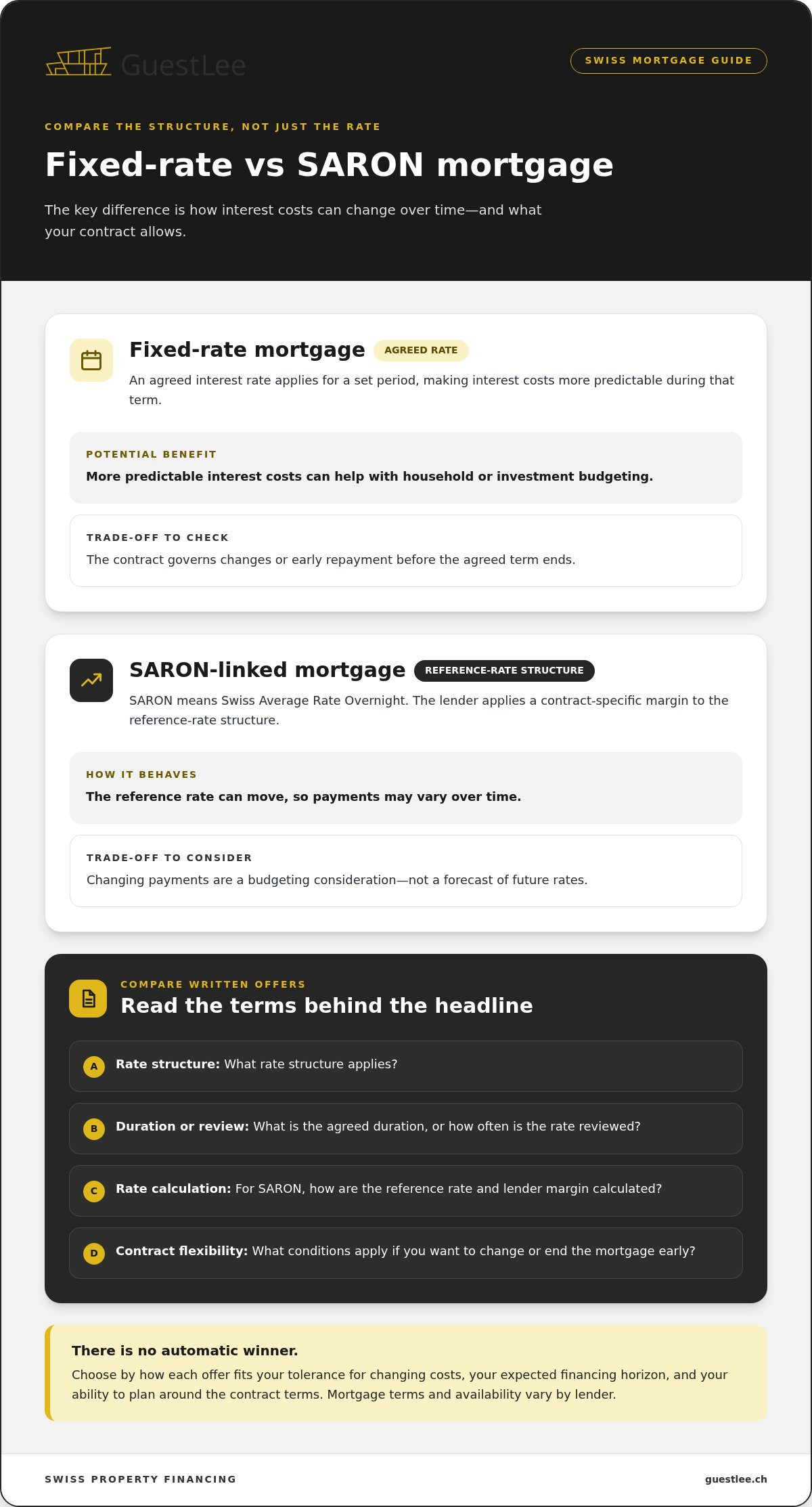
Once you know what you’re buying, compare mortgage structures by how they shape costs over time, not just by their initial appeal. A fixed-rate mortgage offers an agreed interest rate for a set period. A SARON-linked mortgage follows a reference-rate structure, with the lender’s margin and contract terms affecting the amount payable. Neither option is automatically right for every buyer.
Product terms and availability vary by lender. When financing a property purchase in switzerland, focus on how each offer fits your tolerance for changing costs, the time you expect to hold the financing and your capacity to plan around it.
When a fixed-rate mortgage may suit a buyer
A fixed-rate structure can make interest costs more predictable during the agreed term, helping buyers plan household or investment budgets. The trade-off is that the contract governs what happens if you want to change or end the mortgage before the term expires. Read the written offer in full, including its duration, conditions and provisions for early repayment or changes.
How SARON-linked financing differs
A SARON-linked mortgage uses the Swiss Average Rate Overnight as a reference, with a lender-specific margin applied according to the contract. Because the reference rate can move, payments may vary over time. Treat that variability as a budgeting consideration, not a forecast. Ask the lender to explain the calculation method, how often the rate is reviewed, the margin and the relevant contract terms.
| Structure | Potential benefit | Trade-off and question |
|---|---|---|
| Fixed-rate | Interest costs are more predictable for the agreed term. | Conditions may affect changes or early repayment. What does the contract allow? |
| SARON-linked | The structure follows a reference rate rather than fixing the interest rate for the full term. | Payments may change. How are the rate and margin calculated, and when are they reviewed? |
Use the same questions to compare written offers: What rate structure applies? What is the agreed duration or review process? What flexibility does the contract provide, and what conditions govern a change? A headline rate alone won’t show how a mortgage behaves throughout its term. Read the full contractual conditions and compare like with like before deciding.
The choice between fixed-rate and SARON-linked financing depends on your risk tolerance, time horizon and the lender’s terms. If you’re considering a rental property, connect the mortgage choice to the practical work of ownership too. GuestLee’s Swiss property management perspective offers context on that operational side, distinct from mortgage advice.
Financing a Swiss Property: Compare Home and Investment Scenarios
The same property can represent two very different financial commitments, depending on whether you plan to live in it or rent it out. When financing a property purchase in switzerland, compare both scenarios across four areas: the income supporting the plan, the liquidity you’ll retain, the risks you can absorb and the period you expect to own the property. Intended use may affect a lender’s assessment, and it changes your responsibilities as an owner.
Questions for financing a home for personal use
For a home you’ll occupy, consider the reliability of household income, existing financial commitments, available equity and possible changes in your plans. A lender’s affordability assessment applies its own criteria, which buyers should verify against current requirements. Separately, build a household budget that feels manageable beyond the lender’s assessment. Allow room for ownership costs and changes in your circumstances instead of treating the maximum financing available as a target.
Test your budget against possible changes to income or expenses. Would you still have enough flexibility for regular commitments and unexpected needs? This personal comfort test is separate from formal approval, but it can help you set a more sustainable purchase budget.
Questions for financing a rental property
An investment property calls for a closer look at how the asset will operate. Estimate rental income cautiously and test your plan against periods without tenants rather than assuming continuous occupancy. Include maintenance and other ongoing obligations in your cash-flow view. Rental income isn’t guaranteed, and a projection should not be treated as automatic loan approval.
Consider the work behind the expected return too. Who will coordinate maintenance, manage guest communication and oversee the property day to day? GuestLee provides property management services, including marketing, guest communication and maintenance, for owners of luxury short-term rental properties. Explore property management services in Switzerland as part of your rental strategy. The aim is to understand both the potential income and the practical responsibilities that come with it.
A simple comparison can sharpen your questions before approaching a lender:
- Income: For a home, focus on the income available to meet household commitments. For a rental property, assess projected rent cautiously alongside your other resources.
- Liquidity: Consider how much financial flexibility you’ll have after completing the purchase, including capacity for maintenance or a gap in rental income.
- Risk: Think about changes to household circumstances for a home, and vacancy, upkeep and management demands for a rental asset.
- Holding period: Relate your ownership horizon to your personal plans or, for an investment, the period over which you expect to operate and hold the property.
Tax treatment, legal considerations and financing criteria can depend on individual circumstances and applicable rules. Verify current guidance for the property and its intended use before relying on assumptions in your plan. A careful comparison won’t remove uncertainty, but it can reveal whether the purchase remains workable across different scenarios.

Prepare a Swiss Property-Financing Application in Five Steps
A well-prepared application makes it easier to explain the purchase and compare financing proposals consistently. Start early: a preliminary discussion with a lender can help you understand how it may assess your plans before you make a binding purchase commitment. It isn’t final approval, and requirements and decision timelines vary, so allow for further review.
- Define the purchase. Set out the property you’re considering, its intended use and approximate purchase budget. For a rental property, include the proposed rental approach. For personal use, describe the household plans that shape your budget.
- Review your finances. Summarise income, existing obligations, available equity and relevant assets. Check that your planned contribution and expected commitments fit your own budget.
- Gather supporting documents. Examples may include income records, information about existing debts, evidence of available funds and details of relevant assets. These are examples, not a universal document list. Each lender sets its own current requirements and may request further evidence.
- Compare written offers. Review the interest structure, duration, amortisation conditions, flexibility and any fees stated in each offer. Use the same purchase details and financial figures across comparisons so differences reflect the terms, not inconsistent assumptions.
- Check conditions before committing. Read the contractual documents carefully and confirm what applies to your circumstances, including any conditions attached to the offer. Verify current requirements and details in the lender’s documents before relying on them.
Organise finances and supporting documents
Keep a clear record of the figures used in your application and purchase planning. If your available equity or a key income figure changes, update the information consistently rather than letting different versions circulate. An organised file can make follow-up questions easier to answer, but it doesn’t replace the lender’s assessment or guarantee an outcome.
Discuss the lender’s current documentation process during the preliminary conversation. Requirements differ, and additional evidence may be requested as the application develops. Don’t assume an example document list will be sufficient for every lender or buyer.
Compare written offers and verify conditions
Look beyond the headline interest rate. Compare the structure, duration, amortisation, flexibility and fees set out in writing, then consider how each condition fits your purchase plans and financial comfort. Contract wording matters: understand how the offer operates, what obligations it creates and which details remain subject to approval.
For financing a property purchase in switzerland, use this preparation checklist: define the purchase, review your finances, gather relevant documents, compare written offers and verify conditions before making a binding commitment. If you plan to rent the property, include its future operation in your ownership plan. Explore GuestLee’s property management services as you prepare for that responsibility.
After Financing Approval: Plan Ownership and Rental Operations
Financing approval is an important milestone, but it doesn’t guarantee investment performance or complete your ownership plan. Before proceeding, compare the final financing conditions with the purpose you set for the property. Check that the arrangement still fits your intended use, expected holding period and available financial flexibility. A sound plan accounts for what happens after the purchase, not only how it will be funded.
Connect financing assumptions to a realistic ownership plan
Build ongoing obligations into your long-term budget. Set aside capacity for maintenance and routine operating responsibilities, and consider how you would respond if a repair needed attention sooner than expected. Costs depend on the property and its condition, so use information relevant to the asset rather than relying on a generic estimate.
For an investment property, keep projected rental income separate from guaranteed cash flow. Rent may be affected by vacancies, operating needs and the chosen rental strategy. Review the assumptions behind your financing plan and consider whether you could manage the property’s commitments during a period of reduced or interrupted income. Approval reflects the lender’s financing decision, not a promise that the property will produce a particular return.
Map out practical responsibilities before they become immediate demands. Depending on your rental approach, you may need to coordinate maintenance, oversee the property and keep its operation aligned with your objectives. Decide which responsibilities you’ll handle yourself and where professional management could fit. Include that choice in your ownership plan alongside the financing conditions.
Make the next step a considered property decision
Consider whether the property and its operating model suit the level of involvement you want. An owner who prefers a hands-on role may plan differently from one seeking a managed approach. For a rental asset, assess the intended guest or tenant experience, the work required to support it and how that approach connects with your wider objectives. A carefully planned operation can support those objectives, but it can’t remove uncertainty or assure returns.
GuestLee provides luxury short-term rentals and property management in Switzerland. Its property management services include marketing, guest communication and maintenance, helping owners manage the operational responsibilities that follow an acquisition. This is distinct from mortgage advice or arranging financing.
Financing a property purchase in switzerland is one step in a longer relationship with the asset. Align the final terms with a practical ownership plan, then make your next decision with a clear view of the property’s potential and the work it requires. Explore GuestLee’s Swiss real estate services as you consider the acquisition and management side of your plans.
Turn Your Purchase Plan into a Confident Next Step
A property decision becomes clearer when you consider financing alongside the life you want the property to support. Before moving ahead, check that your intended use still fits the commitments you’re prepared to carry and that your next steps reflect the practical realities of ownership. A considered plan leaves room to adapt as circumstances change instead of relying on a single set of assumptions.
This perspective matters whether you’re choosing a home or considering an investment. Financing a property purchase in switzerland isn’t only about completing the transaction. It’s about making a choice you can stand behind as ownership unfolds. For the property decisions that follow, explore GuestLee’s Swiss real estate services, bringing acquisition and ongoing property care into view.
Move forward with a clear plan. Explore GuestLee’s property management and real estate services to plan the acquisition and ongoing care of your property.

Frequently Asked Questions
How much equity do you need to finance a property purchase in Switzerland?
For a typical residential purchase, buyers are generally expected to contribute at least 20% of the purchase price as equity, with at least 10% coming from sources other than pension funds. Requirements can differ by property, buyer and lender, particularly for investment purchases. Treat these figures as a starting point, not a personal approval. Ask the lender how it assesses your specific equity sources and whether additional funds are needed for purchase-related costs.
What is the difference between a fixed-rate and a SARON mortgage in Switzerland?
A fixed-rate mortgage sets the interest rate for an agreed term, giving greater visibility over interest costs during that period. A SARON mortgage links the rate to a reference rate and generally includes a lender’s margin, so payments can change as the reference rate moves. Compare the structure, contract duration, review method, flexibility and conditions for early changes or repayment.
Can you use pension assets to finance a property purchase in Switzerland?
Possibly, but whether pension assets can be used depends on the asset, the property’s intended use and applicable pension rules. The effect also differs depending on whether funds are withdrawn or used as security, and each route may have implications for retirement provision and tax. Before counting pension assets toward your contribution, obtain current guidance from your pension provider and clarify how the lender treats them.
Can expected rental income help finance an investment property in Switzerland?
Expected rent may be relevant to a lender’s assessment, but it doesn’t guarantee approval or arrive as reliable cash flow. A property may be vacant between occupancies or require repairs while rental income is interrupted. Build a cautious projection that accounts for these possibilities and operating responsibilities. Ask how the lender assesses rental assumptions, and make sure your own plan can withstand a less favourable period.
Is financing an investment property different from financing your own home?
It can be. A lender may assess an investment purchase differently from a home you’ll occupy, and criteria vary by lender and circumstances. Investors should be ready to explain the rental strategy and consider operating costs, maintenance and periods without tenants. For an owner-occupied home, household income and personal commitments are central planning considerations. Verify the current assessment criteria for your specific purchase.
What costs should buyers consider beyond mortgage financing?
Budget for transaction and ownership expenses as well as the mortgage. Depending on the canton and transaction, purchase-related items may include notary, land-registry, property-transfer and mortgage-note costs. Ongoing costs can include maintenance and, where applicable, property taxes. Amounts and rules vary, so request a property-specific estimate and verify tax and transaction details through current cantonal or other authoritative guidance before finalising your budget.
When should you discuss financing with a lender during a property purchase?
Start before making a binding commitment, ideally while defining your budget and assessing suitable properties. An early discussion can clarify the lender’s process, the financial information it needs and whether your initial assumptions appear workable. It isn’t final approval, and no universal timeline applies. Allow for further assessment, document requests and review of the specific property. Make sure any purchase commitment reflects the financing conditions actually secured.

Article by
Giacomo Esposito