
Guide to Buying a Chalet in Switzerland: Costs and Rules
A Swiss ski chalet is as much a legal and financial decision as a mountain retreat. Purchase transaction costs are estimated at 0.25% to 3.55% of the property cost, in addition to the purchase price.
The appeal is easy to understand: a home in the Alps can bring together time on the slopes, a distinctive setting and the possibility of rental income. For foreign buyers, however, the right property also depends on its location and the rules that apply. A guide to buying a chalet in Switzerland should make those practical considerations as clear as the view from the terrace.
This guide covers costs to plan for, how cantonal and commune-level rules can shape a purchase, and the legal, tax and inheritance issues foreign buyers should understand. It also looks at what makes Swiss ski regions appealing, from varied terrain and transport access to the features that support comfortable chalet ownership.
Key Takeaways
- Budget for transaction costs as well as the chalet’s purchase price; these can range from 0.25% to 3.55% of the property cost.
- Check how foreign-buyer permits, local quotas and property-use rules apply in the specific canton and commune.
- Plan for legal, tax and inheritance considerations alongside financing, ownership and any intended rental use.
- Assess each resort’s access, ski terrain and local setting, and consider the chalet’s condition before committing.
Why Choose Switzerland for Your Ski Chalet?
Switzerland combines Alpine access with defined rules for foreign ownership, holiday-home use and building permits. A guide to buying a chalet in Switzerland should consider those rules alongside location, financing and ongoing costs.
Chalet Prices Across Cantons and Regions
Chalet prices vary by canton, resort, property type and location, so compare relevant areas before setting a budget. These are individual listings, not canton-wide averages. Compare similar homes by condition and permitted use, and seek guidance from someone familiar with the local property market.
Property and Ownership Taxes
Property, income, wealth and capital-gains taxes are separate costs that can affect ownership. Their treatment depends on factors such as the canton, commune, property value and rental income. Include these obligations in your financial plan, and consider how personal use or rental may affect your tax position. Second-home owners may also pay a tourist sojourn tax.
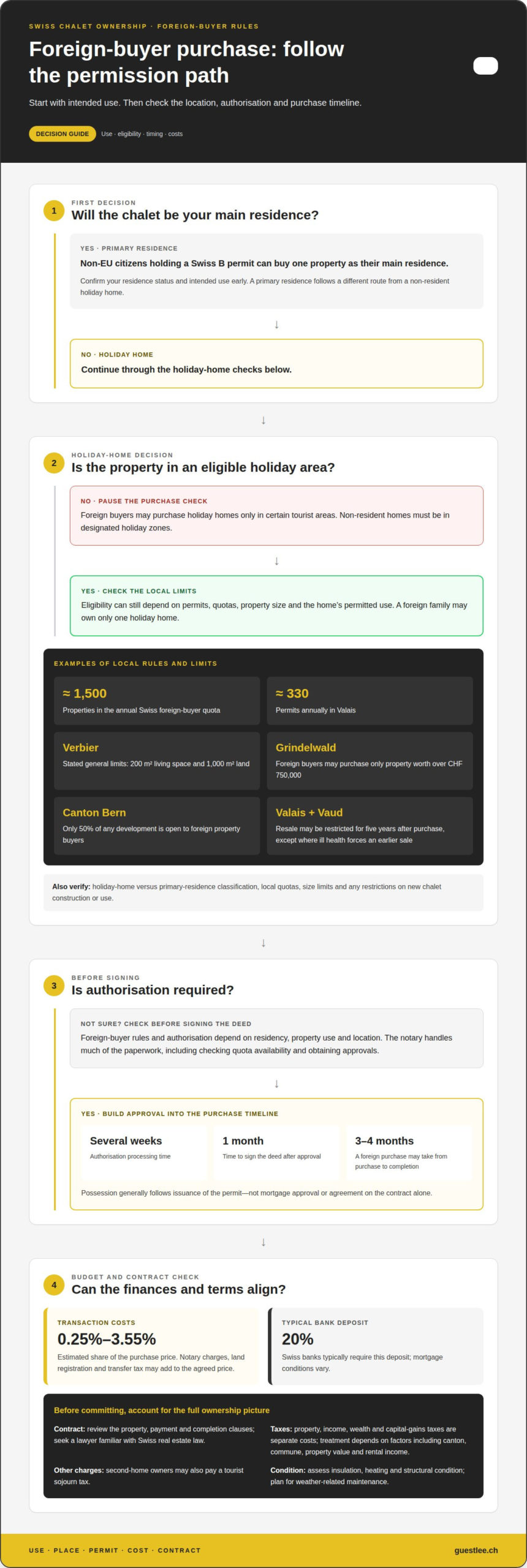
Foreign buyers may purchase holiday homes only in certain tourist areas, subject to permits, quotas and size limits. The annual Swiss quota is approximately 1,500 properties; Valais has around 330 permits annually. In Verbier, the stated general limits are 200 m² of living space and 1,000 m² of land. Non-resident homes must be in designated holiday zones, and a foreign family may own only one. New chalet construction in ski resorts may be subject to restrictions on who can build and how the property is used.
Swiss banks typically require a 20% deposit, while mortgage conditions vary. A foreign purchase may take three to four months from purchase to completion, so financing and permit timing belong in the same plan.
Listings distinguish holiday homes from primary residences by permitted use and location. Confirm a property’s classification before making an offer, as it can affect who may buy it and how it may be used.
Mountain properties need careful assessment of insulation, heating and structural condition. A survey can identify potential issues, while exposure to seasonal weather makes ongoing maintenance planning essential.
Cantonal and commune-level purchase rules
Swiss property transaction costs are estimated at 0.25% to 3.55% of the purchase price. Notary charges, land registration and transfer tax may add to the agreed price. Regional rules also shape a foreign buyer’s options. In Grindelwald, foreign buyers may purchase only property worth over CHF 750,000. In Canton Bern, only 50% of any development is open to foreign property buyers. These examples show why the canton and commune matter alongside the estate itself.
Foreign buyers should check whether authorisation is needed before signing the deed of sale. The notary handles much of the paperwork, including checking quota availability and obtaining approvals. Processing takes several weeks, so include it in the purchase timeline. After approval, the buyer has one month to sign the deed. Possession generally follows issuance of the permit, not mortgage approval or agreement on the contract alone.
Read the purchase contract carefully before signing, especially if language or local terminology could obscure your obligations. A lawyer familiar with Swiss real estate law can review clauses covering the property, payment and completion. The contract is only part of the cost picture: transfer tax, land registration and notary charges vary by transaction and location. Mortgage conditions vary too, so align financing with the purchase timetable.
Ownership brings ongoing obligations, including property-related taxes and insurance. Cantonal and commune-level rules can differ, so location matters beyond the purchase price. In Valais and Vaud, buyers may not resell a purchased property for five years after the purchase date, except where ill health forces an earlier sale. This restriction can affect plans to sell, relocate or change the property’s use.
For a regional comparison, weigh transaction expenses against each area’s eligibility rules. Grindelwald’s minimum property value and Bern’s development restriction illustrate how different the conditions can be. GuestLee’s Swiss real estate sales can help connect a purchase search with the local market.
Legal, tax and inheritance advice for foreign buyers
Foreign buyers should distinguish holiday-home permissions from residence-based ownership before choosing an alpine property. In Switzerland, the applicable route depends on residency, property use and location.
Foreign-Buyer Rules and Authorisation
Lex Koller regulates real estate acquisitions by people residing abroad or without Swiss nationality, a framework Switzerland has had since 1961. Foreign buyers should check which purchase requirements apply to a holiday home in Verbier before proceeding. The notary handles much of the paperwork, including quota checks and approval applications. Buyers generally cannot take possession until the permit is issued.
Authorisation can shape the purchase itself, not just its timing. Swiss authorities may require additional guarantees, such as insurance or a commitment not to rent out the property. A lawyer familiar with Swiss real estate law can review the sale contract and clarify your obligations. If you are not fluent in the relevant language, legal representation can explain the contract before you sign.
Buying a Primary Residence as a Foreigner
Buying a primary residence follows a different path from buying a holiday chalet. Non-EU citizens holding a Swiss B permit can buy one property as their main residence. A home intended for full-time living should not be treated as a non-resident holiday property. Confirm your intended use and residence status early, since both affect the applicable authorisation route.
Tax and inheritance planning are also part of the ownership decision. Account for property taxes, wealth taxes and taxes on potential rental income. Renting a chalet periodically may create income-tax considerations alongside personal use. Discuss inheritance planning with a lawyer familiar with Swiss property and your circumstances, so ownership and succession intentions are considered together.
Before committing, align the permit process, contract review and financing timeline. Lex Koller applications can take several weeks to process before completion. Early legal preparation is particularly useful for Alpine buyers: the permit must precede the deed, and the property’s intended use should match the chosen purchase route.
Reasons to choose Switzerland for a ski chalet
Switzerland appeals through its varied skiing, distinctive mountain villages and transport connections. The right resort is not necessarily the one with the most famous slopes. Look for a place whose landscape, access and year-round character suit how you plan to use the property.
Valais offers markedly different settings within one canton. Grimentz sits at 1,570 metres in Val d’Anniviers, while car-free Saas-Fee is at 1,800 metres. These examples give buyers a sense of how elevation and village layout shape daily life. Compare the resort’s character with the practical needs of reaching the chalet, carrying equipment and enjoying local services.
Ski terrain is another reason Switzerland draws chalet buyers. Its ski areas offer slopes for beginners and expert skiers, making a resort relevant to households with different abilities. Nendaz provides access to over 400 km of ski piste in the 4 Valleys. From Champéry, the Portes du Soleil spans 650 km of piste across Switzerland and France, offering a cross-border holiday setting.
High-altitude locations and modern snowmaking contribute to reliable snow conditions in the Swiss Alps. But a resort’s wider appeal matters too. Consider how the village feels outside peak ski days, and visit at different times of year to understand its surroundings and community. The chalet’s insulation, heating and structural condition also affect comfort in a mountain climate.
Access can be by train, car or plane, depending on the destination. Andermatt, for example, is described as 1.5 hours from Zurich, while Champéry connects buyers to a ski area shared with France. These contrasts make transport part of the location decision, not an afterthought. Compare the resort’s slopes, village setting and journey before narrowing your search. To explore Swiss chalet property options, consider how each location fits your plans for ownership and holiday use.
GuestLee
GuestLee’s real estate sales and property management services can support your property decision. When assessing a chalet purchase, consider how its location and permitted use fit your ownership plans. If you plan to rent out the home, professional management can help with the rental process and occupancy planning while keeping its long-term care in view.
Turn to GuestLee when you’re ready to explore a purchase or consider how a chalet could be managed after acquisition. The right next step depends on your priorities, whether that’s finding a property or planning its future use. Contact GuestLee to discuss your property plans.
Shape Your Next Alpine Chapter
Turn a compelling location into a clear ownership plan. Decide how you want the chalet to fit your life: as a personal retreat, a property for potential rental, or an investment you may eventually transfer. That intention can guide decisions about the setting, ownership structure and long-term care.
A thoughtful guide to buying a chalet in Switzerland is most useful when it leads to decisions tailored to your priorities. GuestLee combines real estate sales, property management services and luxury villa rentals, connecting property decisions with future use and guest experience.
When you’re ready to explore your plans with a knowledgeable property partner, contact GuestLee to discuss your plans. Take the next step at your own pace, with a clearer sense of the Alpine home you want to make your own.
Frequently Asked Questions
Acquisition costs in Switzerland: what should you know?
Budget beyond the agreed price for transaction expenses and the costs of owning the chalet. Swiss purchase transaction costs are estimated at 0.25% to 3.55% of the property cost, with notary charges, land registration and transfer tax among possible items. Estate agency fees are generally paid by the seller unless agreed otherwise. Include insurance and the tourist sojourn tax in your ownership budget.
What Documents Must Be Provided to the Authorities?
The required documents depend on the canton and the purchase application. For a foreign-buyer application in Valais, the canton provides directives and document requirements under the LFAIE, the French abbreviation used for Lex Koller. The notary handles much of the purchase paperwork, including approval applications. Prepare the application around the property, buyer and intended use, following the relevant cantonal requirements.
What is the Lex Koller and Why Does It Exist?
Lex Koller is the Swiss framework regulating real estate acquisitions by people residing abroad or without Swiss nationality. Switzerland has regulated these acquisitions since 1961. For a chalet buyer, it matters because eligibility and authorisation depend on circumstances such as residency, property type and intended use. Treat it as a purchase-eligibility framework, not simply a rule about signing the sale contract.
Who can buy?
Eligibility depends on residency, nationality, property use and location. Non-EU citizens with a Swiss B permit can buy one property as their main residence. Foreign non-residents may buy holiday homes only in certain tourist areas, subject to permits, quotas and size limits. If you are considering a second home, distinguish that route from buying a primary residence before making an offer.
Who is Affected by the Lex Koller?
Lex Koller can affect people residing abroad and people without Swiss nationality who are acquiring Swiss real estate. The outcome depends on the buyer’s situation and the property’s intended use, so nationality alone does not determine every case. A non-resident seeking a holiday chalet, for example, faces a different purchase route from a foreign resident buying a main home.
What are the steps to buying a chalet in Switzerland?
Start by defining the intended use and confirming the property’s eligibility for the buyer. Then arrange financing, review the sale documents, and have the notary handle the purchase paperwork and any required authorisation. Allow time for the permit process before completion. The deed follows approval, and foreign buyers generally take possession only after the permit is issued.

Article by
Giacomo Esposito