

How luxury vacation rental revenue management shapes rates and returns
A full calendar does not always produce the strongest return. Luxury vacation rental revenue management balances nightly rates with seasonal demand, booking channels and occupancy, helping owners assess performance beyond the number of nights booked.
It is understandable to compare short-term rental income with the steadier feel of a long-term lease. But the two approaches generate revenue differently. The right fit depends on how a property can perform as demand, operating costs and owner priorities change.
This article explains how revenue management shapes rates and bookings, why channel mix and occupancy matter, and how to weigh potential returns against a long-term lease in Switzerland. It also outlines how professional property management can support an informed decision, from coordinating rentals to managing a luxury home for guests.
Key Takeaways
- Assess pricing as a response to seasonality and booking pace, rather than relying on one fixed nightly rate.
- Read demand and competition together to understand when a property’s positioning or pricing may need to adapt.
- Consider how booking channels affect visibility, occupancy and the revenue retained from each reservation.
- Compare short-term rental potential with a long-term lease by weighing operating demands and income flexibility alongside expected returns.
1. What is vacation rental revenue management?
Luxury vacation rental revenue management coordinates pricing, availability, and booking decisions to improve a property’s financial performance. Automated pricing can increase annual rental revenue by 10% to 40% compared with static rates, and lift occupancy by up to 30%. These figures describe potential improvements, not a guaranteed result for every Swiss property. An owner’s outcome depends on location, season, property features, and operating costs.
Dynamic pricing adjusts nightly rates as demand changes, but revenue management takes a broader view. It also considers the booking calendar, minimum stays, channel mix, discounts and income after expenses. Review upcoming seasons regularly, then adjust rates and availability as booking pace and local demand shift. Monthly performance reviews can show whether a rate change increased revenue or simply filled more nights.
Swiss taxes, licensing rules and local regulations depend on the property’s canton, commune and intended use. Build the requirements for the property’s address into its operating plan before accepting holiday bookings. They can affect costs and availability, as well as the returns a pricing strategy needs to cover.
Management agreements may be based on a revenue share. The contract should state whether the owner’s percentage is calculated from gross room revenue or net revenue after specified expenses and fees. It should also explain how cleaning charges, cancellations, refunds and owner-approved expenses are treated, so the reported return has a clear basis.
For a luxury home, automated rate optimization works best when it reflects the property’s individual appeal. A lake-view villa with generous entertaining space may attract a different booking pattern from a secluded chalet. A property management team can use these distinctions, seasonal demand and the booking calendar to tailor pricing instead of applying a standard rate. Booking management also helps keep availability aligned with the property’s operating plan.
Finally, a full calendar is not automatically the strongest result. Occupancy of 100% can leave little room for higher-value dates or suitable longer stays. Compare revenue per available night with occupancy and costs; this shows whether pricing is helping the property generate stronger returns, not merely more bookings.
2. Demand, competition, and booking trends
Demand can shift with season, travel patterns, and competing listings, so a rate that suits one period may miss another. Luxury vacation rental bookings grew 119% year over year, a global market signal rather than a forecast for an individual Swiss home. Local positioning still matters: a lakeside villa and an alpine chalet can attract different guests, trip lengths, and booking windows.
Competition involves more than nightly rates. A property’s location, design, amenities, presentation and guest experience all shape how it compares with other options. Strong photography and accurate listing details help guests understand the home before booking. A polished arrival, responsive hosting and consistent care can support positive reviews, improve visibility and encourage repeat bookings.
A distinct identity can help guests remember a property after their stay. Returning guests may already know its setting and amenities, while a clear identity can distinguish it from similar listings. Turnover matters too: coordinated cleaning, inspections and timely maintenance protect the guest experience between reservations. Poorly managed changeovers can undermine reviews, even when demand is strong.
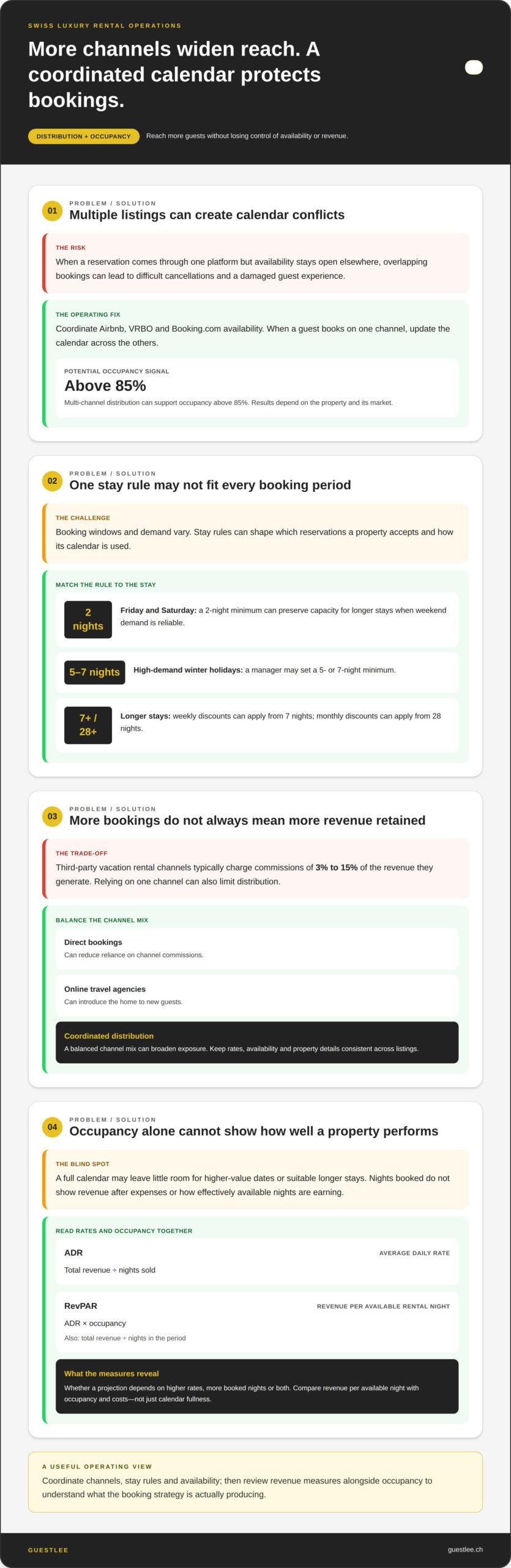
Distribution also shapes net revenue. Third-party vacation rental channels typically charge commissions of 3% to 15% of the revenue they generate. Direct bookings can reduce reliance on those commissions, while online travel agencies can introduce a home to new guests. A balanced channel mix can broaden exposure without placing every booking in one marketplace. Marketing should present consistent rates, availability, and property details across listings.
Revenue risks include changing demand, reliance on one booking channel, cancellations and service issues that affect reviews. A management plan can help limit exposure through diversified distribution, clear booking terms, responsive guest care and pricing adjustments as demand shifts.
For owners considering professional oversight, Swiss luxury property management can connect booking distribution with the home’s guest experience and operating needs.
3. Multi-channel distribution and occupancy
Listing a Swiss holiday home across Airbnb, VRBO, and Booking.com can widen its reach. Multi-channel distribution across these platforms can support occupancy above 85%, though results depend on the property and its market. A coordinated calendar is essential: when a guest books on one channel, availability should update across the others. Otherwise, overlapping reservations can create difficult cancellations and damage the guest experience.
Minimum-stay rules help shape which bookings a property accepts. In a market with reliable weekend demand, a 2-night minimum on Friday and Saturday can preserve capacity for longer stays. A manager may set a 5- or 7-night minimum during a high-demand winter holiday period. Weekly discounts can apply to stays of 7 nights or longer, while monthly discounts can apply from 28 nights.
Revenue projections are more useful when they connect rates, nights sold and available nights. Average daily rate, or ADR, is total revenue divided by nights sold. Revenue per available rental night, or RevPAR, is ADR multiplied by occupancy, or total revenue divided by nights in the period. These measures show whether a forecast depends on higher rates, more booked nights or both.
For example, a projection for an alpine chalet should account for its winter calendar, expected booking pace and planned maintenance closures. Instead of assuming every available night will sell, a manager can model different demand patterns and adjust rates as reservations come in. This gives a more useful view of occupancy than a single annual target.
Balance matters. Lower rates may attract more guests, but they can reduce revenue per available night if demand was already strong. Higher rates can protect value, yet leave more dates unsold when comparable homes offer compelling amenities. Hotels may compete for some of the same travellers, so a rental’s space, privacy and local character should inform its distribution strategy. Clear communication across channels keeps rates, stay rules and availability aligned.
4. Luxury rentals versus long-term leases
A long-term lease offers a more predictable income pattern, while holiday rentals tie earnings to bookings and seasonal demand. Luxury vacation homes can reach net margins of 45% in peak seasons, but that figure describes peak performance, not a full-year return. A Swiss alpine chalet, for example, may have a different booking rhythm from a lakeside villa. The relevant comparison is annual net income, not one strong season.
Fixed rent trades some earning potential for steadier payments. Fixed-rent agreements are mostly available for select luxury properties with strong historical performance. The comparison in the market facts estimates that fixed rent typically pays 25% less than market potential. That difference represents a possible trade-off, not a guaranteed gap for every home or agreement.
Revenue share links an owner’s income more closely to actual bookings. Luxury vacation homes with 3+ bedrooms are identified as better suited to revenue share, since larger homes can serve groups seeking space and shared amenities. However, a larger property also needs a suitable operating plan. Seasonal availability, owner use, maintenance, and booking expenses all influence the amount retained.
Choose an approach that matches the property’s strengths with your priorities. Fixed rent may suit an owner who values predictable income over variable upside. A revenue share may suit an owner comfortable with seasonal variation and a home positioned to attract bookings. Compare projected annual net returns after operating expenses, rather than comparing peak-season revenue with a full-year lease. The property’s location, condition, guest appeal and booking history all inform that assessment.
Consider personal use, too. Owner stays can reduce nights available for guests, while a lease may limit flexibility during the agreement. A clear comparison should account for these calendar choices, the ability to manage changing demand, and the time required to maintain a competitive guest experience. For a tailored view of Swiss luxury villa opportunities, explore the available property options.
GuestLee: Luxury Villa Rentals
GuestLee helps property owners align a home’s rental strategy with the practical work of welcoming guests. Its Property Management Services support the rental process from property setup through guest departure, coordinating pricing, bookings and presentation.
This can be a natural next step when you are weighing seasonal rental income against a long-term lease, or when managing bookings and guest arrangements has become a significant responsibility. GuestLee also offers Luxury Villa Rentals and Real Estate Sales, supporting owners and travellers at different stages of their property journey.
For owners, the right approach begins with the property’s position, availability, and goals. Contact GuestLee to discuss your property and its rental management needs.
Choose the role your property should play
Start by defining what you want the property to make possible. Is your priority dependable income, flexibility for personal use or an actively managed hospitality asset? Your answer gives luxury vacation rental revenue management a clear purpose and helps align the operating approach with your longer-term plans.
Consider how involved you want to be in guest stays, property decisions and the rhythm of seasonal letting. A thoughtful conversation can clarify your preferences and help you decide whether a professionally managed rental fits your plans. The aim is not simply to keep a home occupied, but to choose how it serves you over time.
Contact GuestLee about your rental to discuss the next step for your property. A clear direction can turn a promising possibility into a confident plan.
Frequently Asked Questions
What is vacation rental revenue management?
It is the coordinated planning of a holiday property’s availability, rates and bookings to support its financial performance. For example, a manager may assess whether to keep an open date available for a longer reservation or offer it for a shorter stay. The aim is to align booking decisions with the property’s calendar, operating needs and owner priorities.
What is revenue management for luxury vacation rentals?
For a high-end home, revenue management considers how the property’s distinctive features influence guest interest and booking value. Luxury vacation rental revenue management may account for privacy, design, service expectations, and the home’s ideal guest profile, alongside rates and availability. A private chalet suited to family gatherings, for instance, may need a different booking approach from a compact city apartment.
What are typical occupancy rates and average daily rates for luxury rentals in Switzerland?
No single occupancy rate or average daily rate represents every Swiss luxury rental. Results depend on the property, its location and amenities, the booking period, and how long the home is open to guests. For a meaningful comparison, assess the same calendar period across similar properties, distinguishing booked nights from owner stays and maintenance closures.
How do luxury vacation rental prices vary by season and region in Switzerland?
Rates can vary with the purpose of travel and the property’s setting. An alpine home may attract interest around winter activities, while a lakeside property may appeal to guests seeking warm-weather stays. Local events, access, views and the home’s features also shape its position. A pricing plan should reflect these patterns rather than apply one rate all year.
Which factors most affect luxury vacation rental revenue and demand?
Guest capacity, condition, privacy, design and access all influence how a luxury property is positioned. Owner-blocked dates, maintenance periods and the ability to present the home clearly to its intended guests matter too. A property with generous shared spaces, for example, may suit group travel, while a secluded home may appeal to guests seeking quiet. These differences shape demand and operating plans.
How do professionals set minimum stays and adjust nightly rates for luxury vacation rentals?
Property managers consider booking patterns, calendar gaps, cleaning logistics and the stay lengths that best suit each home. A short gap between reservations may not work for a property that needs extensive preparation, while a longer open period may suit a flexible stay rule. Rates can then respond to booking pace and local demand, while availability stays consistent across booking channels.

Article by
Giacomo Esposito