How to Buy a Chalet in the Swiss Alps: The 2026 Investor’s Guide
With only 1,500 permits issued annually for foreign buyers across the entire Confederation, acquiring a piece of the Swiss Alps is as much a feat of regulatory precision as it is a financial triumph. You likely recognize that a chalet in a premier destination like St. Moritz or Verbier is more than a home; it’s a sophisticated legacy asset that demands meticulous custodianship. However, the path to ownership often feels obscured by the intricacies of Lex Koller and the strict 20% cap on second homes in many municipalities. This swiss chalet investment guide is designed to illuminate that path, offering the expert insights needed to navigate Switzerland’s unique legal landscape with absolute confidence.
We understand that managing a high-value property from afar requires a partner who values excellence as much as you do. You will learn how to secure a prestigious residence while optimizing rental yields through professional management in a market where luxury prices have climbed 40% over the last five years. From understanding the 8.1% standard VAT rate to evaluating current mortgage trends, this guide previews the essential steps to ensuring your investment remains a source of both financial security and personal joy.
Key Takeaways
- Understand the enduring strength of the Swiss Franc (CHF) as a primary driver for alpine property as a premier safe-haven asset in 2026.
- Master the nuances of Lex Koller and Lex Weber to navigate foreign ownership restrictions and the 20% second-home cap with absolute precision.
- Review the 2026 mortgage landscape and the essential checklist of Swiss acquisition costs, including notary fees and cantonal transfer taxes.
- Apply this swiss chalet investment guide to select locations that offer both altitude reliability and the specific amenities required for high-end rental success.
- Discover how professional property management serves as the essential partner in preserving asset value while transitioning your home into a seamless luxury hospitality experience.
The Landscape of Swiss Alpine Real Estate in 2026
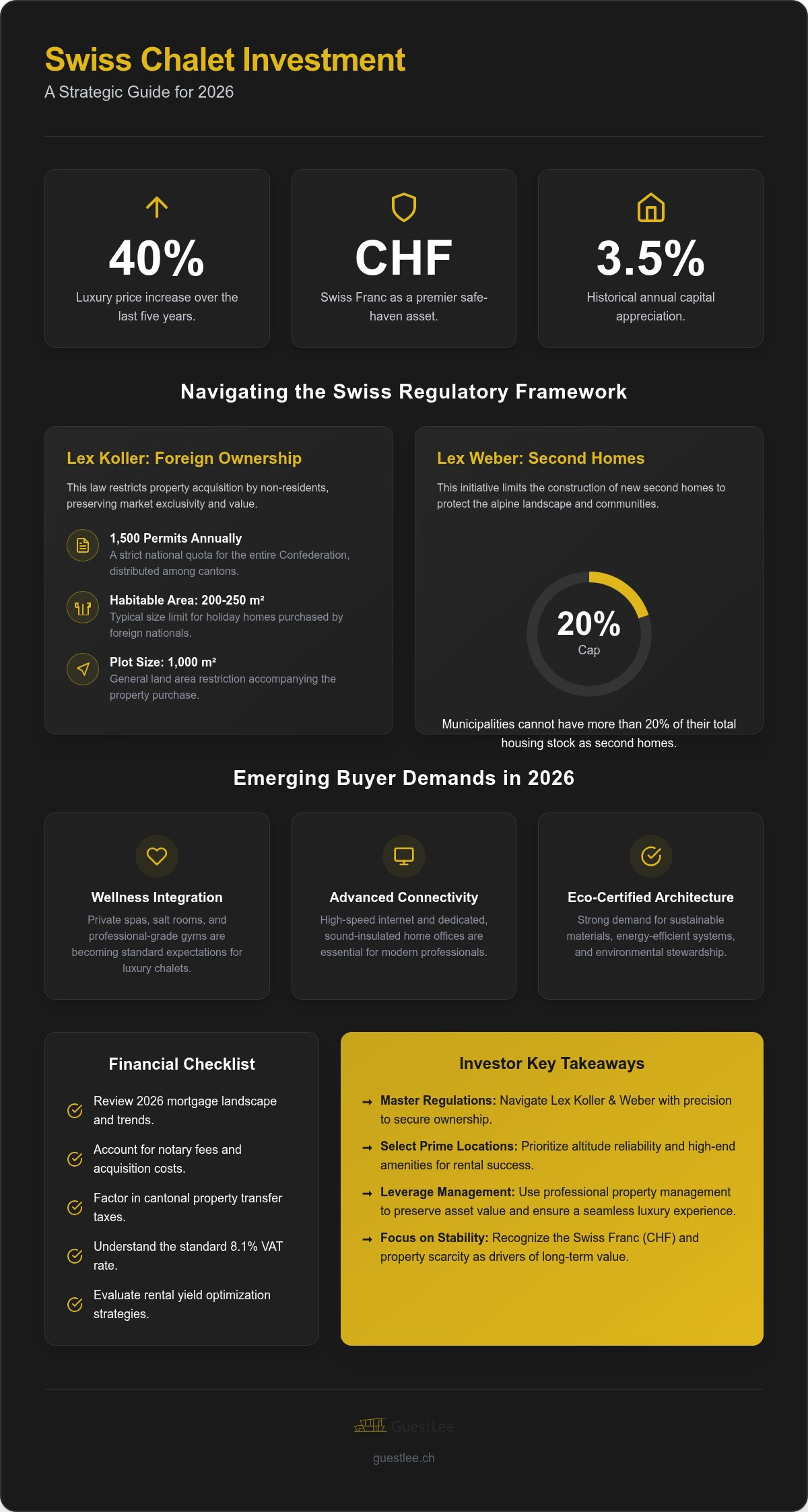
The Swiss alpine market has long been a bastion of stability, but in 2026, its role as a “safe haven” for global wealth has reached a new pinnacle. This swiss chalet investment guide observes that luxury property prices in high-altitude regions have climbed by 40% over the last five years. Such growth isn’t accidental. It’s the result of a deliberate national commitment to privacy, security, and financial integrity that few other jurisdictions can replicate. For the discerning investor, these mountains offer more than a retreat; they provide a fortress for capital in an unpredictable global economy.
The resilience of the Swiss Franc (CHF) remains a cornerstone of this appeal. In a year where other currencies have faced significant volatility, the CHF provides a reassuring anchor for international portfolios. Because the topography of the Alps limits available building land, every existing chalet gains value through natural scarcity. Purchasing a property here is a multi-generational legacy decision. It’s an intentional move toward long-term stability rather than a speculative short-term flip. You’re buying into a tradition of excellence that values permanence over the ephemeral.
To better understand the regulatory environment surrounding these prestigious acquisitions, watch this helpful video:
Why Investors Prioritize the Swiss Alps
Investors are drawn to the unmatched national standards of infrastructure that ensure these resorts remain accessible and pristine. Beyond the winter season, Swiss destinations have successfully transitioned into year-round hubs. Summer hiking, golf, and cultural festivals now support high occupancy rates during the warmer months. This “dual-season” appeal contributes to a historical capital appreciation of 3.5% annually. While Lex Koller regulations provide a framework for foreign acquisition, the reward is an asset in a market where exclusive segments have reached CHF 45,000 per square meter. Partnering with a specialist like GuestLee ensures that your property is managed with the same precision that defines the Swiss financial sector.
Emerging Trends: What Discerning Buyers Seek in 2026
The definition of luxury has evolved toward holistic well-being and functional elegance. Discerning buyers now prioritize “wellness-integrated” chalets that feature private spas, salt rooms, and professional-grade gyms. High-speed connectivity is no longer optional. Dedicated, sound-insulated home office spaces are essential for the modern global professional who manages their interests from the mountains. Additionally, there’s a significant shift toward eco-certified architecture. Sustainable materials and energy-efficient systems are now standard requirements for those looking to align their property portfolios with environmental stewardship. These trends reflect a buyer who values both the heritage of the Alps and the technological advancements of the future.
Navigating the Swiss Regulatory Framework: Lex Koller and Lex Weber
Success in the Swiss market requires an intimate knowledge of the regulatory environment. For the international investor, two primary pieces of legislation dictate the possibilities of ownership: Lex Koller and Lex Weber. While these laws might seem restrictive, they are the very mechanisms that preserve the exclusivity and value of your asset. By limiting supply and regulating demand, Switzerland ensures that its alpine real estate remains a stable, high-value investment rather than a volatile commodity. This swiss chalet investment guide serves to demystify these rules so you can move forward with absolute clarity.
Lex Koller focuses on the identity of the buyer. As of July 2026, the federal government maintains a strict quota of 1,500 permits for the entire country, which are then distributed among the cantons. These permits allow non-residents to purchase holiday homes, typically limited to a habitable area of 200m² to 250m² and a plot size of 1,000m². It’s also vital to monitor the current consultation period ending mid-July 2026. The Federal Council has proposed tightening rules that could remove exemptions for commercial properties as pure capital investments. This represents a critical pivot point for those looking to diversify their Swiss holdings beyond traditional residential chalets.
Foreign Ownership: Permits and Authorizations
A buyer’s residency status is the most significant factor in the acquisition process. For instance, holders of a B or C settlement permit often enjoy rights similar to Swiss citizens, allowing them to bypass many Lex Koller restrictions when purchasing a primary residence. Non-residents, however, must secure specific cantonal authorization. Utilizing luxury real estate Switzerland expertise is the most effective way to navigate these administrative layers. While official Swiss rules for foreign property buyers provide the baseline, local cantonal nuances often determine the final outcome of a permit application.
The Impact of the Second Home Act (Lex Weber)
Lex Weber, or the Second Home Act, governs the property itself rather than the buyer. It restricts second-home construction to 20% of the total housing stock in any given municipality. With 331 municipalities already over this threshold in 2026, the supply of new-build chalets is effectively capped in the most desirable resorts. This creates a “closed loop” market where existing chalets with “secondary residence” status carry a significant premium. They represent a finite resource in a high-demand market, ensuring long-term supply constraints that drive capital growth. Verifying a property’s legal status before signing a deed is non-negotiable to ensure the residence can be legally rented or used as a holiday home. If you’re seeking a seamless acquisition experience, ensuring every regulatory detail is vetted by professionals is the only way to protect your legacy investment.
The Financial Architecture of Alpine Investment
Understanding the fiscal framework of a mountain acquisition is as vital as selecting the right peak. A swiss chalet investment guide must address the precise costs that accompany these high-value assets. While the emotional draw of a mountain retreat is undeniable, the financial architecture behind it requires a steady, analytical hand. In 2026, Switzerland continues to offer a stable environment, yet the entry costs and tax nuances vary significantly between cantons. Success depends on aligning your capital with these regional specificities.
Financing remains attractive for international investors, even as mortgage reference rates have seen a slight upward trend in July 2026. Ten-year fixed rates currently hover between 1.37% and 1.96%, while five-year options sit lower at 1.16% to 1.71%. For those preferring flexibility, SARON-based variable rates remain competitive around 0.66% to 0.76%. These rates allow investors to leverage their positions while maintaining the security of the Swiss Franc (CHF), providing a hedge against global currency fluctuations.
One unique aspect of Swiss homeownership is the “Eigenmietwert”, or imputed rental value. This is a taxable income figure based on what the property could theoretically earn if it were rented out. Although a 2025 vote approved the abolition of this tax, the change is not expected to take effect until 2029 at the earliest. Owners must factor this into their annual tax declarations, though it’s often balanced by the ability to deduct mortgage interest and property maintenance costs from your taxable income.
Acquisition Costs and Ongoing Tax Obligations
Closing costs typically range from 2.5% to 5% of the purchase price. This total includes the cantonal property transfer tax, which varies from 0% in Zurich to over 3% in cantons like Vaud. The Swiss notary plays a pivotal role here. Unlike in other jurisdictions, the notary is a neutral public official who acts for both parties to ensure the transaction meets every national standard of accuracy. Beyond the initial purchase, you should also anticipate annual wealth taxes, which are calculated based on the net value of your Swiss assets and vary by municipality.
- Notary Fees: Typically 0.1% to 1% of the property value.
- Land Registry Fees: Usually around 0.1% to 0.5%.
- Property Transfer Tax: Cantonal rates range from 0% to 3.3%.
- Value Added Tax: A standard rate of 8.1% applies to many services, while lodging services enjoy a reduced rate of 3.8%.
Projecting ROI: Rental Income vs. Capital Growth
In premier resorts like Verbier or Zermatt, net rental yields for luxury chalets typically range from 2% to 4%. While these figures might seem modest compared to more volatile assets, they are bolstered by a historical capital appreciation of 3.5% annually. High-end short-term rentals are the most effective way to offset maintenance and ongoing tax obligations. By positioning your property within the Luxury Villa Rentals in Switzerland market, you transform a silent asset into a performing one. This dual focus on yield and growth ensures your chalet serves both your personal lifestyle and your long-term financial legacy.
Selection Criteria for Premier Alpine Properties
Choosing the right chalet requires a shift in perspective. You aren’t just buying a view; you’re acquiring a managed environment that must satisfy both your personal standards and the rigorous expectations of the high-end rental market. This swiss chalet investment guide prioritizes assets that offer “altitude reliability.” With prices in exclusive segments reaching CHF 45,000 per square meter, the geographical resilience of your property is its ultimate insurance policy. High-altitude resorts such as Zermatt, where prices average CHF 21,000 per square meter, or St. Moritz at CHF 24,000, ensure your investment remains a premier destination regardless of seasonal fluctuations.
Step 1 involves evaluating accessibility. A property located within 90 minutes of an international airport, such as Geneva or Zurich, holds a significant liquidity advantage. Step 2 focuses on “Rental Readiness.” A floor plan that lacks flow or privacy will struggle to achieve the competitive net yields seen in high-demand resorts like Verbier. Step 3 demands a technical audit. In 2026, smart home technology and high-efficiency heating systems are expected by guests and owners alike to manage costs and environmental impact effectively. Finally, Step 4 assesses the potential for concierge-style upgrades, such as dedicated ski rooms or wellness suites, which elevate a standard home into a world-class residence.
The Anatomy of a High-Performing Asset
A luxury asset must be designed for seamless hospitality. En-suite bathrooms for every bedroom are now a baseline requirement for the discerning traveler. Professional-grade kitchens are equally vital, as they allow for the seamless integration of private chefs and high-end catering services. We also recommend prioritizing “owner storage” zones. These secure, private areas allow you to keep personal items on-site while the rest of the home remains a pristine “guest zone.” This distinction is what allows a property to transition from a private sanctuary to a luxury host environment without friction.
Micro-Location and Accessibility Standards
The value of a chalet is often determined by the final kilometer of the journey. While proximity to the ski lift is a classic metric, the 2026 buyer looks for year-round desirability. Properties with south-facing exposure and protected views command the highest premiums, as they offer the sun-drenched terraces that define the summer alpine experience. Noise levels and privacy from neighboring plots are equally critical for long-term asset preservation. To ensure your selection meets these exacting national standards of excellence, consider our property management services to evaluate a site’s operational potential before you commit to the purchase.
Integrating Management for Long-Term Asset Preservation
The transition from the complex acquisition process to the reality of daily ownership requires a strategic shift in mindset. While the previous sections of this swiss chalet investment guide focused on securing the asset, its long-term success depends on professional management acting as your silent partner. In a market where luxury standards are non-negotiable, proactive care is the only way to ensure the high-altitude resilience and wellness features you’ve prioritized don’t degrade over time. Meticulous custodianship preserves the structural integrity of the home while maintaining its status as a premier destination.
Moving from a property owner to a luxury host involves an operational precision that few individuals can manage effectively from abroad. It requires viewing the chalet as a performing asset that demands the same attention to detail as a private boutique hotel. When every guest interaction and technical repair is handled with regional standards of excellence, the property’s reputation grows. This directly impacts its future market value. This seamless approach allows you to enjoy the rewards of ownership without the logistical burdens that often accompany high-value real estate.
GuestLee: Your Guardian in the Swiss Alps
GuestLee provides the essential link between a physical property and a high-performing hospitality asset. We specialize in real estate asset optimization through bespoke property management services Switzerland. Our concierge approach handles everything from guest screening to the technical upkeep of sophisticated smart home systems. By maintaining elite hospitality standards, we ensure your residence attracts the global travelers necessary to achieve competitive yields. We don’t just oversee properties; we curate them to meet the exacting expectations of the world’s most discerning guests.
Peace of Mind for International Owners
Managing a Swiss household from a distance involves navigating strict national employment laws for domestic staff. Whether you require private chefs or seasonal housekeepers, we oversee the social security contributions and legal contracts required by the Confederation. We provide full financial transparency through regular audits and performance reporting in CHF. This level of meticulous care protects your legacy and ensures your peace of mind is absolute. Secure your Swiss legacy with GuestLee’s expert management and experience a truly effortless ownership journey.
Securing Your Alpine Legacy in 2026 and Beyond
The journey to acquiring a prestigious Swiss residence is defined by a commitment to quality and a respect for national standards of excellence. Success in this market isn’t merely about the initial purchase; it rests on your ability to navigate regulatory hurdles like Lex Koller and Lex Weber with absolute precision. By selecting high-altitude locations and prioritizing “rental readiness,” you transform a beautiful retreat into a resilient financial asset. This swiss chalet investment guide has provided the framework for that transformation, highlighting why meticulous planning is the prerequisite for long-term growth.
Our role at GuestLee is to serve as the trustworthy guardian of your property value. We provide comprehensive national property management and bespoke concierge services that reflect the highest Swiss standards of accuracy and hospitality. We handle the complexities of regional regulations and guest experiences so you don’t have to. We invite you to take the next step toward a seamless ownership experience. Explore Bespoke Swiss Real Estate & Management with GuestLee. Your future in the Alps is waiting to be curated with the care it deserves.
Frequently Asked Questions
Can a foreign national buy a chalet in Switzerland without a residency permit?
Yes, foreign nationals can purchase a holiday home without a residency permit, provided they secure a cantonal authorization under the Lex Koller quota system. This system allocates 1,500 permits annually across Switzerland for non-resident buyers. While these permits are limited to specific tourist zones and have restrictions on habitable area, they provide a clear legal pathway to ownership. It’s essential to verify permit availability in your chosen municipality before starting the acquisition process.
What is the Lex Koller and how does it affect property buyers in 2026?
Lex Koller is the federal legislation that regulates the acquisition of Swiss real estate by persons abroad to prevent excessive foreign ownership. In 2026, it remains a primary consideration for any swiss chalet investment guide, especially with proposed changes currently under consultation. These proposals may tighten rules for non-EU/EFTA nationals and remove exemptions for certain commercial investments. Monitoring the consultation period ending July 15, 2026, is vital for understanding future permit eligibility and investment scope.
Are there restrictions on how many days I can rent out my Swiss chalet?
There are generally no federal limits on the number of days you can rent out your chalet, though municipal regulations and tax requirements vary. Most owners utilize their properties for short-term luxury rentals to offset costs, with services related to lodging subject to a special VAT rate of 3.8%. Professional management ensures your rental activity complies with local tourism laws and guest reporting. This approach allows you to maximize yields, which currently range from 2% to 4% in prime resorts.
What are the typical maintenance costs for a luxury chalet in the Alps?
Annual maintenance costs encompass property taxes, insurance, utilities, and routine upkeep required to meet national standards of excellence. Owners must also factor in the “Eigenmietwert,” or imputed rental value tax, which remains in effect until at least 2029. While specific costs depend on the property’s age and amenities, proactive technical inspections are the most effective way to prevent major repairs. Budgeting for professional oversight ensures that your asset remains in peak condition for both personal use and rental guests.
Is buying a chalet in the Swiss Alps a good investment in 2026?
Buying a Swiss chalet remains a premier safe-haven investment in 2026, supported by a historical capital appreciation of 3.5% annually. The market’s resilience is driven by the stability of the Swiss Franc (CHF) and the natural scarcity of building land in the Alps. With luxury prices in exclusive segments reaching CHF 45,000 per square meter, these properties serve as sophisticated legacy assets. They offer a unique combination of financial security and an unmatched lifestyle that few other global markets can replicate.
How does the Lex Weber affect the resale value of my property?
Lex Weber enhances the resale value of existing chalets by capping new second-home construction at 20% in any given municipality. With 331 municipalities currently over this threshold, properties with “secondary residence” status belong to a finite and shrinking supply. This artificial cap on new builds creates a “closed loop” market that protects your investment from oversupply. Consequently, existing chalets often command a significant premium because they represent the only way for many buyers to secure a holiday home in top-tier resorts.
Do I need a local property manager if I only visit my chalet twice a year?
Engaging a local property manager is highly recommended for non-resident owners to ensure the property is maintained to the highest standards during their absence. A manager handles everything from snow clearing and technical repairs to navigating complex Swiss employment laws for household staff. This “silent partner” approach protects your asset from deterioration and ensures the home is perfectly prepared for your arrival. It transitions the burden of logistical complexity to a professional, allowing you to focus on enjoying your alpine retreat.
What is the difference between a primary and secondary residence in Switzerland?
A primary residence is the legal and tax domicile where an individual lives for the majority of the year, while a secondary residence is a holiday home. This distinction is a vital component of any swiss chalet investment guide because Lex Weber only restricts the construction of new secondary residences. Buyers with B or C permits can often purchase a primary residence without the strictest Lex Koller limitations. Understanding which category your purchase falls into is essential for determining your legal rights and future resale potential.

Article by
Giacomo Esposito