How to Manage a Swiss Property from Abroad and Keep It as a Second Home
Keeping a Swiss property as a second home is possible for some foreign owners, but it isn’t automatic. Managing a Swiss property from abroad usually means first securing any required purchase authorisation: non-residents can generally buy a second home only in a designated tourist commune, subject to an annual quota of 1,500 properties and a living-area limit of 200 m². A second home may not be rented out, while a qualifying holiday home may be rented temporarily.
The appeal is clear: a place to return to, with the option of letting a holiday home while you’re away. The rules depend on your residence status, the property’s location and how you plan to use it. This guide explains the difference between a second home and a holiday home, how rental income and Swiss tax progression can affect your finances, and what to plan for when managing a Swiss property from abroad.
Key Takeaways
- Start by identifying your residence status and the property’s location, since both shape whether purchase authorisation is required.
- Distinguish a second home from a holiday home before planning rentals; the permitted use can affect how you may let the property.
- Factor foreign rental income and property value into your Swiss tax planning, as they can affect the rates applied through tax progression.
- Map out local tax obligations, maintenance and rental operations so the property can be managed smoothly while you’re abroad.
- Choose a remote-management approach that fits your intended use, from overseeing the home yourself to arranging professional property management.
Swiss tax progression on foreign property and rental income
- Separate Swiss tax residence from property ownership before calculating your tax exposure. Swiss tax residents generally declare worldwide income and wealth, including foreign property and rental income. Someone living abroad who owns Swiss property is personally liable for income and wealth taxes connected with that property. This distinction matters when managing a Swiss property from abroad, because residence status affects which income is included in the Swiss tax calculation.
- Apply the location rule to foreign rental income. Rental income from a foreign property owned by a Swiss resident is taxed where the property is located, but it can still affect the rate applied in Switzerland through progression. In practice, the foreign income can raise the rate applied to taxable Swiss income without being taxed again as Swiss-source rent. Review the tax treatment in both jurisdictions before forecasting the net return on an overseas investment.
- Use the progression calculation, not just the Swiss income figure. For example, a Swiss tax calculation with 120,000 Swiss francs of income and 50,000 Swiss francs of rental income from a Brittany property uses 170,000 Swiss francs to determine the rate. The foreign rent remains taxable where the property is located, while the higher calculated rate may apply to Swiss-taxable income. Treat this as a rate-setting example, not a tax bill.
- Include taxable property value when assessing wealth-tax progression. In the same example, 600,000 Swiss francs of assets plus a Brittany property valued at 400,000 Swiss francs gives a progression basis of 1,000,000 Swiss francs. The foreign property itself is not taxed by Swiss federal, cantonal or municipal authorities, but its taxable value can affect the rate applied to wealth taxable in Switzerland. Keep income and wealth calculations distinct.
- Account for losses and local variation before estimating the outcome. If costs exceed foreign rental income, some Swiss cantons allow the loss to reduce income; in most cantons, it affects only the tax rate. Keep records of rent, expenses and taxable property value, then classify each item by tax jurisdiction. The applicable canton’s treatment matters, so don’t assume one canton’s approach applies nationwide.
- Check purchase eligibility separately from tax progression. Switzerland’s foreign-buyer restrictions are governed by Lex Koller, cited as the Federal Act on the Acquisition of Immovable Property in Switzerland by Foreign Non-Residents, CC 211.412.41. EU/EFTA nationals living in Switzerland have the same purchase rights as Swiss citizens; C-permit holders are treated likewise. Other foreign nationals living abroad generally need authorisation, with the competent authority in the property’s canton handling applications. Buying property does not grant a residence permit.
Can I keep the property as a second home for myself?
Yes, some foreign nationals living abroad can keep a qualifying Swiss property as a second home, subject to authorisation and location rules. The decisive details include your ties to the area, the property’s category, the canton’s quota and the commune’s restrictions.
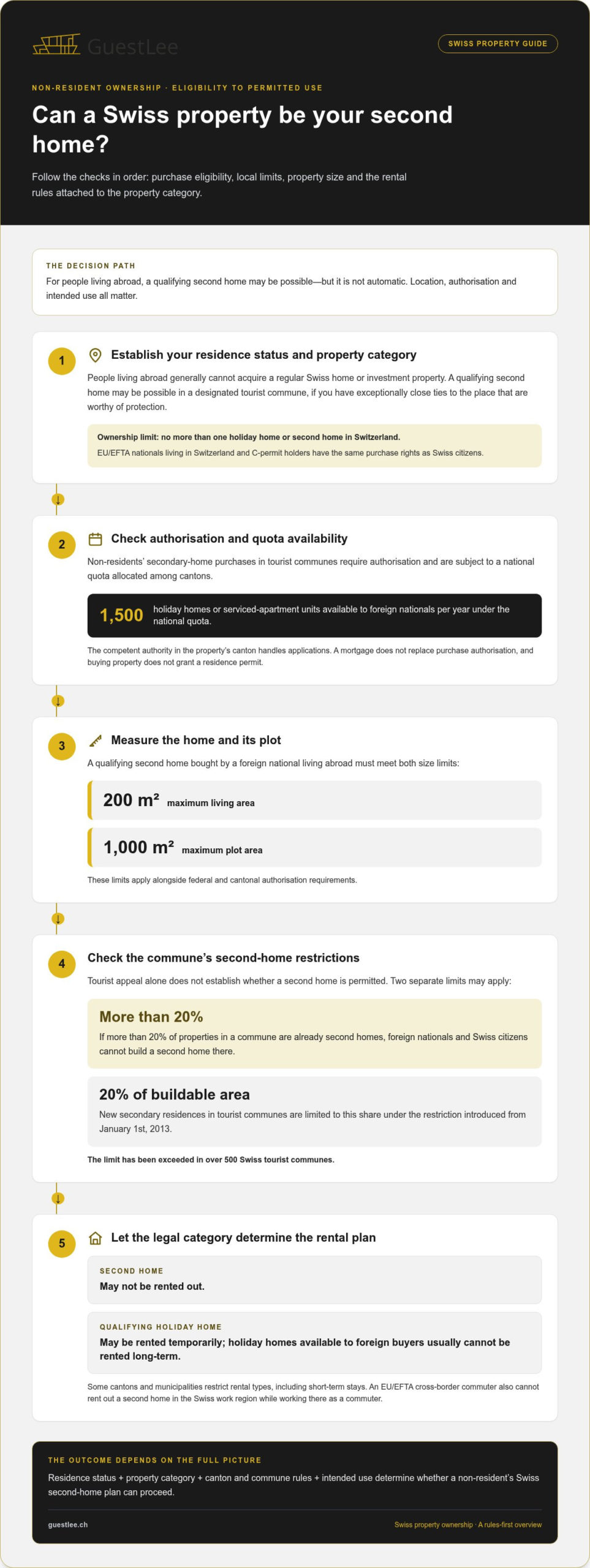
- Confirm which category applies before buying. Under Lex Koller, people living abroad generally cannot acquire a regular Swiss home or investment property; a qualifying second home may be possible in a designated tourist commune. You must have exceptionally close ties to the place that are worthy of protection, and may own no more than one holiday home or second home in Switzerland. A mortgage does not replace purchase authorisation.
- Establish whether the canton has quota capacity. The national quota for holiday homes or serviced-apartment units sold to foreign nationals is 1,500 properties per year currently, allocated among cantons. Non-residents’ secondary-home purchases in tourist communes are subject to authorisation and this quota. Ask the competent authority in the canton where the apartment is located about the application process before committing to an acquisition.
- Check the property’s permitted size and land area. A qualifying second home bought by a foreign national living abroad must have living area at or below 200 m², and the plot is limited to 1000 m². These limits apply alongside the federal and cantonal authorisation requirements. Confirm that the specific property fits both measurements before treating it as a viable personal retreat.
- Review the commune’s second-home status, not only its tourist appeal. Foreign nationals and Swiss citizens cannot build a second home in a commune where more than 20% of properties are already second homes. Separately, new secondary residences in tourist communes are limited to 20% of buildable area under the restriction introduced from January 1st, 2013. The limit has been exceeded in over 500 Swiss tourist communes.
- Decide whether personal use or rental income is your priority. A second home may not be rented out. A holiday home bought by a foreign national living abroad may be rented only temporarily, and holiday homes available to foreign buyers usually cannot be rented long-term. The legal category therefore determines whether occasional letting fits your ownership plan.
- Assess local rental rules before advertising stays. Swiss property owners may rent out property, but some cantons and municipalities restrict certain rental types, including short-term stays. Rules differ by location and property use, so factor local limits into your holiday-home rental plan. An EU/EFTA cross-border commuter also cannot rent out a second home in the Swiss work region while working there as a commuter.
Property ownership support throughout the ownership lifecycle
Plan ownership in sequence: establish eligibility, appoint local representation, then set management and reporting standards. Each step should reflect the property’s canton, municipality and intended use.
-
Clarify ownership eligibility and structure
Start by matching the purchaser’s nationality and residence status to the intended residential use. Under Lex Koller, C-permit holders and EU/EFTA nationals living in Switzerland generally have purchase rights comparable to Swiss citizens; other cases depend on the applicable authorisation rules. Before signing a contract, identify the legal purchaser and beneficial owner, especially if a company or transfer is involved. Don’t assume a company structure removes restrictions on foreign acquisitions.
-
Arrange local representation
Prepare a written mandate naming the representative, permitted tasks and limits on decision-making. Specify how they may communicate with local authorities, coordinate maintenance, receive documents and approve routine expenses. If signing or transaction authority is needed, define it separately and have the wording reviewed for its intended use. A clear record of permissions helps prevent confusion when managing property from abroad.
-
Compare property management options
Compare managers by service scope, reporting, communication and how they document maintenance, tenant relations and rental income. Swiss firms may handle tenant searches, rent collection, upkeep, maintenance and, in some cases, periodic renovations. Local rules differ: cantons and municipalities can restrict rental types, including short-term stays. Ask prospective managers to explain how their process accounts for the property’s location and intended use.
For remote oversight, agree on regular financial statements, maintenance updates and records of occupancy and rental activity. Set clear responsibilities for decisions that require your approval.
-
Review management services and fees
Request an itemised agreement before appointing a manager. Swiss property-management fees are commonly calculated as a share of rental income. Services may include tenant searches, rent collection, property upkeep, maintenance and tenant relations. The agreement should distinguish included duties from work requiring separate approval, such as renovations. Compare the scope and reporting, not just the headline fee.
Set out in the mandate who handles tenant screening, leases, deposits and rent collection. Managers may search for tenants, maintain tenant relations and collect rent; require clear records of applications, agreements, deposit handling and payments.
Budget for ownership costs beyond management. Recurring expenses can include annual cantonal and municipal property taxes, building insurance and maintenance. Tax treatment depends on the property’s location and use, so organise ownership, rental and expense records for reporting.
Swiss property and rental-income taxation
Separate the property’s tax treatment from your personal tax residence. If you live abroad, a Swiss home can still create Swiss tax obligations based on its location and use.
- Identify the taxable income linked to the home. Swiss income tax applies to imputed rental value when you occupy the property yourself, or to rental income when it is let. Keep records distinguishing personal use from rental periods, along with rent received and property expenses. The relevant treatment depends on whether you occupy the home or earn rental income from it.
- File according to the Swiss property’s location and your residence status. The tax treatment of a Swiss home can depend on where it is located and the owner’s residence status. If you live abroad and own Swiss property, you need to submit a Swiss tax return. Keep cantonal and municipal assessments with your return documents.
- Track mortgage debt and interest across tax jurisdictions. Mortgage debt can be deducted for Swiss wealth-tax purposes, but the deduction considers the owner’s total wealth, not just the value of the Swiss property. Allocate debt and interest among tax domiciles according to value. This links financing records to the appropriate tax calculations rather than assigning every liability solely to the Swiss home.
- Review cross-border tax relief to avoid paying tax twice on the same income. A property owner living abroad may be able to offset some Swiss taxes against taxes in their country of residence when a double-taxation agreement with Switzerland applies. The treatment depends on the agreement and the tax involved. Keep evidence of rental income and foreign tax paid, then match each amount to the relevant return.
- Plan for a sale separately from annual rental reporting. Swiss property gains tax applies to the capital gain regardless of how long the property was owned or the seller’s citizenship or residence status. Rates vary by canton and holding period, with reported progressive rates ranging approximately from 10% to 50%. Keep acquisition and sale records, as well as documented costs, to support the calculation of the gain.
- Include the current imputed-rental rules in your ownership forecast. Switzerland’s imputed rental value is to be abolished only in 2029, so owners should distinguish the rules applying now from the stated future change. Citizens and foreign owners alike should organise rental, mortgage-interest and property-value records by tax year. For a member of a household who shares ownership, document each owner’s share consistently across the records.
What are the options for managing a Swiss property remotely from abroad?
Choose whether to handle routine decisions yourself, appoint a local representative or delegate property operations. The right arrangement depends on whether the home is for personal use, temporary holiday letting or another permitted purpose.
- Map recurring property tasks before choosing an approach. List bill payments, maintenance, inspections, guest or tenant communication, and records needed for tax reporting. Mark which tasks require your decision and which can be handled under agreed instructions. For example, you could approve major repairs yourself while authorising a representative to arrange routine upkeep. A written task list clarifies responsibilities from the outset.
- Keep direct oversight if you can respond reliably to local issues. Self-management can suit an apartment used mainly for personal stays, especially if you already have trusted local contacts. Organise invoices, maintenance records and rental documents in one secure system. Set a regular routine for reviewing payments and property condition, and name someone local who can respond when you can’t attend in person.
- Appoint a local representative for practical coordination. A written mandate can specify who may arrange access, communicate with contractors, receive notices or approve routine work. Limit their authority to the tasks you intend to delegate, and record how larger decisions will be referred to you. This arrangement bridges the distance without transferring ownership or giving the representative unrestricted control.
- Use a property management firm when ongoing rental operations need consistent attention. Swiss firms may handle tenant searches, rent collection, property upkeep, maintenance, tenant relations and sometimes periodic renovations. Define reporting expectations and decision-making processes before work begins. For a holiday home, align every rental activity with its authorised use and any local restrictions.
- Build remote oversight around records, not occasional updates. Agree on a report covering rental activity, payments received, expenses, completed maintenance and unresolved issues. Keep supporting invoices and correspondence with each entry. Compare reports over time: recurring repair issues, long gaps between bookings or delayed payments may signal a need to adjust the operating plan.
- Keep a contingency plan for urgent property issues. Document the representative’s authority, your preferred contact method and how decisions should be escalated when you’re travelling or unavailable. Store key property documents securely where you can access them. If the home is let, maintain a clear record of occupancy, income and upkeep so remote decisions reflect its actual use.
For a tailored discussion of remote ownership support, explore options for your Swiss property.
GuestLee: Luxury Villa Rentals
GuestLee can help when distance makes the day-to-day care of a Swiss property difficult. Its Property Management Services support owners with the rental process, from property setup through guest departure, coordinating the home’s use while you’re abroad. If you’re considering holiday stays, GuestLee also offers Luxury Villa Rentals; Real Estate Sales can help when your plans shift from holding a home to selling it.
Choose support that fits your property’s authorised use and your ownership goals. If you’re ready to discuss your Swiss home, contact GuestLee about property management.
Set Your Ownership Plan in Motion
Turn your ownership intentions into a practical plan for the home. Decide how you want to use it, which responsibilities you’ll retain and what should happen if your plans change. For owners managing a Swiss property from abroad, clear priorities make it easier to align upkeep, rental activity and local support.
Keep your plan adaptable. A home that serves as a personal retreat today may need a different approach if your travel, residence or investment goals change. Setting a direction early helps you make considered decisions while keeping the experience the property is meant to provide in focus.
GuestLee can discuss how its services may fit your property plans, whether you’re considering management, villa rentals or a future sale. Contact GuestLee about your Swiss property and take the next step toward a well-considered ownership plan.
Frequently Asked Questions
Can I rent out my Swiss home after moving abroad?
It depends on whether the property is classified as a second home or a holiday home. A second home may not be rented out, while a holiday home bought by a foreign national living abroad may be rented temporarily. Rental plans for other Swiss homes may also be affected by cantonal or municipal limits, particularly on short-term stays. Check the property’s authorised use before advertising or accepting bookings.
What Swiss tax obligations apply to non-resident property owners?
Non-resident owners may have Swiss tax obligations connected with their property, including income and wealth taxes, as well as municipal property taxes where applicable. Swiss income tax applies to imputed rental value when you use the home yourself, or rental income when it is let. Keep these obligations distinct from taxes in your country of residence, and account for any applicable double-taxation agreement.
How do non-residents declare Swiss rental income and property wealth?
Prepare a Swiss tax return using records of the property’s rental income, taxable value, ownership share, mortgage debt and related interest. Organise supporting documents by tax year, including rental statements, expense receipts and loan records. Foreign rental income and property may affect progression calculations for Swiss tax residents; non-resident owners should report Swiss property-related items according to applicable cantonal requirements.
How can an overseas owner arrange repairs, maintenance, and emergency access in Switzerland?
Give a trusted local representative or property manager written authority for agreed tasks, such as arranging repairs, coordinating access and reporting completed work. Set clear approval limits and provide a secure way to reach you about decisions beyond that scope. A maintenance log with dates, invoices and photos helps you assess recurring issues remotely and keep a clear record of work carried out.
What insurance and liability risks should Swiss property owners abroad consider?
Building insurance is mandatory in most Swiss cantons, so confirm the applicable local requirement and keep policy details accessible. Check that your cover reflects the property’s actual use, including personal stays or permitted letting. Maintenance records also matter: document inspections, repairs and contractor work, and clarify who handles access and reports damage. These steps help you manage risks while away without assuming every policy covers the same things.
How do property management rules and costs differ across Swiss cantons and municipalities?
Cantons and municipalities may restrict rental types, including short-term stays, so check local rules for the property’s location and intended use. Property managers typically charge 4% to 5% of rental income; fees and services should be set out in an itemised agreement.

Article by
Giacomo Esposito