
Lex Koller permits for holiday homes in Crans-Montana
A buyer classed as a person abroad may need cantonal authorisation before completing a holiday-home purchase in popular Swiss destinations like Crans-Montana. The lex koller permit process for holiday homes depends on the buyer’s status, the property’s eligibility and the approval required in the canton where it is located. Without the necessary authorisation, the purchase cannot proceed, which is why GuestLee helps clients navigate these complex legal requirements nationwide.
Finding the right property may seem like the main challenge, but the legal steps matter just as much. An eligible home and a signed sale agreement do not replace required approval. The process also includes registering the acquisition properly.
This guide explains who may need authorisation, how cantonal approval and land registration fit together, and what can happen if the rules are not followed. It also clarifies why a holiday-home permit does not automatically allow the property to be used as a primary residence or a permanent rental investment. Whether you are buying in Crans-Montana or elsewhere in Switzerland, understanding the rules with GuestLee can help you approach your purchase with greater clarity and confidence.
Key Takeaways
- Whether you need authorisation depends on your status under Swiss law and whether the property qualifies as a holiday home in an eligible tourist area.
- Holiday-home quotas apply, so a property’s location and remaining cantonal authorisations can affect whether a purchase proceeds.
- Where approval is required, the competent canton must authorise the acquisition before completion, with the land-register process following the applicable requirements.
- Knowingly taking part in a transaction that breaches Lex Koller can carry serious consequences, including a prison sentence of up to three years.
Can I buy a holiday apartment in Crans-Montana?
Yes. A foreign non-resident may buy a holiday home in Switzerland if the canton allows purchases in that tourist commune and grants authorisation. Rules vary by canton, which determines eligible areas and annual quotas.
Holiday-Home Quotas and Tourist-Zone Rules
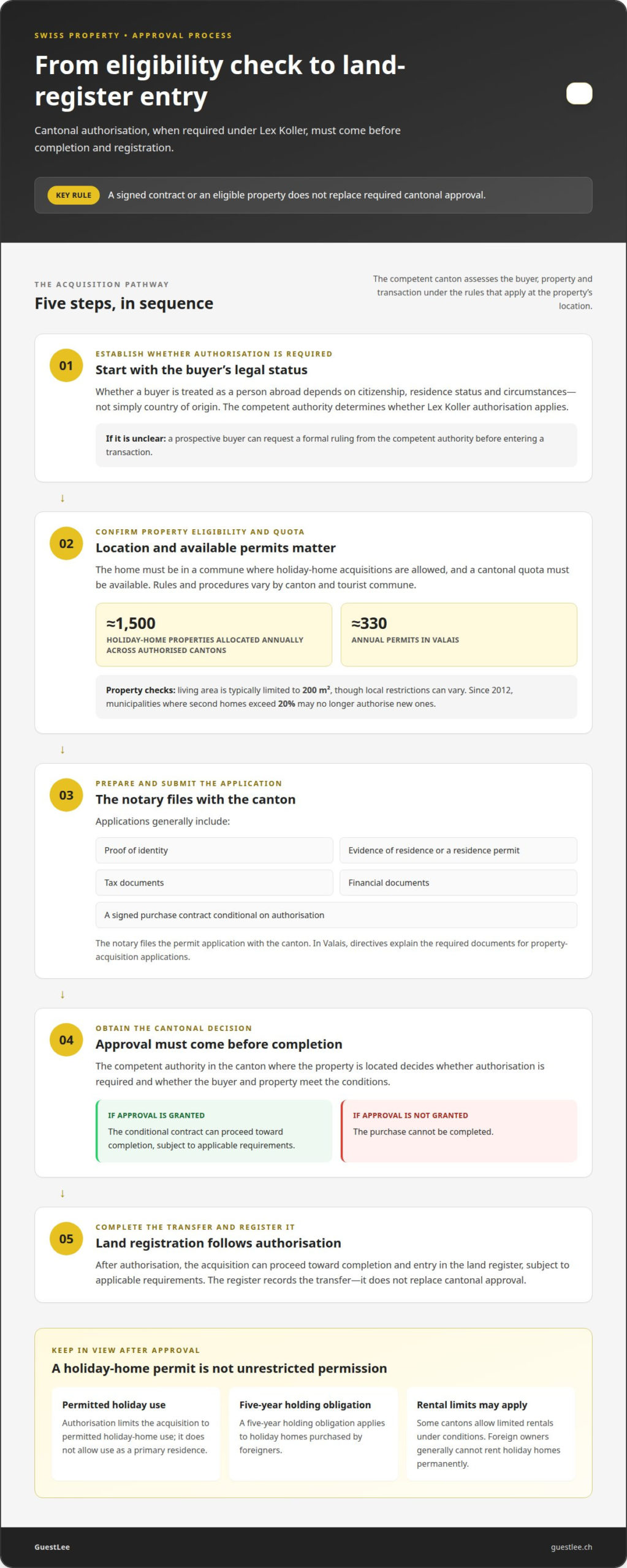
A holiday-home quota limits how many properties eligible foreign buyers may acquire in a canton each year. Switzerland allocates approximately 1,500 holiday-home properties annually among cantons authorised for these purchases; Valais has around 330 annual permits.
Crans-Montana must also qualify under the tourist-zone rules: the canton must allow acquisitions in the relevant commune. Property size matters too. A Swiss holiday home’s living area is typically limited to 200 m², while restrictions can vary locally. Since 2012, municipalities where second homes exceed 20% may no longer authorise new ones.
Cantonal Authorisation and Purchase Exceptions
Cantonal authorisation is the approval required for a purchase covered by Lex Koller. The authority responsible for the property’s location decides whether approval is needed and whether the buyer and property meet the conditions.
Some exceptions depend on the buyer’s circumstances, not simply their citizenship. For example, a foreign natural person may be authorised to acquire a secondary residence where exceptionally close, protectable ties to the place exist and continue. A proposed Lex Koller revision may tighten rules: Thomas Aeschi introduced a motion in September 2024 calling for a reversal of liberalisations. The consultation ran from 15 April to 15 July 2026; no specific commencement date had been set in the account of the proposal. This is not itself a new holiday-home quota.
Conditions for Authorised Holiday-Home Use
Authorisation limits the acquisition to permitted holiday-home use, rather than unrestricted residential investment. A holiday home bought under Lex Koller cannot be used as a primary residence, and a five-year holding obligation applies to holiday homes purchased by foreigners.
Rental use may also be restricted. Some cantons allow limited rentals under conditions that depend on the canton and property type, but foreign owners generally cannot rent holiday homes permanently. Authorities monitor permitted use, so approval should not be treated as permission to convert the property later into an investment asset.
Cantonal approval and land-register requirements
For a property in Switzerland, the competent canton decides whether the Federal Act on the Acquisition of Real Estate by Persons Abroad requires authorisation. If it does, approval must be granted before completion and registration.
Holiday-Apartment Quotas and Eligibility
Holiday-apartment quotas limit acquisitions by foreign nationals in eligible tourist areas. Switzerland’s nationwide allocation is divided among authorised cantons, which may set their own annual limits.
Eligibility depends on both the buyer and the property. The home must be in a commune where holiday-home purchases are allowed, and a cantonal quota must be available. A non-resident foreign buyer generally cannot acquire residential property purely as an investment. The lex Koller permit process for holiday homes brings these requirements together: meeting the buyer criteria does not reserve a quota or establish that the property is eligible.
Permit Authorities and Required Documents
The competent authority in the canton where the property is located decides whether authorisation is required and issues the decision. In Valais, directives explain the Federal Act and the documents required for property-acquisition applications.
Applications generally include proof of identity, evidence of residence or a residence permit, tax and financial documents, and a signed purchase contract conditional on authorisation. The notary files the permit application with the canton. The conditional contract allows the transaction to proceed only if approval is granted. Without approval, the purchase cannot be completed.
Cantonal and Communal Permit Rules
Federal law sets the framework, while cantonal authorities apply it to each property and transaction. Cantons and tourist communes can also limit foreign acquisitions through quotas or other local restrictions. As a result, procedures and available permits vary by location.
After authorisation, the acquisition can proceed toward completion and entry in the land register, subject to applicable requirements. The register records the transfer but does not replace cantonal approval. If it is unclear whether the law applies, a prospective buyer can request a formal ruling from the competent authority before entering a transaction. This can clarify the approval requirement before registration.
Who qualifies as a person abroad under Lex Koller
Whether someone is treated as a person abroad under Lex Koller depends on their citizenship, residence status and circumstances. The distinction depends on the buyer’s legal status and actual residence, not simply their country of origin. This matters because a person abroad buying residential real estate may need authorisation, particularly for a holiday home or investment property.
Swiss citizens and dual citizens may acquire real estate in Switzerland without Lex Koller restrictions, whether they live in the country or abroad. A foreign national’s residence permit affects the assessment. A settlement permit C generally means a third-country national residing in Switzerland is not classed as a person abroad, while non-residents remain subject to the relevant rules.
EU or EFTA nationals who legally and actually reside in Switzerland are generally treated like Swiss citizens when buying a primary residence. A valid B, C or L permit can be relevant to that status. Intended use matters: this treatment for a main home does not automatically extend to a holiday apartment or other secondary property.
Third-country nationals living in Switzerland with a B or L permit may buy a primary residence without Lex Koller authorisation, but a secondary or investment property is subject to the rules. A foreign national with a valid B, C or Ci residence permit may acquire one property as a primary residence without authorisation. The home must be their legal residence and actually occupied.
Companies also require scrutiny. A Swiss company may count as a person abroad if foreign individuals or entities effectively control it. The law can also cover arrangements that give a person abroad actual power over a property, even without a land-register transfer. Buying real estate in Switzerland does not itself grant a residence permit, so the buyer’s status and the property’s intended use must be assessed separately.
Consequences of non-compliance
For a holiday-home purchase subject to Lex Koller, proceeding without required authorisation can prevent completion. If an application is rejected, the purchase cannot proceed. A signed agreement does not remove this condition when approval is required, so the buyer’s status and intended use must be considered before the sale advances.
The rules can cover more than a registered transfer. An acquisition may include a legal arrangement that gives a person abroad actual power to dispose of a property, even without a change in the land register. Foreign financing or acquiring a usufruct may also trigger authorisation. The deal’s legal form alone does not determine whether approval is required.
Using an entity does not automatically avoid the restrictions. Swiss law covers acquisitions involving companies or trusts whose real purpose is to acquire restricted real estate. A Swiss company may itself be treated as a person abroad if foreign parties effectively control it. The underlying control and the apartment’s residential use remain relevant.
Criminal consequences can apply to parties who knowingly participate in a transaction that breaches Lex Koller. In Switzerland, the potential prison sentence is up to three years. Knowingly taking part in an unauthorised acquisition is materially different from having a permit application refused. This consequence concerns knowing participation, not every error or unsuccessful application.
Before a tourist-area purchase advances, clarify whether the acquisition requires approval and whether the transaction is conditional on receiving it. That distinction helps keep the sale process aligned with the buyer’s legal status and the property’s intended use. For support with a property transaction, explore real estate sales services.
GuestLee
GuestLee supports property decisions that follow an understanding of Lex Koller, from exploring Real Estate Sales to managing a home after acquisition. If you’re considering a purchase in Crans-Montana, the distinction matters: authorisation determines whether a qualifying buyer may acquire the property, while property management concerns its ongoing care and use. GuestLee’s Property Management Services help owners manage their assets, and its Luxury Villa Rentals connect guests with high-end stays.
Consider GuestLee when your plans move from understanding the rules to buying, managing or enjoying a property. For guidance on the property services that fit your plans, contact GuestLee.
Shape Your Next Property Decision
A considered property decision looks beyond the purchase itself. Before moving ahead, consider how you want to use your Crans-Montana home and what ongoing ownership will involve. Clear plans can help you make choices that suit your circumstances and the property’s permitted use.
The lex koller permit process for holiday homes is one part of a wider property decision. Understanding the approval framework gives you a clearer basis for planning. The next step is to connect your property plans with appropriate real estate support. GuestLee can help you explore the property services relevant to your needs, without rushing a complex decision.
Whether you’re considering a purchase or planning what comes after it, take the next step at your own pace. Discuss your Crans-Montana property plans with GuestLee, and move forward with greater clarity and confidence.
Frequently Asked Questions
How to Apply for Lex Koller Authorisation?
For a qualifying holiday-home purchase, the notary files the cantonal application. The lex koller permit process for holiday homes generally requires identity documents, proof of residence or a residence permit, tax and financial documents, and a purchase contract conditional on approval. Provide consistent information about the buyer and property, since the competent canton assesses the proposed acquisition. Where authorisation is required, it must be granted before completion.
Which Transactions Require Authorization?
Authorisation may be required when a person abroad acquires a house, owner-occupied apartment or building land intended for residential use. The transaction’s legal form is not decisive: arrangements giving a person abroad actual power to dispose of property may also fall within the rules. Foreign financing or acquiring a usufruct can trigger authorisation, even without a direct land-register transfer.
Can I rent out my holiday property?
Limited rental use may be permitted under conditions that vary by canton and property type. Foreign owners generally cannot rent holiday properties permanently. For example, permission to use an apartment as a holiday home should not be treated as approval for unrestricted, year-round investment letting. The authorised purpose and any rental conditions remain relevant after purchase, not just during the application.
How does the authorisation procedure work?
The notary submits the application to the competent cantonal authority, usually with the conditional sale contract and supporting documents. The authority assesses whether authorisation is required and whether the acquisition can be approved. If granted, the transaction can proceed toward completion and entry in the land register, subject to applicable requirements. If refused, the purchase cannot proceed; possible appeals depend on the circumstances.
How long does Lex Koller approval take?
A holiday-home permit application is estimated to take 4-12 weeks. The actual processing period can depend on the canton and the complexity of the application. Allow time for the authority to assess the buyer, property, and submitted documents before planning completion. A purchase requiring authorisation cannot be completed first and regularised afterward; the approval must come before completion.
Lex Koller: Who is permitted to acquire real estate in Switzerland?
Swiss citizens, including dual citizens, may acquire Swiss real estate without Lex Koller restrictions, whether they live in Switzerland or abroad. EU or EFTA nationals with legal and actual residence in Switzerland are generally treated like Swiss citizens for property acquisition. Third-country nationals residing in Switzerland with a C permit are generally not classed as persons abroad. For other buyers, residence status and intended property use affect whether authorisation is required.

Article by
Giacomo Esposito