
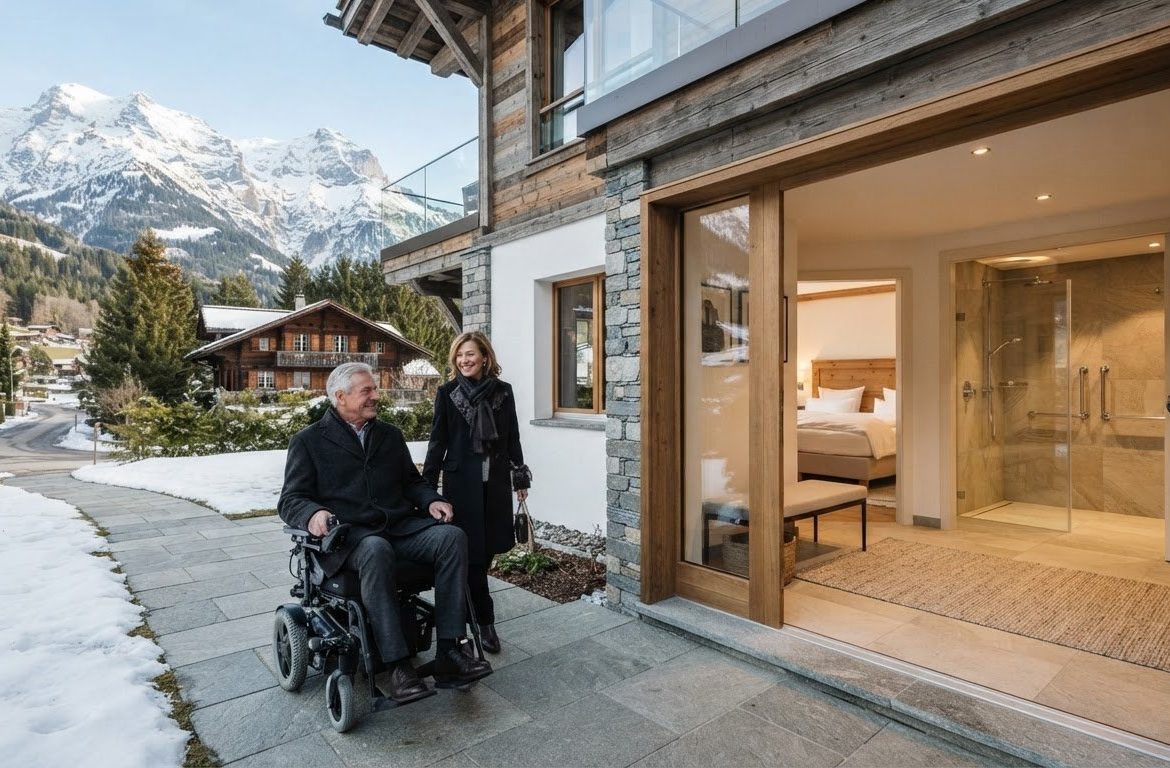
Luxury chalets accessible for elderly guests, with prices
An internal lift alone doesn’t make a chalet accessible: entrance steps, thresholds, bathroom layouts and outdoor routes all affect ease of movement. Luxury chalets accessible for elderly guests should be assessed as a whole, from the entrance and bedroom to the bathroom and transport. Spacious rooms and step-free access can make a stay more comfortable, but the right features depend on each guest’s mobility needs.
Choosing a beautiful alpine retreat shouldn’t mean overlooking practical details. This guide explains what to consider, including door widths, lift access, bathrooms and snow-covered paths, so you can compare chalets with confidence.
You’ll also see how capacity and location vary between properties and what affects their prices. The aim is to help you balance comfort, accessibility and the kind of Swiss mountain stay you have in mind.
Key Takeaways
- Assess the whole route, from entrance and thresholds to bedrooms and bathrooms; an internal lift alone doesn’t establish accessibility.
- Compare bedroom and bathroom layouts for room to manoeuvre, then consider how snow-covered paths and transport affect access to lifts and resort centres.
- Chalet capacities range from smaller apartments to large group properties, while rental prices depend on factors such as location, season and catering.
- Explore accessible Swiss options in places such as Zermatt and Verbier, and weigh each property’s layout and access features against your travel needs.
What makes a ski chalet accessible?
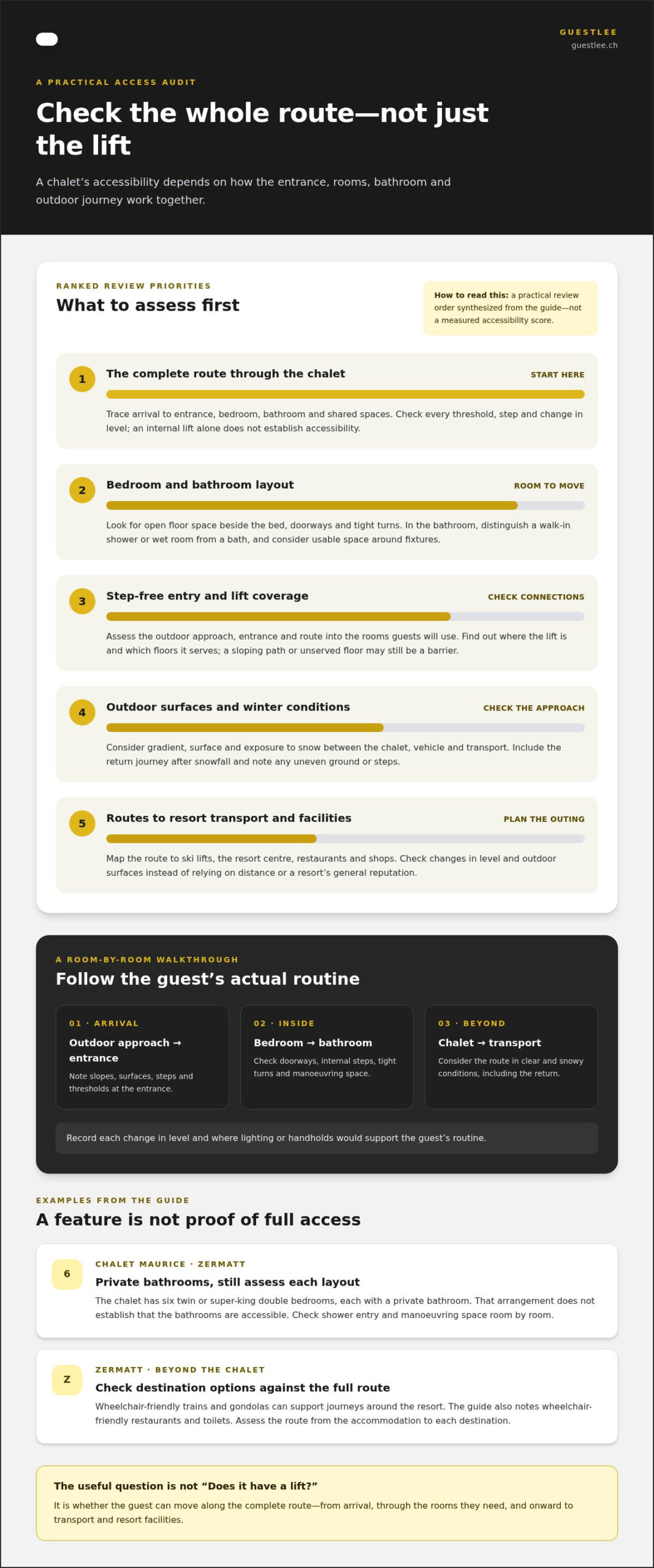
Accessibility depends on the complete route through a chalet, not just one feature. An internal lift cannot overcome entrance steps, thresholds, bathroom barriers or difficult outdoor access.
Bedroom and Bathroom Arrangements
Start with the route from the entrance to the bedroom and bathroom. Check for steps between rooms, raised thresholds and enough open floor space to manoeuvre beside the bed. Larger bedrooms can give wheelchair users more room, while wet rooms and walk-in showers can make bathroom access more practical. Assess the whole layout rather than relying on a single accessibility feature.
Private Bedroom and Bathroom Configurations
Private bathrooms can make daily routines easier to organise, especially when guests have different mobility needs. Chalet Maurice in Zermatt has six twin or super-king double bedrooms, each with a private bathroom. This arrangement gives each bedroom its own bathroom, but does not establish that the bathroom is accessible. Consider the layout, shower entry and available manoeuvring space.
For each room, trace the route from bed to bathroom. Note doorways, internal steps and tight turns along the way. In the bathroom, distinguish a walk-in shower or wet room from a bath, and consider whether the layout leaves usable space beside fixtures. These details help determine whether the accommodation suits the guest’s mobility and usual routine.
Make a room-by-room assessment: entrance, bedroom, bathroom, then the route back to shared spaces. Record where the lift is located and which floors it serves, since an elevator may not remove every barrier. This walkthrough shows how bedroom and bathroom arrangements work together, rather than treating a private bathroom or lift as proof of full accessibility.
What accessibility details should you consider?
For alpine holidays in Switzerland, assess the route between the chalet, ski lifts and resort facilities. Snow-covered paths, unexpected steps and steep approaches can create practical safety risks for elderly guests.
Access to Lifts, Slopes and Resort Centres
Look beyond the chalet’s distance from a lift or resort centre. Consider the route’s gradient, surface and exposure to snow, then identify how guests will travel between the entrance and their destination. In Zermatt, wheelchair-friendly trains and gondolas can support journeys around the resort. Map the route from the chalet to transport and note changes in level or outdoor surfaces.
For restaurant and shop visits, consider the whole outing, including the return journey after snowfall. Zermatt’s wheelchair-friendly restaurants and toilets provide accessible facilities beyond the accommodation. Compare these amenities with the guest’s planned activities, rather than assuming a resort’s reputation means every route is convenient.
Step-Free Access and Chalet Lifts
Trace step-free access from the outdoor approach through the entrance and into the rooms guests will use. A sloping path can still be challenging, while a lift may serve only selected floors. For luxury chalets accessible for elderly guests, assess the entrance and internal routes against each traveller’s mobility needs.
Check whether the lift connects the arrival point with the bedroom and shared living spaces. Note any thresholds or changes in level along the way. This room-to-room walkthrough can reveal practical barriers that a general description of lift access may not explain.
Safety Considerations for Elderly Guests
Snow and uneven surfaces can complicate movement between a chalet, vehicle and resort transport. Indoors, steps, thresholds and tight turns may be harder to manage while carrying luggage or ski equipment. Consider the approach in both clear and snowy conditions, including any sloped path to the entrance.
Use a simple route check: entrance to living area, bedroom to bathroom, then chalet to transport. Record each change in level and note where lighting or handholds would support the guest’s routine. This sequence helps identify access concerns before planning skiing or other mountain activities.
Chalet prices and capacities
Swiss chalet prices vary by location, season, capacity, catering and facilities. The price depends on the property and booking details, and is provided after a quote request. Compare like with like: a self-catered apartment and a catered chalet offer different arrangements, even if they have similar guest capacities.
Capacity ranges from compact apartments to spacious chalets for larger groups. In Verbier, No. 5 – Apt. 4 is listed for six guests, while Chalet Rock sleeps ten. In Zermatt, Chalet Tuftra Findelbach is listed for 14+3 guests. These examples show how listings may distinguish the main guest count from additional sleeping places.
That distinction matters for comfort and mobility. A property’s stated capacity doesn’t show how bedrooms are arranged, how much shared living space is available or whether the layout suits a guest with reduced mobility. For luxury chalets accessible for elderly guests, compare the number of bedrooms and bathrooms with the group’s needs, then consider whether shared areas leave enough room to move comfortably.
To compare prices meaningfully, note the resort, travel dates, guest count and catering arrangement. Then compare properties with similar features and capacities. A larger chalet may offer more bedrooms, but its maximum occupancy alone doesn’t show whether everyone has a suitable sleeping arrangement. For luxury chalets accessible for elderly guests, assess the practical layout alongside price and capacity rather than relying on the headline guest count.
Use this shortlist before deciding:
- Separate stated capacity from the number and type of bedrooms.
- Compare catered and self-catered accommodation as distinct options.
- Consider whether the floor plan gives guests with reduced mobility enough usable space.
- Review price alongside location, season, capacity and included facilities.
This approach keeps the comparison focused on value and practical comfort.
Luxury ski chalets with disabled access
In Switzerland, Zermatt and Verbier have named chalet examples with access features. Cancellation and accessibility-related booking conditions are set out in each property’s booking terms, so read them before reserving.
Accessible Chalet Options in Switzerland
In Zermatt, Apartment Idyll has a lift that goes directly into the apartment. In Verbier, Chalet Bella Coola has an elevator connecting its entrance hall to the ground and first floors. These features can reduce barriers between arrival and living spaces, but don’t establish that every area or route suits every guest.
Compare each access feature with the guest’s plans. Check which floors the lift serves, whether the bedroom and bathroom are on an accessible route, and how the entrance connects to the vehicle drop-off. Zermatt also offers wheelchair-friendly restaurants, gondolas, trains and toilets, providing accessible facilities beyond the accommodation.
Swiss Regions with Accessible Chalet Selection
Zermatt and Verbier are the Swiss regions represented by these named chalet examples. The properties illustrate different features: Apartment Idyll’s lift goes directly into the apartment, while Chalet Bella Coola’s elevator connects three levels, the entrance hall, ground floor and first floor.
Choose a location and chalet layout that fit the trip. For skiing, consider how the entrance and internal routes connect with transport to the lifts. For time in the resort, consider access to restaurants, trains and other facilities. Zermatt’s wheelchair-friendly transport and public amenities can support outings beyond the chalet, while the specific elevator arrangement in Verbier may suit guests who prioritise access between floors.
For a Swiss mountain stay, compare the chalet’s access features with the guest’s mobility, travel plans and preferred resort activities. Explore Swiss luxury stays as you shape a stay around comfort and access.
GuestLee: Luxury Villa Rentals
GuestLee offers luxury villa rentals for guests planning a refined stay in Switzerland. Use the accessibility criteria above to assess whether a property’s layout, entrance and routes suit your travel needs, alongside its location and capacity.
For property owners, GuestLee also provides property management services, supporting the rental process from property setup through guest departure. This can help owners prepare a home for short-term guests while maintaining a considered guest experience. GuestLee also offers real estate sales for owners exploring a property transaction.
To explore GuestLee’s services, visit GuestLee online.
Plan a stay around the way you travel
A considered alpine break starts with the guest, not the property. Think about daily routines, preferred activities and who will be travelling together, then let those priorities guide your chalet choice. For luxury chalets accessible for elderly guests, this approach connects practical access with the experience you want from a Swiss mountain holiday.
GuestLee offers luxury villa rentals for guests, property management services for property owners, and real estate sales for those considering a property transaction. If you’re planning a stay, share what matters most to your group and explore your options with GuestLee.
Contact GuestLee about accessible chalets and take the first step towards a more thoughtfully planned Swiss escape.
Frequently Asked Questions
Which Swiss chalet resorts offer step-free entrances and wheelchair-accessible rooms?
Zermatt and Verbier have chalet examples with lift access, though this doesn’t establish that every property has step-free entry or accessible rooms. Apartment Idyll in Zermatt has a lift directly into the apartment, while Chalet Bella Coola in Verbier has an elevator linking its entrance hall with two floors. Compare the entrance and room arrangements for the specific property you’re considering.
What accessibility features should elderly guests look for in a luxury chalet?
Prioritise features that match the guest’s daily routine, not just a general accessibility label. Consider whether the entrance, bedroom and bathroom form a manageable route, and whether doors, thresholds and lift access support movement between spaces. In bathrooms, look for a shower entry and layout suited to the guest’s needs. Also consider access from the chalet to transport and shared facilities.
How much do accessible luxury chalets in Switzerland cost per night?
There isn’t one fixed nightly rate for accessible luxury chalets in Switzerland. Price depends on the property, season, travel dates, guest capacity, location and catering arrangement. Compare quotes in CHF on the same basis, including stay dates and guest count, so differences between properties are meaningful. A chalet’s accessibility features and layout may also affect whether it suits your trip.
Are accessible chalets near ski lifts, restaurants, shops, and medical facilities?
Some properties are close to resort facilities, while others require transport or travel over sloped or snowy routes. Proximity varies by chalet, so consider the actual route, not just the distance on a map. Zermatt has wheelchair-friendly restaurants, gondolas, trains and toilets. For shops or medical facilities, assess the property’s location and the practical route from its entrance.
Do Swiss luxury chalets offer adapted bathrooms, grab rails, and walk-in showers?
Bathroom features vary by property, so don’t assume an accessibility description includes every adaptation. Wet rooms and walk-in showers can offer more manoeuvring space, but the terms alone don’t indicate grab rails or other support features. Compare the shower entry, available floor space and fixture placement with the guest’s specific needs. Assess each feature separately.
How can guests confirm a chalet’s accessibility before booking?
Compare the property’s written description and available layout information against a route checklist: entrance to living space, bedroom to bathroom, and chalet to transport. Note essential details, such as step-free entry, lift access or bathroom features, and look for them in the booking documentation. This helps distinguish an explicitly described feature from a broad accessibility label.

Article by
Giacomo Esposito