
Luxury Property Investment Trends in Switzerland for 2026
Could a coveted Swiss property become a weaker investment simply because its operating model doesn’t fit? For investors weighing luxury property investment trends switzerland 2026, rising values are only part of the picture. Switzerland’s owner-occupied home prices rose 3.3% year over year in the third quarter, according to the Federal Statistical Office, while UBS’s real estate bubble index reached 0.72 in the second quarter, indicating moderate risk.
It’s understandable to be drawn to a market known for stability and enduring appeal. But a strong headline trend doesn’t guarantee that a particular property suits your goals, generates reliable rental income or remains straightforward to own.
This article explores signals shaping Swiss luxury property opportunities in 2026, compares personal use with professionally managed short-term rentals, and explains how operating responsibilities affect an investment’s fit. Rental management can support a property’s condition and guest readiness, but it can’t guarantee occupancy or income.
Before committing, resolve the questions that matter to your plan, from financing assumptions and rental demand to ownership eligibility and rules affecting how a property can be used. The aim is a clearer view of each opportunity, before its setting or reputation makes the decision for you.
Key Takeaways
- Read luxury property investment trends switzerland 2026 as signals to investigate, not promises of future performance.
- Test premium guest demand against booking, enquiry and seasonality data, while assessing privacy, service quality and property readiness.
- Compare personal-use ownership, owner-managed rentals and professional management by time commitment, control, guest experience and access to operating data.
- Make permitted use and ownership eligibility part of due diligence before relying on a rental or investment strategy.
- Build a practical plan around your objectives, verified evidence and operating needs, including setup, marketing, guest communication and maintenance.
What is shaping Swiss luxury property investment in 2026?
Read 2026 market movements as decision signals, not forecasts or promises of return. For anyone assessing luxury property investment trends switzerland 2026, the useful question is how financing conditions, housing data and policy context intersect, then how that picture compares with the individual property. A national average sets the scene; it can’t determine whether a particular home suits personal use, short-term rental or another permitted purpose.
Which Swiss market indicators should investors monitor?
Start with dated figures and distinguish official observations from market commentary. The Swiss National Bank’s policy rate was 0.0% as of October 2026, following its September 2025 reduction. Mortgage offers are set by lenders and may not move in step with the policy rate. On October 10, 2026, the average 10-year fixed mortgage rate across 29 providers was 2.05%. Treat both figures as snapshots, not financing assumptions for an individual purchase.
For housing context, the Swiss Federal Statistical Office reported that residential property prices rose 3.6% year over year to the second quarter of 2026. This is a broad indicator, not a measure of luxury assets alone. Switzerland’s wider economic setting also matters. The Economy of Switzerland offers useful background, but investment decisions still require property-specific evidence.
- Financing: Track SNB policy announcements alongside the actual mortgage terms available for the intended ownership structure.
- Housing: Compare FSO price data by property type and reporting period. Don’t assume national movement reflects a specific asset.
- Land use: Review Federal Office for Spatial Development material on spatial planning and second homes. The Lex Weber framework limits the construction of second homes in municipalities where they reach 20% of the housing stock, so verify permitted use for the property.
How should investors read a 2026 trend forecast?
Keep historical data, current conditions and forecasts separate in your analysis. FSO price changes describe a past measurement period; the SNB policy rate describes a current monetary setting; price-growth projections from UBS or Wüest Partner are estimates, not outcomes. Forecasts depend on assumptions that can change.
Investor sentiment adds context, but no single index captures a property’s purchase terms, condition, permitted use, operating demands or likely guest appeal. For every figure, note its date, metric and coverage, then decide whether it applies to the asset you’re evaluating. Market indicators inform an investment decision, but they don’t determine an individual property’s performance.
This distinction matters when a property’s appeal rests on both personal enjoyment and rental potential. Before assigning value to either, verify the intended use and test demand and operating assumptions against evidence for that asset. Broad market strength can frame the questions, but it can’t settle them.
Which luxury property and guest-demand trends matter in Switzerland?
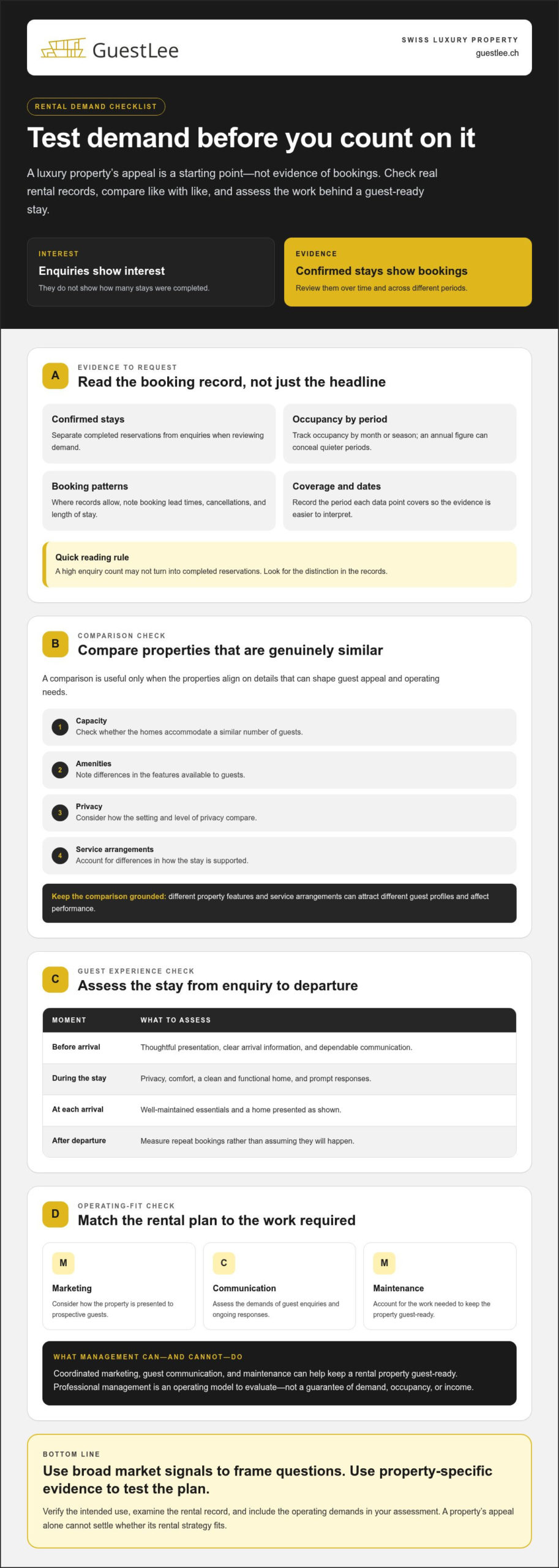
Luxury demand is a question to investigate, not an assumption to build into an investment model. For anyone assessing luxury property investment trends switzerland 2026, the practical test is whether current evidence supports the property’s intended rental use. A polished listing or a high volume of enquiries may suggest interest, but neither shows how often a home is booked, which periods are quiet or what it takes to deliver a consistent stay.

What guest expectations can influence a property’s rental appeal?
Premium appeal rests on more than architecture or furnishings. Guests may value privacy, comfort, thoughtful presentation and dependable communication. The property also needs to be clean, functional and ready for each arrival. These are hospitality considerations, not proof that a particular home will attract bookings. Assess them from a guest’s perspective, from the first enquiry through departure.
Operational details shape the experience: clear arrival information, prompt responses, well-maintained essentials and a home presented as shown. A smooth stay can support guest satisfaction and future consideration, but repeat bookings should be measured rather than presumed. Professional management is an operating model to evaluate, not a guarantee of stronger demand or income in 2026. Coordinated marketing, guest communication and maintenance can help keep a rental property guest-ready.
How can owners validate short-term rental demand?
Look for dated, property-specific evidence. Review booking records over a meaningful period, separating confirmed stays from enquiries and tracking occupancy by month or season. Where records allow, note booking lead times, cancellations and length of stay. A high number of enquiries may not become completed reservations, while an annual occupancy figure can hide quiet periods that affect planning.
Comparisons are useful only when the properties are genuinely similar. Differences in capacity, amenities, privacy or service arrangements can attract different guest profiles and affect performance. Use like-for-like examples, record the period each data point covers, and distinguish advertised availability from confirmed bookings.
- Booking evidence: Separate enquiries, provisional holds and confirmed reservations.
- Seasonality: Compare demand across periods instead of relying on a single annual average.
- Property fit: Account for capacity, amenities, condition and the service level delivered.
- Guest feedback: Identify recurring comments about comfort, presentation and communication, then connect them to practical improvements.
Guest interest signals potential; completed bookings and the operating record show realized rental performance. That distinction helps owners decide whether a hospitality-led approach fits their objectives and the property’s permitted use. For an overview of how luxury property management connects owner needs with guest stays, weigh the operating responsibilities alongside the demand evidence.
How do Swiss luxury property investment approaches compare?
There’s no single operating model that suits every owner. Compare each approach against the property’s intended use, the time you can commit, the control you want and the information you’ll need to judge performance. In the context of luxury property investment trends switzerland 2026, treat rental income and occupancy as assumptions to test, not outcomes to expect.

| Approach | Time commitment | Operating control | Guest experience | Data visibility |
|---|---|---|---|---|
| Personal-use ownership | Focused on care and upkeep for the owner’s use | Direct control over the home and its use | Designed around the owner and invited guests | Property costs and maintenance records, rather than rental performance |
| Owner-managed rentals | Ongoing attention to marketing, communication, stays and upkeep | Direct decisions across day-to-day operations | Shaped by the owner’s processes and availability | Direct access to booking and operating records, if consistently maintained |
| Professionally managed rentals | Less direct involvement in routine rental operations, while owner oversight remains necessary | Responsibilities are shared according to the management arrangement | Can follow more consistent processes for communication and property readiness | Depends on the quality and regularity of reporting provided |
What changes between self-management and professional management?
With owner-managed rentals, the owner coordinates preparation, marketing, guest responses, maintenance and follow-up after each stay. Professional management can bring these tasks into a coordinated process. GuestLee’s property management services in Switzerland cover marketing, guest communication and maintenance. Delegating operational work may reduce the owner’s day-to-day workload, but it doesn’t assure stronger occupancy, higher income or lower costs. Define who handles each task and how information is shared.
Which performance measures belong in an investment comparison?
Use the same definitions and period when comparing approaches. Start with realized rental income, then compare it with confirmed occupied nights, operating expenses and maintenance needs. Separate gross revenue from net performance by stating which costs are deducted, what period the calculation covers and which assumptions remain estimates. Include owner use and unavailable periods when they affect the property’s ability to host guests.
- Income: Record completed stays and revenue received, not enquiries or advertised rates.
- Operating picture: Track occupancy alongside recurring operating expenses and maintenance.
- Owner input: Account for time spent managing the property, even if it isn’t recorded as a cash expense.
- Comparability: Use consistent periods and cost categories before drawing conclusions.
Begin with the owner’s priorities, then test each model against the same property, permitted use and operating assumptions. This makes it easier to compare control, workload and net performance without relying on an unsupported yield or forecast.
What risks and due diligence should investors assess in Switzerland?
A desirable setting and a well-presented home don’t establish that a buyer can acquire it, use it as planned or operate it profitably. In Switzerland, assess ownership eligibility, the property’s legal status and its intended use separately. This is especially important if a rental strategy underpins your view of luxury property investment trends switzerland 2026: an attractive asset isn’t evidence of permitted use or viable performance.
What ownership and use rules need current verification?
Swiss rules can depend on the buyer’s residence status, the property and its intended use. Under the federal framework, Lex Koller restricts purchases by foreign non-residents without authorization; holiday-home purchases are generally limited to designated tourist areas and subject to permits. A tightening revision was under consultation in 2026, and the National Council supported tighter rules on September 22, 2026. As of October 2026, the proposed changes had not entered into force. Verify the law’s current status and application before relying on it.
The Second Homes Act limits the construction of second homes in municipalities where they account for more than 20% of the housing stock. That national threshold doesn’t establish the permitted use of a specific property. Review current federal guidance and applicable cantonal and local rules, including limits relevant to the intended use. Ownership, location and use all shape the analysis.
How can an investor stress-test an operating plan?
Review the plan before committing. Keep legal eligibility, permitted use and commercial assumptions distinct, and record the date and basis for each conclusion. Test more than one operating scenario using evidence tied to the property, rather than assuming that a favourable market signal will translate into bookings.
- Establish buyer eligibility. Confirm how the buyer’s nationality and Swiss residence status affect the proposed acquisition under the current Lex Koller framework.
- Verify property status and use. Review the property’s classification, second-home context and applicable federal, cantonal and local requirements against current official material.
- Test the operating case. Model different levels of booking demand and occupancy using dated, property-relevant evidence. Include periods without bookings.
- Account for operations. Build in maintenance needs and the time required to prepare, market and manage stays. If professional management is part of the plan, define its responsibilities and the reporting needed to assess performance.
- Revisit assumptions. Compare scenarios with actual operating records as they become available, and update the model when legal or market conditions change.
Legal eligibility, permission to rent and investment performance are three separate questions; satisfying one doesn’t answer the others. This distinction keeps due diligence grounded, even when a property’s appeal is immediate. To understand how rental operations can fit into an owner’s plan, explore Swiss property management support.
How can owners turn 2026 trends into a practical property strategy?
Broad signals become useful only when they shape a disciplined plan for a specific home. Luxury property investment trends switzerland 2026 can inform that plan, but the decision should start with your priorities, evidence about the property and a clear understanding of how it may be used. A measured process separates an asset’s appeal from the practical work of owning and operating it.
How should an investor translate trends into property criteria?
First, decide whether personal use, rental operation or a deliberate balance of both is the primary objective. That choice changes what matters: a home for private enjoyment may be judged differently from one expected to welcome guests. Turn the objective into criteria you can assess instead of relying on general market sentiment.
- Define the purpose: Clarify how much owner use you expect and what role rental activity should play.
- Match the property to the plan: Assess its layout, privacy, condition and amenities against the guest profile and service level you intend to provide.
- Test the evidence: Use relevant booking and enquiry records, seasonality and comparable properties to examine whether demand assumptions fit the asset.
- Revisit the criteria: Review the plan when market evidence or applicable property-use requirements change, rather than carrying assumptions forward unchanged.
This creates a practical filter for evaluating opportunities. If the desired use and the property’s characteristics don’t align, a strong market narrative won’t resolve the mismatch.
What does a managed luxury rental operation involve?
A managed rental is an operating plan, not simply a decision to list a home. GuestLee supports owners from property setup through guest departure, bringing marketing, guest communication and maintenance into the rental operation. Thoughtful preparation and consistent care can help keep a property ready for guests, while clear communication supports a considered stay. These services don’t guarantee occupancy or income; owners still need to assess the property’s objectives, permitted use and performance evidence.
Before committing to a model, map the work across the guest journey. Property setup establishes readiness; marketing presents the home; communication supports guests before and during their stay; and maintenance helps protect the property’s condition. Decide how you’ll receive operating information and review results. That visibility makes it easier to compare actual activity with the assumptions in your investment plan.
- Set the objective. State whether personal use, rental operation or a balance leads.
- Validate the asset. Match its features to dated demand evidence and the intended guest experience.
- Confirm permitted use. Resolve ownership and applicable property-use requirements before relying on rental income.
- Model and organize operations. Include quiet periods, maintenance and management responsibilities, then decide how results will be reviewed.
For owners considering an end-to-end rental model, Explore Swiss property management services as part of a carefully developed property strategy.
Build a strategy that can adapt
A considered property strategy shouldn’t be fixed at the moment of purchase. Set clear points to review your assumptions, then revisit them as market evidence, operating results or applicable requirements change. This keeps decisions anchored to the property’s real purpose rather than a trend that may shift.
For luxury property investment trends switzerland 2026, turn your priorities into a practical ownership plan. Decide what you want the property to deliver, which responsibilities you’re prepared to retain and how you’ll judge progress. A well-matched operating approach can support the asset and the experience it offers, without treating performance as guaranteed.
For a considered approach to rental operations, Explore GuestLee’s Swiss property management services. With a clear framework in place, you can move forward with greater confidence.
Frequently Asked Questions
Is luxury property in Switzerland a good investment in 2026?
It can suit an investor when the property, financing, intended use and ownership objectives align, but no broad market trend guarantees performance. Write down the assumptions that matter most, such as how much you’ll use the property personally and whether rental activity is essential to the plan. Test those assumptions against property-specific evidence, and consider what would change your decision if conditions were less favourable.
What luxury property investment trends should investors watch in Switzerland in 2026?
For luxury property investment trends switzerland 2026, monitor financing conditions, housing indicators, guest-demand evidence and developments that may affect property use. Give every figure a date and distinguish recorded data from forecasts. A national price measure, for example, offers context but won’t show whether a particular home attracts bookings during quieter periods. Consider several relevant signals rather than relying on one headline.
Can foreign investors buy property in Switzerland?
Some foreign buyers can purchase Swiss property, but eligibility and conditions depend on the buyer’s circumstances and the property’s intended use. Lex Koller may apply, and a general description can’t determine an individual buyer’s position. Before making an offer, assemble details about residence status, ownership structure and intended use, then verify applicable requirements using current official Swiss information and qualified legal advice. Don’t treat proposed changes as current rules.
How do short-term rentals affect a Swiss property investment?
Short-term rentals involve operational work as well as possible rental revenue. Consider how stays affect personal-use availability, maintenance planning and the time needed to prepare for guests. A calendar showing owner stays, maintenance periods and confirmed reservations can reveal practical conflicts. Actual performance depends on permitted use, demand and execution, so projected bookings remain assumptions until supported by the property’s operating record.
What is the difference between gross rental income and investment performance?
Gross rental income is revenue before expenses and other relevant costs; it isn’t the same as net performance. For a useful comparison, specify which expenses are included, how maintenance is treated and whether unbooked periods are reflected. Two scenarios with equal gross revenue may differ once operating assumptions are applied. Keep the calculation period and definitions consistent, and don’t present a gross figure as a net return.
How can I assess whether a luxury property is suitable for short-term rentals?
Suitability depends on more than finish or presentation. Confirm the intended use against applicable current rules, then assess whether the layout, capacity, privacy and upkeep suit the guest experience you plan to offer. Compare relevant properties like for like, noting differences in amenities and service. Map a typical guest stay from arrival to departure and identify the work, costs and owner time it requires.

Article by
Giacomo Esposito