

Rental Income Potential for Swiss Investment Properties by City
In Switzerland, rental income is only part of an investment property’s return. Across the country’s 50 largest cities, rental income contributed an average of 2.5 percentage points to pre-tax buy-to-let returns through 2021, while property value increases contributed 3.5 percentage points. The rental income potential for Swiss investment properties therefore depends on both the rent a property can command and the city’s prospects for value growth.
It’s natural to focus on monthly rent when assessing a purchase, but location, demand, property condition and financing costs all shape the result. Higher rent does not necessarily mean a stronger investment if expenses or vacancy reduce the income you retain.
This guide compares the factors that influence rental yields across Swiss cities and explains how to assess income potential alongside longer-term value. It also explores how property type, local demand and the benefits of owning Swiss rental property can affect your decision, so you can consider the overall return, not rent alone.
Key Takeaways
- Assess an investment by considering both rental income and potential property appreciation, rather than relying on rent alone.
- Compare local demand, vacancy risk, property condition and financing costs; each can change the income a property ultimately delivers.
- Use rental yield to compare cities on a like-for-like basis, and look beyond headline rents to account for losses and ownership costs.
- Swiss rental properties can offer stable income, but weigh that advantage against maintenance needs and the possibility of periods without tenants.
Investment Properties: Is It Worth Investing?
Swiss buy-to-let returns can combine rental income with property appreciation. Assessing rental income potential for Swiss investment properties means weighing cash flow during ownership against possible value growth over time.
Rental Income and Property Appreciation
Buy-to-let return combines rent received with changes in a property’s value. Across Switzerland’s 50 largest cities, rental income contributed an average of 2.5 percentage points to pre-tax returns through 2021; appreciation added 3.5 percentage points. Together, these components produced an average pre-tax return of 6%. This comparison shows why rental income potential for Swiss investment properties is only one part of the longer-term investment picture.
Short-Term and Long-Term Rental Models
Short-term holiday rentals host successive guests, while long-term rentals generally involve ongoing tenancies. Holiday stays can generate income during travel periods, but occupancy may vary with seasons and local demand. Longer tenancies follow a different rental pattern. In Switzerland, foreign nationals living abroad need authorisation to buy property, and holiday homes may only be rented out temporarily. Annual holiday-home sales to foreign buyers are capped at 1,500 units nationwide, with no quota in Geneva or Zurich.
Project-dependent return expectations should account for rent, purchase price, financing and periods without tenants. A property bought for CHF 800,000 and rented for CHF 3,000 monthly produces a stated gross annual return of 4.5%. That figure excludes operating costs and financing, so it is not the final return. A 2% to 5% return is described as a more realistic range for property investment.
Financing can also change returns on invested equity. Swiss investors who financed a buy-to-let apartment with a mortgage equal to 60% of its purchase price could achieve an average return on equity of up to 13% through 2021. That historical example reflects leverage alongside rental income and appreciation. The rental income potential for Swiss investment properties therefore depends on how income, value growth and financing combine in a specific project.
Factors affecting rental yields, including location and property condition
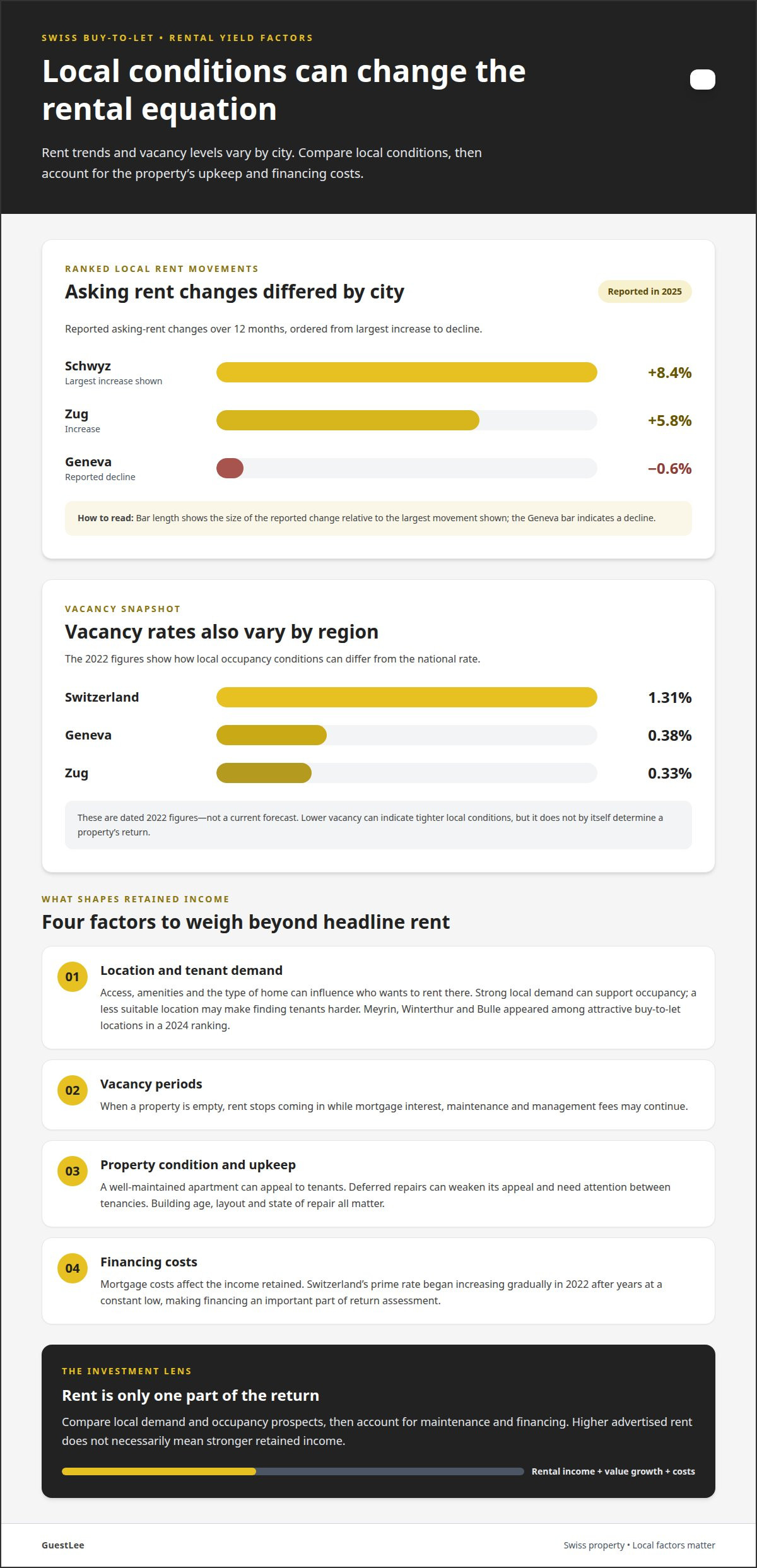
Rental yields in Switzerland depend on more than advertised rent. Local tenant demand, vacancy risk, property condition and mortgage costs all affect the income a property can generate.
Location and Tenant Demand
Location and tenant demand describe how well a property’s setting matches renters’ needs. A 2024 ranking named Meyrin, Winterthur and Bulle among Switzerland’s attractive buy-to-let locations. Their appeal illustrates why investors assess local demand alongside the unit itself: access, amenities and the type of home can influence who wants to rent there. Strong demand can support occupancy, while a less suitable location may make finding tenants harder.
Vacancy rates vary by region. Switzerland’s national dwelling vacancy rate was 1.31% in 2022, compared with 0.33% in Zug and 0.38% in Geneva. These figures are a dated snapshot, but they show how sharply local conditions can differ.
Property Condition and Rental Yield
Property condition affects both a rental unit’s appeal and the upkeep its owner must manage. A well-maintained apartment can attract tenants looking for a comfortable, functional home, while deferred repairs can weaken its appeal and require attention between tenancies. Maintenance planning belongs alongside expected rent, since expenses reduce the income you retain. The building’s age, layout and state of repair therefore matter when comparing otherwise similar locations.
Vacancies and mortgage costs are key risks to rental income. During an empty period, an investor may still face mortgage interest, maintenance and management fees without rent coming in. Switzerland’s prime rate began increasing gradually in 2022 after years at a constant low, making financing costs an important part of assessing a property’s returns.
Regional rent trends also differ: in 2025, asking rents rose 8.4% in Schwyz and 5.8% in Zug, while Geneva recorded a 0.6% fall over the reported 12 months. These contrasts show why national averages can obscure local demand and appreciation prospects. Thoughtful property oversight can help owners manage the practical details that affect a rental asset.
Rental yield definition and comparison between Swiss cities
Rental yield compares a property’s rental income with its value and costs. For Swiss real estate, using consistent assumptions makes comparisons between apartments and portfolios more useful.
Residential rent is set by the tenancy agreement, and increases must follow applicable Swiss tenancy rules rather than being reset at will. The legal basis and procedure matter, so market comparisons alone do not determine whether an increase is permitted.
For Swiss investment properties, banks finance up to 75% of value, with at least 25% covered by equity. Mortgage interest and amortisation affect cash returns, while greater borrowing increases sensitivity to financing costs.
Understanding Rental Yield
Gross yield compares annual rent with a property’s purchase price; net yield also accounts for expenses. The distinction helps investors compare properties consistently. A gross figure can look attractive until vacancy losses, insurance and other costs are included.
Net Yield Calculations and Expenses
Net yield reflects rental income after relevant costs, measured against invested funds and purchase costs. The estimated net return is 5.79%; without rental losses, it rises to 6.42%. These assumptions show why expense details can materially change a calculation.
Comparing Yields Across Cities
City comparisons show how purchase prices and rents affect yields differently. Geneva generally has lower rental yields than Lausanne, where yields are relatively higher. That does not make one city automatically preferable: assess the property, expected rent and costs together. Comparing similar apartments using the same expense assumptions gives a clearer view of relative income potential.
Target Yields and Rental Returns
A stated project target for Swiss real estate is a 10-15% net rental yield after taxes, but this is a target, not a universal benchmark. Investors weighing returns should consider debt costs alongside rent, expenses and equity, rather than judging an asset by its headline yield alone.
Advantages of Swiss rental property investment
Swiss apartment buildings are associated with stable rental income and low vacancy rates, which can make cash-flow planning more predictable. For investors building a portfolio, rent can provide recurring income while the property remains an asset. These are distinct benefits: rental receipts support ongoing returns, while potential appreciation depends on the property and its market.
Swiss tax treatment can also affect net returns. Rental income is taxed as earnings, while mortgage interest, maintenance and renovation costs can be deducted for tax purposes. For privately held real estate, substantial renovation costs can be deducted against other sources of income. Planned improvements may therefore affect both the building’s condition and an investor’s taxable income.
Property tax varies by canton, so similar rental assets can face different local tax arrangements. Property-tax arrangements can vary by location, so check local rules when estimating net income. Geneva does, while in Vaud, communes determine it. When comparing apartments in Geneva and Vaud, for example, include these differences in your net-income estimate.
Swiss investment properties include multi-family homes, rental condominiums and commercial or mixed-use properties. A multi-family building spreads rental income across several units, while a single apartment depends on one tenancy. Compare each property’s costs, condition and demand, rather than relying on its category or expected rent alone.
These advantages do not eliminate practical risks. A vacant unit can still incur mortgage interest, maintenance and management costs, so stable income depends on occupancy and attentive upkeep. Private ownership can also make renovation deductions relevant when substantial work is planned. Assess income, tax treatment, property condition and ownership structure together, rather than treating rent as the entire return.
For owners considering how day-to-day oversight supports a rental asset, explore property management services as a practical next step.
GuestLee: Luxury Villa Rentals
GuestLee provides Property Management Services for owners seeking attentive oversight of rental assets. When a property suits short-term stays, GuestLee supports the rental process from setup through guest departure, with a focus on optimizing occupancy. This is a natural next step after assessing location, condition and income potential, particularly for owners seeking professional support with the guest experience.
For investors considering a purchase or sale, GuestLee also offers Real Estate Sales. Its Luxury Villa Rentals give guests access to curated Swiss stays, connecting property ownership with a high-end hospitality experience. The right service depends on your goal: managing a rental property, pursuing a real estate transaction or arranging a villa stay.
If you’d like to discuss your property or investment plans, contact GuestLee.
Shape Your Next Property Decision
Turn your investment idea into a clear ownership plan. Consider how you want the property to function, which responsibilities you are prepared to manage and how its role may change over time. A home intended for guest stays requires a different approach from an asset held for ongoing rental income. Matching the property’s purpose to your priorities makes the rental income potential for Swiss investment properties more relevant to your decision.
Your plan may involve preparing a property for guests, arranging ongoing management or pursuing a real estate transaction. GuestLee’s services support these needs, while the right approach depends on your property and objectives. Contact GuestLee to discuss the next step.
Contact GuestLee about Swiss property to discuss your plans. Take the next step with care and confidence.
Frequently Asked Questions
Real Estate Market Trends in Switzerland Till 2030?
Through 2030, investment performance will depend on how rental demand, property values and financing costs develop. Recent figures provide context, not a long-term forecast: Swiss asking-rent growth was around 2% year over year as of June 2025, while residential and mixed-use investment-property transaction prices rose 1.5% over the 12 months to Q2 2025. These indicators measure different parts of the market.
Should You Consider Buy-to-Let Properties in Geneva and Lausanne?
Either city may suit your investment aims if the specific property’s rent prospects and purchase price align with them. The decision is not simply between two locations: property type, tenant demand, condition and financing all shape the result. Compare projected income with ownership expenses for each property, then assess the resulting net figures. A city’s reputation alone cannot show whether an individual apartment suits your portfolio.
What are average gross rental yields for Swiss investment properties by canton and city?
No single gross-yield figure usefully describes every canton or city, because the calculation changes with rent and purchase price. Compare similar properties by dividing annual rent by purchase price, before expenses. Then consider the result alongside local demand and vacancy conditions. This helps distinguish a high headline yield from an investment in a less resilient rental market.
What are typical residential rents per square metre in Zurich, Geneva, Basel, Lausanne, and Bern?
Typical rent per square metre varies with an apartment’s size, condition, location and rental terms, so a city name alone cannot establish a reliable figure. To compare Zurich, Geneva, Basel, Lausanne and Bern meaningfully, use similar apartments and the same rent basis. Distinguish asking rents from rents under existing tenancies, since they describe different parts of the market.
How do Swiss property prices compare with rental income across major investment locations?
Property prices can rise faster than rents, changing the relationship between acquisition cost and income. In Zurich, residential buyers were paying 40% more in real terms than in 2013, while rents had risen about 12% in the comparison. That gap illustrates why investors should assess rent against today’s purchase price, rather than assuming past appreciation automatically improves current rental returns.
How do gross and net rental yields differ after Swiss property expenses and taxes?
Gross yield measures rent against a property’s purchase price before expenses; net yield accounts for relevant costs and taxes. In Switzerland, rental income is taxed as earnings, while mortgage interest, maintenance and renovation costs can be deducted for tax purposes. Property tax arrangements also vary by canton. Include applicable expenses and tax treatment when estimating the income left after ownership costs.

Article by
Giacomo Esposito