

Selling Inherited Property in Switzerland: A Clear 2026 Guide
What if the first step in selling inherited property in switzerland isn’t finding a buyer, but establishing who has the authority to agree to a sale? When several heirs inherit jointly, they generally need to reach a unanimous decision, and the right documents must be in place before the property can move forward.
It’s understandable to want clarity early, especially when heirs live in different places or have different plans for the home. The proceeds can also depend on canton-specific tax treatment, the property’s history and transaction costs. This guide sets out the typical decisions and steps, while distinguishing general information from advice for your legal or tax situation.
You’ll learn which ownership questions and documents to resolve before marketing, how inheritance tax differs from property gains tax and property transfer tax, and why the property’s location matters. We’ll also consider cross-border responsibilities and compare selling with retaining, renting or arranging a buyout. Addressing the key questions in sequence can help heirs choose their next step with greater confidence.
Key Takeaways
- Before selling inherited property in switzerland, clarify who inherited it, who can make decisions and which records may be needed.
- Separate inheritance tax from potential sale-related tax questions, and assess the property’s canton and circumstances before estimating net proceeds.
- Align heirs and organize property records before deciding on valuation, repairs or marketing. Preparation depends on the home and your objectives.
- Compare a sale with a buyout, renting or retaining the property, then consider whether professional sales or management support fits the heirs’ plans.
Selling inherited property in Switzerland: decide what happens first
A family home can carry memories as well as practical responsibilities. Heirs may have different ideas about its future, and questions about who will use it, care for it or coordinate a sale can make the first decision feel complex. Before marketing begins, agree on the outcome the family is trying to achieve.
When heirs consider selling inherited property in switzerland, they’re choosing between converting the home into proceeds and continuing to own it under an agreed plan. A sale is one of several possible paths, and the right fit depends on the heirs’ goals, authority and readiness to act.
For a perspective on planning around real estate inheritance in Switzerland, watch this educational video. It’s in French.
Sell, retain or rent: which outcome fits the heirs?
A sale may suit heirs who want to end shared ownership, distribute proceeds or avoid ongoing property responsibilities. Retaining the home can make sense if one or more heirs value continued ownership and are prepared to coordinate its care. A buyout can offer a middle path: one heir keeps the property while the others agree on how their interests will be handled.
Renting may preserve the asset while giving it an active use, but it brings ongoing decisions about management, maintenance and costs. Potential rental income and expenses depend on the property and arrangement, so assess them rather than assume a return. Compare the options against four questions:
- Intended use: Will an heir live there, will it be rented, or is a sale preferred?
- Co-heir alignment: Do the heirs support the same plan, or is a buyout worth exploring?
- Ongoing responsibilities: Who will oversee upkeep, decisions and any rental arrangements?
- Timing: Is there a shared need to resolve ownership soon, or can the heirs take time to assess their options?
No single outcome is automatically best. Comparing the practical responsibilities can show whether continued ownership is workable or whether a sale better fits the family’s priorities.
When several heirs share the property
Where several people inherit a property together, communication is central to the decision. In Switzerland, heirs may form a community of heirs, and major decisions about the estate, including a sale, generally require agreement among them. The position depends on the estate and its documents, so establish decision-making authority before making commitments or presenting the property to buyers.
Discuss selling, retaining and a possible buyout openly, and record what the heirs have agreed. If views differ, identify the points of disagreement before moving into sale preparation. A shared plan helps prevent one person’s assumptions from being mistaken for the family’s decision and keeps the next steps orderly.
Who can sell an inherited Swiss property? Resolve ownership and authority
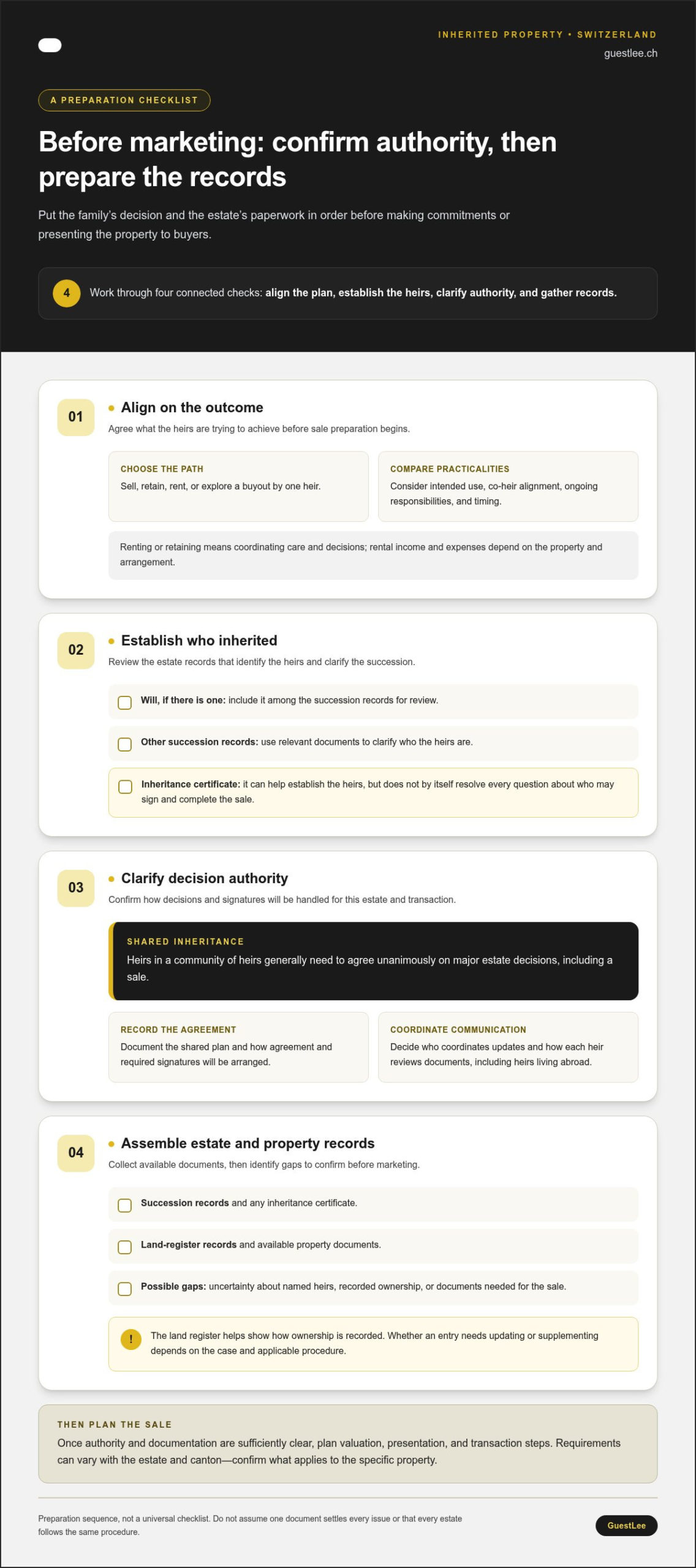
A property can be ready for the market long before the estate is ready to sell it. Before arranging viewings or discussing an offer, establish who inherited the property, how decisions must be made and which records the transaction will require. Documents and procedures can depend on the estate and canton, so treat this as a preparation sequence, not a universal checklist.
An inheritance document can help establish who the heirs are, but it does not by itself answer every question about who may sign and complete a property sale. Confirm both the heirs’ status and the authority needed for this specific transaction before committing to a sale process.
- Establish the heirs. Review the will, if there is one, and other succession records relevant to the estate.
- Clarify decision authority. Identify whether the property is shared among heirs and how their agreement and signatures will be documented.
- Assemble property and estate records. Gather the inheritance certificate and available land-register and property documents for review.
- Prepare the sale. Once authority and documentation are sufficiently clear, plan valuation, presentation and transaction steps.

Documents and registration to clarify before marketing
Start by gathering the will or other succession records, any inheritance certificate, and available land-register records for the property. An inheritance certificate can be essential when heirs need to dispose of estate assets, including real estate. The land register helps establish how ownership is currently recorded, but whether an entry must be updated or supplemented before a sale depends on the case and applicable procedure.
Use the records to identify gaps, such as uncertainty about the named heirs, registered ownership or documents required for the sale. Don’t assume one document settles every issue or that every estate follows the same sequence. Confirm current requirements for the property’s canton and circumstances before marketing. Avoid relying on a fixed registration deadline or a checklist prepared for a different estate.
Co-heirs, non-resident heirs and decision authority
If several heirs share the property, establish how they will reach and record a decision and arrange any required signatures. A community of heirs generally needs to agree unanimously on major decisions, including a sale. Decide who will coordinate communications and how each heir will review documents before the transaction advances.
For heirs living abroad, include communication, representation and cross-border administration in the planning. Residence abroad alone shouldn’t be treated as proof that Swiss requirements have changed. Clarify the estate’s specific process, the documents each heir needs to provide and how signatures will be handled. This can reduce avoidable pauses once a buyer is involved.
After ownership and authority are clear, the sale can move into careful preparation. GuestLee’s Swiss real estate sales supports property presentation and marketing, while legal and tax questions remain separate matters for the relevant professionals.
Taxes on selling inherited property in Switzerland: separate the questions
Tax planning is clearer when the inheritance and the later sale are treated as separate events. Inheritance-related taxes concern the transfer of value to heirs; taxes connected with a later sale concern the property transaction and, where applicable, its gain. The canton, estate and property history can all matter, so a rate or rule from another case may not predict your net proceeds.
Use this comparison to identify questions to resolve, not to calculate a tax bill. Switzerland has no federal inheritance tax; inheritance and gift taxes are a cantonal matter. For real estate, the canton where the property is located may be relevant to inheritance tax, while property gains tax is generally considered in the canton where the property is situated. Confirm the applicable rules using current official cantonal information.
| Tax question | What it concerns | What to verify |
|---|---|---|
| Inheritance tax | The transfer of the inheritance to an heir. | Whether it applies to the heir and property, and how the relevant canton treats the case. |
| Property gains tax | A potential tax on a gain when the inherited property is sold. | How the gain, acquisition value, ownership history and any allowable costs are treated. |
| Transfer-related tax | A possible cantonal tax connected with the property transaction. | Whether it applies to the sale and how responsibility is handled for that transaction. |

Property gains tax and the inherited property’s history
Before estimating what a sale could leave the heirs, establish how the canton will assess the property’s history. In inherited-property cases, the relevant acquisition value may be linked to what the deceased originally paid, rather than simply the property’s value at inheritance. The treatment depends on applicable rules and records, so don’t assume the inheritance valuation becomes the sale’s tax basis.
Gather available purchase documents, records of improvements and transaction-related costs. A qualified tax professional can verify, using current official cantonal rules, which amounts may be recognized and how the ownership period is treated. Documented expenses do not automatically qualify as deductions, and don’t assume the tax result before the property-specific review.
Inheritance, transfer and cross-border tax questions
An inheritance tax assessment and a property gains tax assessment answer different questions, even when they relate to the same home. A transfer-related charge may also need consideration. If heirs live in different countries, include their residence-country reporting and any interaction with Swiss taxation in the review. Don’t assume an exemption or double-taxation relief applies automatically.
For heirs selling inherited property in switzerland, a practical preparation step is to make a short tax file: note the property’s canton, collect available acquisition and improvement records, identify where each heir is tax-resident, and list open sale-related questions. A qualified adviser can assess the facts and current rules before the heirs rely on estimated net proceeds.
Prepare an inherited property for sale with a clear action plan
Once the heirs have agreed on a sale and clarified their authority, a measured preparation plan can turn a family decision into a coordinated transaction. The aim isn’t to make every choice at once. Create a shared record of what’s known, what needs attention and who will move each item forward.
Record the agreed sale objective, each heir’s responsibilities and unresolved questions. This gives everyone a common reference point, particularly if some heirs aren’t involved in day-to-day preparation.
- Align the heirs. Confirm the shared intention to sell and note any conditions or questions that still need agreement.
- Organize available records. Collect ownership and inheritance documents alongside maintenance history and property-related records.
- Assess the property. Review its condition and identify presentation needs before deciding whether repairs or other work are appropriate.
- Plan the marketing. Match valuation and presentation choices to the property, its condition and the heirs’ sale objectives.
- Coordinate transaction steps. Keep responsibilities, decisions and open questions visible as the sale progresses.

Records, condition and sale readiness
A useful file may include ownership and succession records, available maintenance information, plans or manuals, and paperwork relating to improvements. The records available will differ from one home to another. Note missing documents or details that still need to be established rather than treating a general checklist as a complete requirement for every sale.
Assess the property with the intended sale in mind. A well-maintained home may need less preparation than one requiring substantial work. Decide whether repairs, clearing or other presentation steps are worthwhile after considering the property’s condition and the heirs’ objectives. Any related costs, possible tax treatment, deductions or certificates should be assessed for the specific property and canton, not assumed in advance.
Marketing and transaction coordination
Thoughtful marketing helps prospective buyers understand the property’s layout, character and condition. GuestLee’s real estate sales service uses high-end architectural photography and 3D virtual tours as part of property presentation. These tools can give buyers a clearer first impression, while valuation, marketing choices and the transaction plan should reflect the home and the heirs’ aims.
For heirs considering the property as part of a wider portfolio decision, compare the intended sale with the responsibilities and objectives of continued ownership. GuestLee’s Swiss property sales and management gives heirs a way to explore those ownership options through its real estate services, separate from legal and tax advice.
Before marketing, bring the preparation together in a shared record: decisions made, documents assembled, condition issues noted, responsibilities assigned and questions awaiting resolution. This keeps the process transparent without assuming a fixed sale timeline or outcome.
If the heirs are ready to plan a professionally prepared sale, explore GuestLee’s Swiss real estate sales.
Choose the next step: sell, retain or manage the inherited property
The right choice is the one that fits the heirs’ shared priorities and capacity to look after the property. A sale may suit heirs who want to end shared ownership or realize the asset. Retaining it may be worth considering if an heir plans to use the home or the family values continued ownership and can agree on its responsibilities. Renting is another possibility, but income and ongoing costs depend on the property and arrangement.
Before deciding, consider what each option requires in practice: agreement among heirs, time for decisions, responsibility for upkeep and clarity about intended use. If no single option suits everyone, a buyout may be worth discussing. Don’t treat an estimated sale price or potential rental income as the answer on its own; compare the choices against the heirs’ objectives and the property’s circumstances.
If the heirs decide to sell
Move toward marketing only after the heirs have aligned on the sale, clarified authority and reviewed the tax questions relevant to the property. GuestLee’s Swiss real estate sales service supports the presentation of high-value properties with high-end architectural photography and 3D virtual tours. These tools can help communicate the home’s character to prospective buyers, without promising a particular sale price or timeline.
A well-prepared sale gives the heirs a structured route from a shared decision to a property presented with care. GuestLee supports marketing and presentation; legal and tax advice remain separate.
If the heirs decide to retain the property
Keeping the home also means deciding how its day-to-day care and longer-term responsibilities will be handled. Professional management can help coordinate property operations. GuestLee’s full-service management includes proactive maintenance, white-glove cleaning and a dedicated property manager. This support can help heirs organize ownership responsibilities, without guaranteeing rental income or a particular financial result.
Consider whether the heirs have a clear arrangement for decisions, upkeep and the property’s intended use. If they want support with ongoing ownership, GuestLee’s property management services provide a management option to consider alongside continued ownership.
In short, selling inherited property in switzerland may suit heirs seeking to resolve shared ownership, while retaining the home can suit those with a clear purpose and a workable care plan. GuestLee offers Swiss real estate sales and full-service property management. Legal and tax advice remain separate.
Give the heirs a clear next step
The most useful decision now is a manageable one: agree what needs to happen next, who will take responsibility and which questions still need resolution. A shared plan can keep family discussions focused, whether the heirs are preparing for a sale or choosing to hold the property. There’s no need to force a decision before ownership, financial and practical considerations are understood.
For heirs ready to explore a sale or continued ownership, GuestLee provides Swiss real estate sales and full-service property management. Its services are trusted by more than 150 homeowners. Support with property presentation or ongoing care can help organize the practical next steps, while heirs remain guided by their objectives and professional advice where needed.
When the heirs are ready, explore GuestLee’s Swiss property sales and management to discuss a considered plan for the property.
Frequently Asked Questions
Can you sell inherited property in Switzerland before the land register is updated?
Possibly, but whether a sale can proceed before an update depends on the estate, recorded ownership and transaction requirements. An inheritance certificate may establish the heirs’ status, while the land-register position raises a separate question about the steps needed to complete a transfer. Before making commitments or setting a marketing plan, confirm the documentation and registration procedure for the specific property and canton.
Do all heirs have to agree before inherited Swiss property is sold?
If the property is held within a community of heirs, a sale generally requires the heirs’ unanimous agreement. The ownership structure and authority in a particular estate still need to be verified, especially if a will, representative or other arrangement affects decision-making. Before appointing someone to handle the sale, establish how agreement will be recorded and who is authorized to sign the relevant documents.
Is inheritance tax the same as property gains tax in Switzerland?
No. Inheritance tax concerns the transfer of an estate to an heir, while property gains tax may arise when the property is later sold. They involve different taxable events and may be assessed under different rules. For selling inherited property in switzerland, check the relevant canton’s current treatment and the property’s history. Don’t assume that resolving one tax question settles the other.
Can a non-resident sell property inherited in Switzerland?
A non-resident may be able to sell inherited Swiss property, but the estate’s authority and sale requirements still need to be established for that case. Living abroad can add practical planning needs, such as coordinating documents, communication, representation and signing arrangements across borders. It doesn’t, by itself, establish that Swiss requirements differ. Heirs should also obtain case-specific advice on any tax or reporting obligations in their country of residence.
What documents may be needed to sell an inherited property in Switzerland?
Potentially relevant documents include a will or other succession records, an inheritance certificate, land-register information and records relating to the property. The file may also benefit from available purchase, improvement or maintenance documents. This is an illustrative list, not a universal requirement. Documents needed can depend on the estate and transaction, so confirm current requirements for the property’s canton before preparing contracts or marketing materials.
Can one heir buy out the others instead of selling the inherited property?
Yes, a buyout can be considered as an alternative to selling to an outside buyer, if the heirs can agree on the arrangement. They’ll need to resolve how the property is valued, how the departing heirs’ interests will be settled and how ownership will be documented. The legal and tax effects depend on the estate and canton, so review the proposed structure before relying on a valuation or proceeds estimate.
Should heirs sell an inherited property or keep it as a rental?
It depends on whether the heirs prioritize ending shared ownership or continuing to hold the property for a defined purpose. Compare potential rental income with property-specific expenses, maintenance needs, management responsibilities and the heirs’ willingness to coordinate decisions. Renting doesn’t guarantee a return, and a sale isn’t automatically preferable. A realistic comparison of the home’s condition, likely operating needs and family objectives can help clarify which route is workable.

Article by
Giacomo Esposito