
Swiss Property Taxes for Non-Residents: 2026 Guide
What if the labyrinth of Swiss tax law is actually the silent guardian of your investment’s enduring value? Many international owners feel a sense of hesitation when faced with 26 distinct cantonal systems and the peculiar “imputed rental value” tax. It’s a natural concern. You want the security of a Swiss retreat without the friction of unexpected fiscal liabilities or the fear of double taxation. This 2026 guide provides a clear roadmap through the sophisticated landscape of swiss property taxes for non-residents, ensuring you navigate acquisition costs and ongoing liabilities with absolute confidence.
We’ll examine the latest cantonal shifts, from varying notary fees to diverse wealth tax calculations across the country, alongside tax-efficient management strategies designed to optimize your property’s financial performance. You’ll gain a comprehensive understanding of your obligations and the current status of legislative changes like the “Eigenmietwert” abolition. Our aim is to provide the peace of mind that comes from meticulous expert knowledge, leaving you free to enjoy the curated experiences and effortless lifestyle your Swiss home provides.
Key Takeaways
- Understand how Switzerland’s 26 unique cantonal systems create a varied fiscal landscape for international owners.
- Navigate the acquisition process with a clear understanding of swiss property taxes for non-residents, from transfer fees to notary costs.
- Gain clarity on ongoing liabilities like wealth tax and the current status of the imputed rental value for 2026.
- Discover the benefits of the Swiss anti-speculation model, where long-term property holding leads to reduced capital gains tax.
- Learn strategies to transform your seasonal home into a revenue-generating asset that offsets annual maintenance and tax costs.
The 2026 Fiscal Landscape for Non-Resident Swiss Property Owners
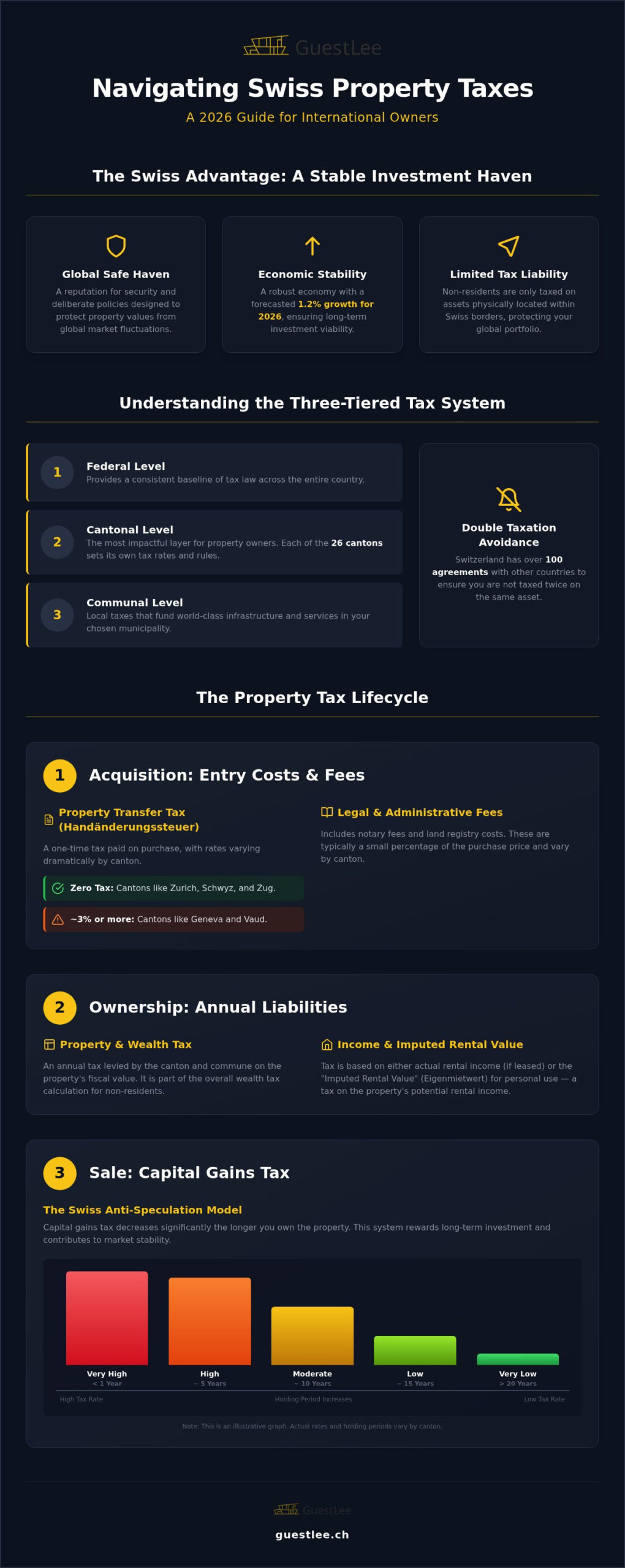
Switzerland remains a beacon of fiscal predictability. While global markets fluctuate, the Swiss real estate sector maintains its allure through a 1.2% economic growth forecast for 2026 and a reputation as a global safe haven. This stability isn’t accidental; it’s a result of deliberate policy designed to protect property values. For international owners, understanding swiss property taxes for non-residents begins with the principle of limited tax liability. This framework ensures you’re only taxed on assets physically located within the Swiss borders, protecting your global portfolio from unnecessary exposure. It’s a reassuring system that prioritizes the security of your capital while maintaining the high standards of the local community.
To better understand how these layers of taxation function, watch this helpful video:
Understanding Economic Affiliation
Owning a luxury villa or a lakeside apartment creates a permanent fiscal link known as economic affiliation. It’s a structured partnership between the owner and the state. You don’t need to be a resident to have this connection; the mere presence of your property establishes the link and triggers specific obligations regarding swiss property taxes for non-residents. Switzerland manages this through an extensive network of over 100 Double Taxation Agreements. These treaties are designed to ensure your investment remains efficient and you aren’t taxed twice on the same asset. It’s a meticulous approach that prevents over-foreignization while welcoming those who value Swiss standards of excellence. This system ensures that your home remains a private sanctuary while contributing fairly to the regional prosperity that makes Switzerland so desirable.
The Three-Tiered Swiss Tax System
The Swiss tax system is a masterpiece of precision and local autonomy. It operates across three distinct levels: federal, cantonal, and communal. Federal taxes provide a consistent baseline across all 26 cantons, but the real nuances emerge at the regional level. Cantons have significant power to set their own rates, reflecting their unique economic priorities. For example, in 2026, Zurich reduced its cantonal multiplier to 95%, while Lucerne adjusted to 1.45 units and Schwyz moved to 110%. This decentralization means your choice of location directly impacts your fiscal obligations. Communal taxes are the final layer, funding the world-class infrastructure and seamless services that GuestLee clients expect from their high-end residences. These local contributions ensure that every detail, from the mountain roads to the local concierge services, meets a global gold standard for quality.
Entry Costs: Taxes and Fees at the Point of Acquisition
Entering the Swiss real estate market is a journey of meticulous details. When you secure a prestigious residence, the initial fiscal steps set the tone for your investment. Understanding swiss property taxes for non-residents at the point of acquisition is essential for a seamless transition into ownership. These entry costs are primarily cantonal, meaning your choice of location determines the initial financial commitment. It’s this regional autonomy that allows for a tailored investment strategy, provided you have the right guidance to navigate the local nuances.
Property Transfer Tax Variations
The most significant variable is the Property Transfer Tax, known locally as Handänderungssteuer. In early 2026, the landscape remains diverse. Cantons like Zurich, Schwyz, and Zug continue to waive this tax entirely, offering a streamlined entry for investors. Conversely, if you’re drawn to the lakeside elegance of Geneva or the terraced vineyards of Vaud, you should anticipate rates of approximately 3% or more. In luxury transactions, it’s standard practice for the buyer to assume this cost, though local customs can occasionally vary. Calculating this tax based on the purchase price ensures there are no surprises during the final signing, allowing you to focus on the aesthetic and lifestyle potential of your new home.
Legal and Administrative Fees
The Swiss legal process is a hallmark of impartiality and security. A Notary Public acts as a neutral guardian of the transaction, ensuring the title transfer is beyond reproach. Fees for these professional services are also cantonal. In Zurich, you might see rates as low as 0.1%, while in the Valais or Geneva, they typically range from 0.5% to 1%. For non-resident buyers, it’s useful to account for VAT on these professional services as part of your administrative budget. For a broader perspective on the current market, you may wish to explore our Luxury Real Estate Switzerland: The 2026 Guide.
Following the legal signing, the Land Registry (Grundbuch) entry finalizes your ownership. In 2026, Switzerland has further embraced digital registration, enhancing the speed and precision of this final step. Expect fees between 0.1% and 0.3% of the purchase price. If your acquisition involves financing, the creation of a mortgage note (Schuldbrief) incurs an additional cost of approximately 0.1% to 0.3% of the loan amount. Finally, as a non-resident, you may face Lex Koller administrative fees, which typically range from CHF 500 to CHF 2,000. These steps ensure your asset is protected by the full weight of Swiss law. To ensure every detail of your acquisition is handled with concierge-level care, consider partnering with a sophisticated property management specialist who understands these regional nuances.
Ongoing Ownership Taxes: Wealth, Income, and Imputed Rental Value
Once the keys are in hand, the focus shifts to the graceful stewardship of your asset. The annual rhythm of ownership in Switzerland involves a few specific fiscal obligations that maintain the high standards of the local infrastructure. Understanding these ongoing swiss property taxes for non-residents is key to ensuring your investment remains a source of pleasure rather than a source of administrative complexity. While the system is comprehensive, it’s also remarkably logical, rewarding those who maintain their properties with care and attention to detail.
Demystifying the Imputed Rental Value
One unique aspect of the Swiss system is the “imputed rental value,” or Eigenmietwert. This is essentially a theoretical income you’re considered to have received by living in your own home rather than renting it out. While it may seem counterintuitive, it’s designed to create tax equity between homeowners and renters. Although Swiss voters approved the abolition of this tax on September 28, 2025, the Federal Council announced on April 1, 2026, that the change won’t take effect until January 1, 2029. For the 2026 tax year, the current system remains in place.
Cantonal treasury offices typically calculate this value at approximately 60% to 70% of the market rental rate. However, you can offset this “income” through meticulous record-keeping. Deductions for mortgage interest and essential maintenance costs are powerful tools for fiscal optimization. By keeping your Alpine retreat or lakeside villa in peak condition, you’re not just preserving its beauty; you’re also managing your tax liability with precision.
Wealth and Property Taxes
Switzerland also levies a wealth tax (Vermögenssteuer) on your net assets, including real estate. It’s important to distinguish between the market value of your home and its “tax value” (Steuerwert), which is usually significantly lower. In 2026, wealth tax rates remain progressive and vary by location. For a property with a net taxable value of CHF 1 million, a couple might expect an annual wealth tax of approximately CHF 1,744 in Zurich, CHF 5,115 in Geneva, or CHF 6,394 in Lausanne. These contributions support the pristine environments that make these regions so exclusive.
Beyond wealth tax, some cantons apply a direct annual property tax (Liegenschaftssteuer). These rates generally range between 0.02% and 0.3% of the property’s taxable value. For a CHF 1 million residence, this equates to a modest annual contribution of CHF 200 to CHF 3,000. If you choose to generate revenue from your home, rental income is taxed as ordinary income at federal and cantonal levels, with marginal rates typically spanning 15% to 45%. Many owners find that partnering with a professional asset manager allows them to maximize this revenue while ensuring every fiscal detail is handled with the quiet confidence of a luxury concierge service.
The Exit Strategy: Capital Gains Tax and Resale Considerations
Switzerland rewards the patient investor. The Real Estate Capital Gains Tax, known as Grundstücksgewinnsteuer, serves as a pillar of the Swiss anti-speculation model. It’s designed to protect the integrity of the market by discouraging rapid turnover and encouraging long-term asset guardianship. For international owners, understanding how this tax applies to swiss property taxes for non-residents is essential for crafting a sophisticated exit strategy. It ensures that when you eventually decide to pass on your Swiss retreat, you do so with a clear understanding of the fiscal rewards of your stewardship.
Holding Periods and Tax Liability
The duration of your ownership is the most critical factor in determining your tax liability. Swiss cantons apply a tiered system where the tax rate diminishes as the years pass. For example, in the Canton of Zurich as of June 2026, the tax rate is progressive, ranging from 10% on the first CHF 4,000 of profit to 40% on profits exceeding CHF 100,000. If you sell within the first two years, a surcharge of up to 50% may apply. This makes short-term flipping less attractive but enhances the value of a long-term hold. By the time you reach the 20-year milestone, many cantons offer a reduction of up to 50% on the total tax due. This approach reinforces the idea of Swiss real estate as a generational legacy asset, meant to be enjoyed and preserved over decades.
Allowable Deductions on Resale
Calculating your taxable gain is a process that requires meticulous attention to detail. You’re only taxed on the net profit, which means a variety of costs can be used to offset your liability. You can deduct the original purchase price, but also any investment in value-adding renovations or high-end maintenance that has increased the property’s substance. Additionally, professional fees such as brokerage commissions, notary costs, and the property transfer taxes paid at acquisition are all deductible. To ensure your property is managed to these exacting standards, you may find The Definitive Guide to Property Management Services in Switzerland to be an invaluable resource. Proper documentation of these expenses is the hallmark of professional asset management. If you’re planning for the future of your investment, our experts can help you optimize your property’s value through strategic maintenance and fiscal oversight.
Optimizing Your Investment: Tax-Efficient Asset Management with GuestLee
Owning a prestige property in Switzerland is more than a financial commitment; it’s a statement of taste and a long-term investment in stability. While the previous sections have detailed the various swiss property taxes for non-residents, the true art of ownership lies in transforming these fiscal obligations into a high-performing luxury asset. At GuestLee, we believe that a well-managed home should do more than just sit idle. By implementing a sophisticated management strategy, you can pivot from simply paying taxes to generating a robust revenue stream that offsets annual liabilities and enhances your property’s capital value.
Our approach centers on the “Seamless Experience,” where the logistical complexities of Swiss regulations are handled with quiet confidence behind the scenes. We optimize occupancy levels through a curated network of international travelers who value the same high standards of excellence that you do. This strategic rental income can comfortably cover your annual wealth taxes and communal levies, effectively neutralizing the carrying costs of your Swiss residence. It’s a dual-focus narrative that satisfies both the heart of the traveler and the mind of the investor.
Professional Property Management Services
Navigating the requirements of swiss property taxes for non-residents requires more than just a calculator; it demands a partner with deep regional accuracy. GuestLee provides a refined, concierge-level service that ensures your property remains compliant with all local regulations while you are abroad. We handle everything from the precision of tax-related record-keeping to the meticulous maintenance that preserves your home’s substance. By maintaining the property to the highest regional standards, we ensure that every renovation and high-end repair is properly documented, maximizing your allowable deductions should you ever choose to sell.
- Sophisticated Hospitality: We treat your home with the same reverence as a high-end boutique hotel, ensuring every guest experience is flawless.
- Yield Optimization: Our data-driven approach to rental rates ensures your asset performs at its peak potential in every season.
- Asset Guardianship: We act as the watchful protectors of your property value, overseeing every detail so no element is overlooked.
Securing Your Swiss Legacy
Professional management is the gold standard for non-resident owners who wish to secure their Swiss legacy without the burden of day-to-day administration. It’s about the peace of mind that comes from knowing your asset is in the hands of a trustworthy guardian. Your home remains a pristine sanctuary for your personal use, prepared to your exact specifications whenever you arrive, while functioning as a disciplined financial instrument in your absence. This balance of experiential comfort and financial efficiency is what defines the GuestLee standard of excellence. If you’re ready to elevate your ownership experience and optimize your fiscal performance, we invite you to Partner with GuestLee for Premier Swiss Property Management.
Securing the Future of Your Swiss Investment
Owning a home in the Swiss Alps or along the shores of Lake Geneva is a privilege that comes with a unique set of fiscal responsibilities. You’ve seen how the 2026 landscape rewards the patient investor, particularly through tiered capital gains reductions and the strategic use of maintenance deductions. From the initial acquisition fees to the nuances of wealth tax, the key to success lies in understanding that these obligations aren’t barriers; they’re the foundation of a stable, world-class market.
Managing swiss property taxes for non-residents doesn’t have to be a solitary burden. By partnering with a dedicated guardian of your assets, you can ensure every cantonal detail is handled with precision. GuestLee offers expertise in Swiss luxury real estate with a dual focus on owner returns and high-end hospitality. We invite you to Discover GuestLee’s Bespoke Property Management Solutions to transform your residence into a performing investment. Your Swiss legacy is waiting to be optimized, and we’re here to ensure it remains a source of enduring pride and financial growth.
Frequently Asked Questions
Can a foreigner buy property in Switzerland without a residence permit?
Yes, foreigners can buy property without a residence permit, provided the residence is a holiday home located in a designated tourist area. These acquisitions are subject to a quota system and require a specific authorization from the cantonal authorities. It’s a structured process that ensures the Swiss landscape remains exclusive and well-preserved. While primary residences are reserved for residents, non-residents can enjoy the prestige of a mountain retreat or a lakeside villa.
What is the Lex Koller and how does it affect my purchase in 2026?
Lex Koller is a federal law that restricts the acquisition of Swiss real estate by persons abroad to prevent the over-foreignization of the soil. In 2026, it continues to limit non-residents to purchasing holiday homes in specific regions, with a standard limit of one property per family. The property’s net living area is typically capped at 200 square meters. These regulations maintain the market’s stability and ensure that swiss property taxes for non-residents contribute to a balanced national economy.
How is the ‘imputed rental value’ (Eigenmietwert) calculated for non-residents?
The imputed rental value is determined by cantonal tax offices as a percentage of the property’s market rental potential, usually ranging between 60% and 70%. Although voters have approved its eventual removal, the system remains active for the 2026 tax year and won’t be abolished until January 1, 2029. Owners can mitigate this theoretical income by deducting mortgage interest and documented maintenance costs, reflecting the meticulous Swiss approach to fiscal fairness and property stewardship.
Do I have to pay Swiss wealth tax if I live outside of Switzerland?
Yes, you are subject to Swiss wealth tax on the value of your property due to the principle of limited tax liability. Even if your primary residence is abroad, the physical presence of your asset in Switzerland creates a fiscal link. The tax is calculated on the tax value (Steuerwert) of the property, which is generally lower than the market price. This contribution supports the world-class infrastructure and high-end regional standards that protect your investment’s value.
Can I deduct my Swiss mortgage interest from my Swiss tax return?
You can deduct your Swiss mortgage interest from your Swiss tax return, though it is often calculated on a pro-rata basis. Swiss authorities typically allow a deduction proportional to the ratio of your Swiss assets to your total global assets. This requires clear documentation and a sophisticated understanding of international tax treaties. Properly managing these deductions is a key part of optimizing the financial performance of your luxury residence while ensuring full compliance with local standards.
What is the average property transfer tax for non-residents in Switzerland?
Property transfer tax rates vary significantly across the 26 cantons, ranging from 0% to approximately 3.3% of the purchase price. In early 2026, cantons like Zurich and Schwyz don’t levy this tax at all, while Geneva and Vaud maintain rates near 3%. When calculating swiss property taxes for non-residents, it’s essential to factor in these regional differences at the start of your acquisition journey to ensure a seamless and predictable transition into ownership.
Are there restrictions on renting out my Swiss holiday home?
Non-residents are generally permitted to rent out their holiday homes on a short-term, seasonal basis when they aren’t using the property themselves. However, the Lex Koller prevents these properties from being used as permanent, long-term rentals. Utilizing a professional management service like GuestLee ensures your home remains a revenue-generating luxury asset while adhering to all local regulations. This allows you to enjoy the returns of a performing investment without the administrative complexity of managing guests.
How long do I need to hold a property to minimize capital gains tax?
To achieve the maximum reduction in capital gains tax, you should aim for a holding period of 20 years or more. Swiss cantons use a tiered system where the tax rate decreases the longer you own the property, with some regions offering up to a 50% discount after two decades. Conversely, selling within the first two years often triggers a significant surcharge. This model rewards the patient guardian and reinforces the status of Swiss real estate as a generational legacy.

Article by
Giacomo Esposito