
Understanding Swiss Property Ownership Structures and Rights
In Switzerland, the land register records more than the name of a property owner: it shows the legal form of ownership. Understanding Swiss property ownership structures starts with the distinction between sole ownership, co-ownership with defined shares, joint ownership and condominium ownership. A transfer of property is completed through registration in the land register.
It is natural to focus on the property itself, but the ownership structure affects who can make decisions, how a sale is handled and which rights come with the home. The suitable arrangement depends on whether an individual owns the property, several people share it or a company holds title.
This guide explains how the land register works, what company ownership involves and how condominium owners’ associations manage shared spaces and responsibilities. It also outlines how EU/EFTA residence status relates to property rights under Lex Koller, helping you understand the legal framework before a Swiss purchase.
Key Takeaways
- Understand how land-register entries distinguish ownership types and why registration makes a property transfer formal.
- See why buying through a real estate company can affect both tax treatment and the application of Lex Koller.
- Learn how condominium ownership combines private-unit rights with shared responsibilities, and what association records can reveal.
- Clarify how EU/EFTA residence status can shape property-purchase rights and the distinction between a primary home and other property.
Transferring shares and land-register registration
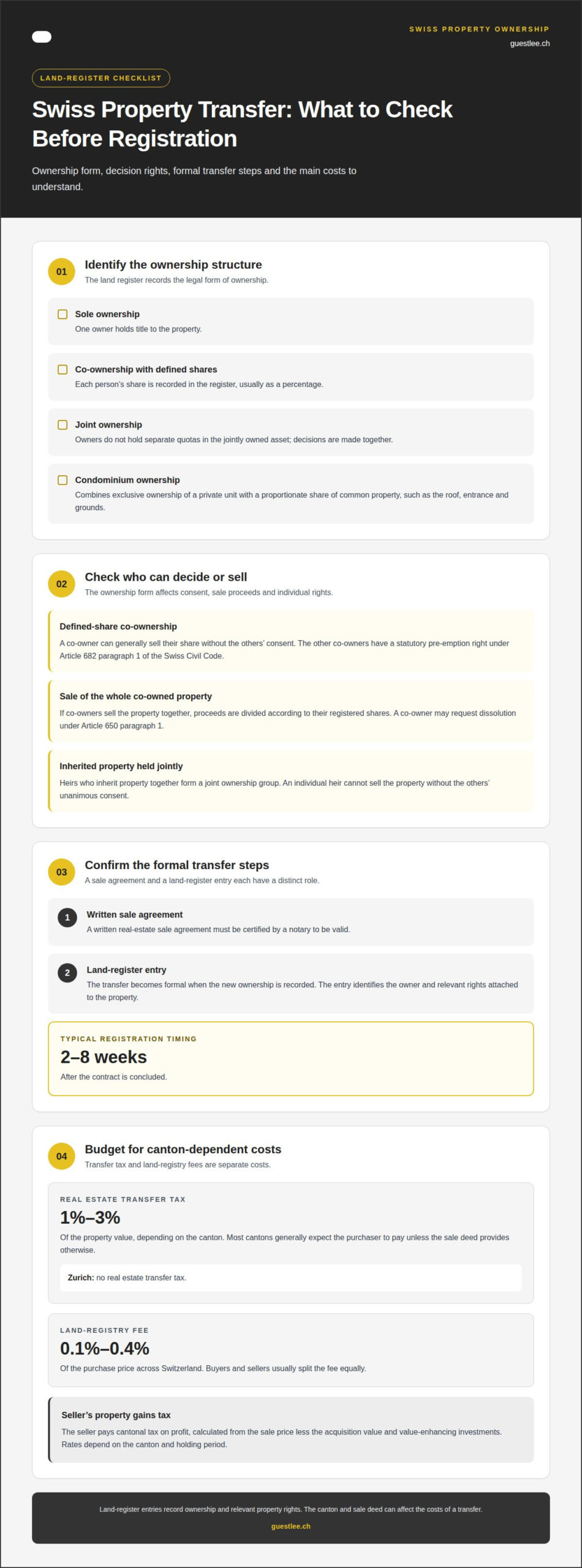
Understanding Swiss property ownership structures starts with the land register: a Swiss property transfer becomes formal once the new ownership is recorded. A written real-estate sale agreement must be certified by a notary to be valid. Registration typically takes 2-8 weeks after the contract is concluded. The land-register entry identifies the owner and records relevant rights attached to the property.
For co-ownership, the register records each person’s defined share, usually as a percentage. An individual co-owner can generally sell that share without the others’ consent. However, the other co-owners have a statutory pre-emption right under Article 682 paragraph 1 of the Swiss Civil Code. If co-owners sell the whole property together, proceeds are divided according to their registered shares. A co-owner may also request dissolution under Article 650 paragraph 1.
Inheritance planning matters because heirs who inherit property together form a joint ownership group. An individual heir cannot sell the property without the others’ unanimous consent. Understanding Swiss property ownership structures also means considering how an estate plan can record the family’s intentions and help heirs make future decisions about the property.
Transfer taxes depend on the canton. Swiss real estate transfer tax can range from 1% to 3% of the property value, and most cantons generally expect the purchaser to pay unless the sale deed provides otherwise. Zurich does not apply a real estate transfer tax. The seller pays cantonal property gains tax on profit, calculated from the sale price less acquisition value and value-enhancing investments. Rates depend on the canton and holding period.
Budget separately for registration costs: across Switzerland, the land registry fee ranges from 0.1% to 0.4% of the purchase price, and buyers and sellers usually split it equally. Share transfers can receive different tax treatment from direct acquisitions. In Geneva, acquiring property through shares in a real estate company is in principle not subject to transfer tax, while direct acquisition may incur transfer tax. The transaction structure, canton and sale deed shape acquisition costs.
Commercial property acquisition through a company
A Swiss real estate company holds the property title, while investors hold shares in the company. This structure changes how acquisition, taxation, succession and property-related obligations are organised.
Company Ownership and Foreign Control
A Swiss company is presumed foreign-controlled under Lex Koller if persons abroad hold more than one third of its equity capital or voting rights. The presumption also applies if they provide at least 50% of its debt financing. These tests matter because Lex Koller also covers indirect acquisitions through real estate companies. Buying shares therefore doesn’t automatically avoid restrictions on property acquisition.
Swiss real estate companies commonly take the form of an SA, or public limited company, or a Sàrl, or limited liability company. They may acquire, manage, operate or sell real estate. The company holds registered title, while shareholders’ interests are represented by shares.
Personal or Company Ownership
Private residential property is usually held in an individual’s name. A company structure may warrant consideration for a luxury property or complex family, inheritance or privacy needs. The distinction affects how ownership passes: an individual owns the property directly, while investors in a company own shares. In Geneva, an individual’s sale of shares in a real estate company is treated transparently as a property sale for gains-tax purposes.
Company ownership can involve tax at both company and shareholder levels. In Geneva, a real estate company pays about 14% tax on net profit, while distributed profits face 35% withholding tax. A Swiss-resident shareholder with at least a 10% shareholding can credit withholding against personal income tax, with any difference reimbursed. Selling the property may also trigger cantonal property gains tax, which depends on the holding period and local rules.
When a company owns the property, successors may inherit shares rather than direct title to the property. The company remains the registered owner, and its ultimate beneficial owners must be known internally, although their identities are not public.
Condominium ownership and owners’ associations
In Switzerland, sole ownership gives the property to one owner; co-ownership assigns defined shares, while joint ownership has no individual shares. Joint owners make decisions together, and a sale requires unanimous consent. Condominium ownership, known as Stockwerkeigentum, combines exclusive ownership of a private unit with a proportionate share of common property.
For example, a buyer may own an apartment privately while sharing rights to the building’s roof, entrance and grounds. The land register records the condominium unit and its associated share of common property. This differs from sole ownership of an entire property, where one owner holds title and no other unit owners share the common areas.
Swiss co-ownership with defined quotas is addressed in Article 646 of the Swiss Civil Code, while Articles 646-651 govern co-ownership more broadly. These defined shares may guide decisions about the property and distribution of sale proceeds. In joint ownership, by contrast, individual owners don’t hold separate quotas in the jointly owned asset. This distinction can matter when relatives inherit property together or parties buy a home jointly.
A condominium owners’ association coordinates decisions about shared areas and expenses. Before buying, review its bylaws, financial statements and planned renovations. These documents can clarify existing commitments, upcoming building work and how owners take part in decisions. The purchase contract transfers the unit along with its associated rights and obligations, including association membership.
That membership continues after a unit is sold. A buyer takes on the related association responsibilities, so the unit’s condition is only part of the ownership picture. From January 1, 2023, Swiss condominium owners’ meetings must again be held in person; virtual meetings and written votes with majority resolutions are no longer permitted. This meeting rule shapes how owners discuss decisions affecting common property.
If you are considering a mortgage, the condominium’s shared obligations sit alongside your own financing and equity arrangements. Understanding both helps distinguish your control of the private unit from the duties attached to the building as a whole.
EU/EFTA buyer residence permits and ownership rights
For EU/EFTA buyers, Swiss residence status can affect whether Lex Koller treats them as persons abroad. This distinction matters because federal rules restrict some foreign purchases, including certain indirect acquisitions through companies.
An EU/EFTA national with a Swiss B permit is generally treated as not being a person abroad under Lex Koller. However, B-permit buyers may purchase a primary residence for personal use only, subject to partial restrictions. Buying an apartment as a home, for example, differs from acquiring a property as an investment. Residence status and intended use therefore affect what purchase is permitted.
Residence registration is a separate step from property acquisition. EU/EFTA nationals must register with their Swiss commune within 14 days of arrival and securing accommodation. Processing for financially independent EU/EFTA applicants typically takes 4 to 8 weeks. A permit supports residence rights, but it doesn’t automatically grant unrestricted rights to acquire every type of property.
Eligible EU/EFTA nationals may qualify for a C permit after five years of residence; others may need to wait ten years. Permit category can affect how Lex Koller applies, so distinguish immigration status from title registration and ownership form. A lawyer can assess how residence, intended use and transaction structure interact before you conclude a purchase contract.
Co-owners also have rights and obligations independent of residence status. Under Article 682 paragraph 1 of the Swiss Civil Code, other co-owners have a statutory pre-emption right when a co-owner sells a share. An individual can generally sell a defined share without their consent, but the pre-emption right may give them priority to acquire it. For joint ownership, a sale requires unanimous consent.
For buyers considering a Swiss property purchase, explore real estate sales with GuestLee as you assess the property, ownership form and intended use.
GuestLee: Property Management Services
GuestLee offers Property Management Services for owners who want attentive oversight of their Swiss property and a considered approach to rental operations. This can be a natural next step after clarifying ownership, particularly when a home will be offered as a luxury short-term rental. GuestLee supports property owners from setup through guest departure, helping coordinate the rental process and work toward efficient occupancy. Owners considering a sale can also explore Real Estate Sales, while guests seeking a refined stay may consider Luxury Villa Rentals. The right option depends on whether your priority is managing an owned property, selling real estate or arranging a short-term villa stay. For a considered discussion of your property needs, contact GuestLee.
Shape Your Next Property Decision With Confidence
Property plans can change as personal priorities, family circumstances and investment goals evolve. A home intended for personal use today may later become part of a sale, inheritance or rental decision. Considering these possibilities can help you choose an ownership approach that remains aligned with your priorities.
A clear understanding of Swiss property ownership structures gives you a stronger basis for weighing these choices over time. The next step is to relate the legal arrangement to the property’s intended purpose, the people involved and the responsibilities you want to retain. This can make future decisions more deliberate, whether you plan to buy, hold or change direction.
GuestLee can be part of the conversation as your plans take shape. Discuss your property plans with GuestLee and explore a thoughtful next step for your Swiss property. A well-considered decision today can support a more confident path ahead.
Frequently Asked Questions
How is the Swiss land register structured?
The Swiss land register organizes information around individual properties and their registered legal circumstances. Entries can identify the owner and record rights or burdens affecting the land, such as easements. Switzerland’s 26 cantons oversee their land registries, with about 2,300 municipal offices maintaining the register. Its parcel-based structure helps connect a property to the rights and restrictions relevant to a sale or ownership decision.
What are easements and can they be deleted?
Easements are registered rights that allow a person or property to use another property in a defined way, such as through a right of way. Buyers should account for them because registered easements bind a new owner. They cannot be removed unilaterally: removal requires the entitled party’s consent or judicial proceedings. For example, a neighbour’s registered access right continues after the burdened property is sold.
What does dependent or subjective in-rem co-ownership mean?
Dependent, or subjective, in-rem co-ownership links a share in one property to ownership of another. In practical terms, the share is associated with the principal property rather than treated as a separate holding. For example, owning a home may carry a related share in shared access land. In practice, the attached share generally passes with the principal property when ownership changes.
What is co-ownership?
Co-ownership means several people hold defined interests in the same property rather than one person holding the entire title. Those interests can guide how sale proceeds are allocated. For example, if two people hold unequal registered shares, their respective interests provide the basis for dividing the proceeds. This differs from joint ownership, in which owners hold the property together without individual shares.
Which forms of ownership does the Swiss land register show?
The Swiss land register records sole ownership, co-ownership with defined quotas, joint ownership without quotas and condominium ownership. These entries identify the legal arrangement attached to a property, not simply the people who use it. A prospective buyer can use the recorded form to see whether ownership is individual, shared in stated proportions, held jointly, or linked to a private condominium unit and common property.
What are the main legal forms of property ownership in Switzerland?
The main forms are sole ownership, co-ownership with defined shares, joint ownership and condominium ownership. A company may also hold registered title while individuals own shares in it; this differs from holding property personally. The appropriate structure depends on who will hold title, how decisions will be made and whether the property is intended for private, shared or company ownership.

Article by
Giacomo Esposito