Market value of alpine properties 2026: Price trends
An Alpine address is no guarantee of a uniform price trend. The market value of Alpine properties in 2026 depends on the destination and the individual home, so values across Switzerland’s mountain resorts need to be considered alongside property quality, demand, and available supply. These factors shape how a valuation may translate into a future resale.
For owners and prospective buyers, a strong resort reputation is only part of the picture. Climate exposure, international demand, and second-home regulation can influence long-term appeal and the time it takes to sell. This guide explores Swiss Alpine price trends and the wider forces that may affect value and liquidity. You’ll gain a clearer framework for assessing a property, whether you’re considering a purchase, planning a sale, or weighing how management and real estate services fit into ownership.
Key Takeaways
- Compare destinations by their recent price movement: in 2025, Swiss Alpine holiday-home prices rose nearly 6%, versus about 1% in France and just over 3% in Austria.
- Assess a mountain home’s climate exposure alongside its location and appeal beyond ski season; Alpine snowfall fell by 34% between 1920 and 2020.
- Factor Swiss second-home regulation into your assessment: the Lex Weber caps second homes at 20%, contributing to limited supply in Alpine areas.
- Allow for a typical Swiss Alpine property transaction of 3-6 months, while recognising that prime homes can sell quickly after listing.
Prices in French, Austrian and Italian Alpine destinations
Swiss Alpine property values vary by property type, quality, and local demand. These figures describe distinct property segments, so they provide context rather than a single national valuation.
Apartment prices offer another reference point, but they are not a national average and should not be compared directly with luxury-home benchmarks. To understand how an asking price relates to these broad indicators, consider the property’s condition, size, and position within its destination.
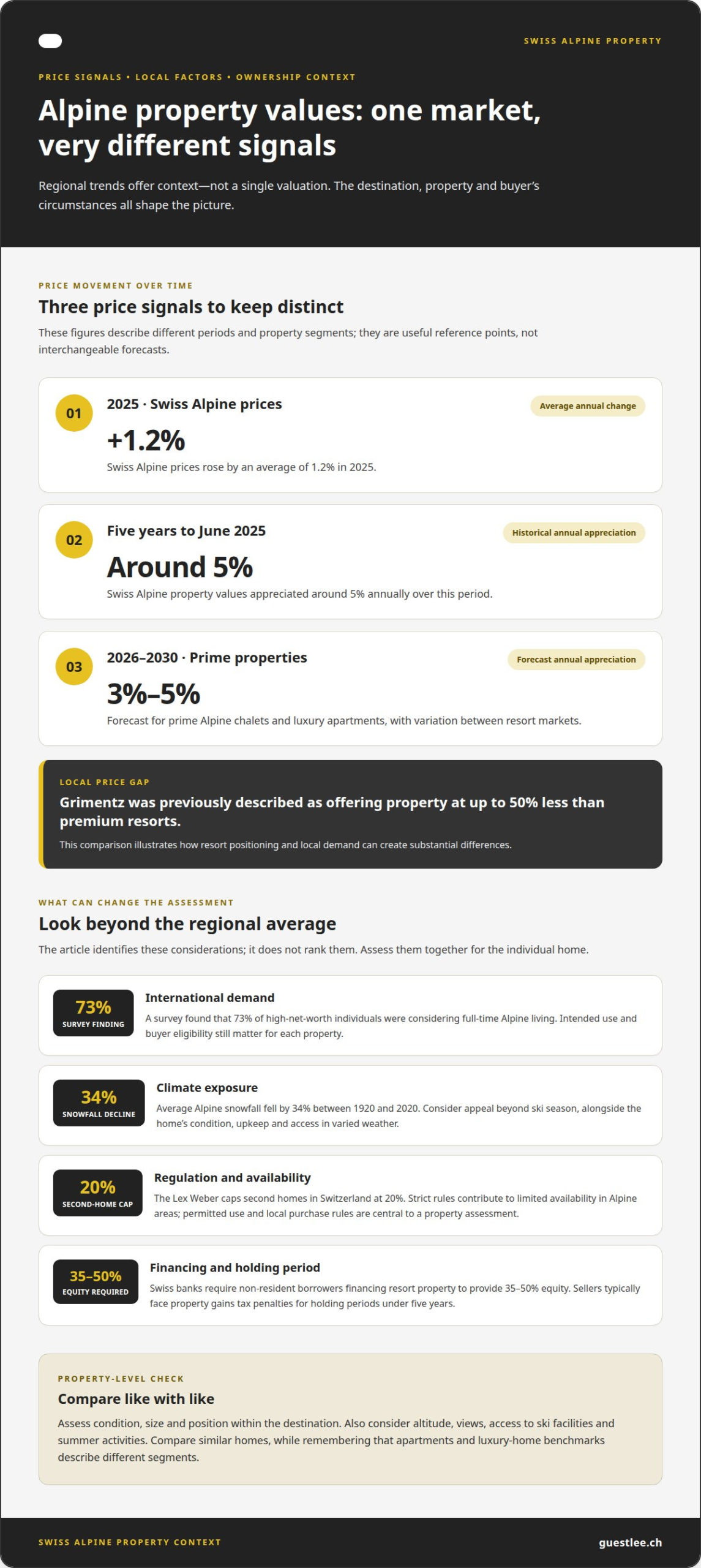
For the estimated market value of Swiss Alpine properties in 2026, recent data gives useful direction rather than one precise figure. Swiss Alpine prices rose by an average of 1.2% in 2025, while values had appreciated around 5% annually over the five years to June 2025. Prime Alpine chalets and luxury apartments are forecast to appreciate by 3% to 5% annually from 2026 to 2030, with variation between resort markets.
That means an individual chalet and apartment can follow different value paths, even within the same market. Swiss Alpine property prices rose by around 5% annually over the five years to June 2025, but that broad trend does not set a home’s price. Grimentz was previously described as offering property at up to 50% less than premium resorts. This comparison illustrates how positioning and local demand can create substantial price gaps.
When assessing a Swiss Alpine home, consider demand in its destination, the property’s condition, altitude, views, and access to ski facilities. Convenient access and an attractive outlook can strengthen buyer appeal, while summer activities may extend interest beyond winter. Compare these features with similar homes and the property’s intended use. Together, they provide a more grounded view of potential value than a regional average alone.
Climate change and mountain property values
Climate exposure adds a long-term consideration to Alpine property assessments. Average Alpine snowfall fell by 34% between 1920 and 2020. For buyers, that historic shift makes a destination’s appeal across the full season relevant, not only its winter conditions. It doesn’t determine a home’s value by itself, but it can influence how buyers assess future use.
In Switzerland’s mountain destinations, consider how the property and its surroundings serve different seasons. Summer activities can broaden a destination’s appeal beyond ski holidays. A mountain residence suited to year-round visits may attract interest from a wider range of buyers than one whose use depends heavily on snow. Seasonal demand can inform rental potential, but it does not establish a property’s income or resale value.
Property-level details matter alongside the wider outlook. During an assessment, examine the home’s condition, heating and ventilation systems, roof, drainage, and access in varied weather. These details help clarify maintenance needs and comfort across changing seasons. Even a well-positioned property can present practical challenges if access or upkeep becomes difficult.
For foreign buyers, climate exposure can also inform financing and ownership decisions. Compare the property’s maintenance profile with its intended use, expected rental periods, and holding horizon. A home planned for occasional winter stays may involve different considerations from one intended for longer visits or broader seasonal use. Consider financing commitments alongside the property and its planned use.
Use a focused assessment: consider seasonal appeal, inspect the home’s condition, and weigh ongoing upkeep against your plans. Owners can also explore mountain property stewardship as part of maintaining a residence over time. These factors help place the 34% historic snowfall decline in context, rather than treating it as a standalone measure of market value.
International demand and regulatory risks
International demand can support Alpine real estate values, but ownership rules shape who can buy. A survey found that 73% of high-net-worth individuals were considering full-time Alpine living. That interest reaches beyond winter holidays: buyers may seek chalets for residence, seasonal stays, or investment. For each property, intended use and eligibility matter alongside its appeal to foreign purchasers.
Swiss second-home regulation affects supply. The Lex Weber caps second homes in Switzerland at 20%, and strict rules contribute to limited property availability in Alpine areas. Scarcity can support prices where demand remains strong, but it also narrows the options available to buyers. In practice, the resort and property’s permitted use are central to assessing a purchase.
For taxes, purchase costs, and financing, a key Swiss consideration is property gains tax on resale: sellers typically face penalties for holding periods under five years. Swiss banks require non-resident borrowers financing resort property to provide 35-50% equity. These facts shape the cost of entering and exiting the market, while the property’s price and the buyer’s financing arrangements determine the transaction’s overall financial demands.
Andermatt differs from many Swiss Alpine resorts because it has more relaxed rules for non-residents buying property. This may widen the pool of eligible international buyers, but does not remove the need to assess financing and intended use. When comparing Andermatt with other destinations, treat local purchase rules as part of the property’s investment profile.
Before committing, establish whether the home is a second residence, identify the buyer’s residency status, and account for the planned holding period. Then consider how these factors interact with seasonal demand and the property’s intended role. A winter-focused chalet and a home intended for full-time residence may appeal to different buyers. In Switzerland, regulatory limits and financing requirements are therefore part of value assessment, not administrative details to leave until later.
Liquidity and transaction times
In Switzerland, a typical Alpine property transaction takes 3-6 months. Prime homes in Swiss resorts can sell quickly after listing, sometimes above asking price. These outcomes show why a general timeline cannot predict one property’s sale. A luxury chalet and a home with a narrower buyer pool may attract different levels of attention, even within the same location.
Liquidity depends on how closely a property matches active demand. Location, condition, layout, and intended use shape its appeal to buyers seeking a residence, seasonal retreat, or investment. International interest may broaden the audience for distinctive homes, while financing and purchase regulations can affect who is able to proceed. Each factor can influence the path from listing to completion.
For sellers, presentation and pricing establish the first impression. A clear description of the home, its setting, and practical features helps buyers understand its value. Accurate documentation can also help keep a transaction moving once interest becomes an offer. In Switzerland, allowing for the typical 3-6-month process supports realistic planning around a sale and any onward purchase.
To assess liquidity, look beyond a resort’s global appeal. Consider whether the property suits more than one lifestyle, such as winter stays and summer visits. Compare its condition and location with likely buyers’ expectations. These steps cannot guarantee a faster resale, but they can clarify which features may broaden or narrow the future buyer pool.
Timing also matters. Prime properties may attract swift interest, while other homes require a longer sales period. Build the Swiss transaction window into decisions about moving, financing, and coordinating a purchase with a sale. For focused guidance on positioning a property for sale, discuss your Alpine property sale.
GuestLee
GuestLee helps property owners connect market insight with the practical decisions involved in owning an Alpine home. If you’re assessing a sale, GuestLee’s Real Estate Sales offering is a relevant next step. Property Management Services support ongoing property care, while Luxury Villa Rentals suit owners considering guest stays.
These services suit different ownership plans. A sale may be the priority when you’re preparing to exit, while management or rental services may suit an owner retaining the property. The right direction depends on your goals, the home’s intended use, and its place in your broader investment plans.
For a considered conversation about your Alpine property, contact GuestLee.
Make your next property decision with clarity
A thoughtful assessment of the market value of Alpine properties in 2026 is a starting point, not the whole ownership strategy. The next step is to connect a home’s market position with your own priorities: how you intend to use it, how long you plan to hold it, and what outcome would make ownership worthwhile. This perspective can help turn market observations into a considered decision, whether you’re preparing for a sale or shaping your plans for the years ahead.
Keep your priorities in view as you weigh the property’s role, future appeal, and practical demands of ownership. A clear plan can make decisions more deliberate, from timing a sale to deciding how the home fits your lifestyle and investment goals.
For a conversation about your next step, Discuss Alpine property with GuestLee. Move forward with a plan that feels informed, personal, and right for your Alpine home.
Frequently Asked Questions
What are average 2026 property prices per square meter in Swiss Alpine regions?
Assess prices by resort and property segment rather than applying one figure to every Swiss Alpine home. Apartment medians and luxury-home benchmarks describe different segments, so they are not equivalent valuations.
How do property values compare across Zermatt, Verbier, St. Moritz, Davos, and Andermatt?
Recent prime-market changes show distinct momentum across these locations. In the year to June 2025, Andermatt rose 14.6%, Davos 10.5%, and St. Moritz 7.1%; Zermatt increased 1.0% and Verbier 0.5%. These growth rates compare different resort markets, not individual homes. Property condition, segment, and location within each destination also influence valuation.
How do foreign-buyer rules and second-home restrictions affect Alpine property values in Switzerland?
Swiss rules can limit the eligible buyer pool and constrain supply, shaping both purchasing options and market competition. The Lex Weber caps second homes at 20%; non-resident buyers financing resort property typically need 35-50% equity from Swiss banks. Andermatt has more relaxed non-resident purchase rules than other Swiss Alpine resorts. Buyers should factor residency, permitted use, and available equity into their plans.
What are the main risks to the value of Alpine properties, including climate change and limited snow reliability?
Climate exposure is one risk: average Alpine snowfall fell by 34% between 1920 and 2020. A property’s appeal may also depend on seasonal activities, access, upkeep, and the resort’s ability to attract visitors beyond winter. Limited supply can support prices, but it does not remove property-specific risks. Consider how the home’s condition and intended use align with changing demand.

Article by
Giacomo Esposito