

Screening Luxury Vacation Rental Guests: A Thoughtful Owner’s Guide
What if protecting a luxury home began with clarity, not suspicion? Screening luxury vacation rental guests can feel delicate: owners want confidence that their property and house expectations will be respected, while genuine guests deserve a warm, private welcome.
A consistent process can balance both priorities. Focus on booking fit and clear communication, not intrusive questions or assumptions. Review practical details such as the purpose of the stay, the size of the travelling party, and whether the booking aligns with the home’s stated capacity and expectations. Then explain key house guidelines in a gracious, practical way before arrival.
This guide shows how to assess booking details, communicate expectations without adding friction, and support a reassuring guest journey while caring for your property. With attentive management, screening can become a seamless part of hospitality, helping owners feel more secure and guests feel prepared for their stay.
Key Takeaways
- Use a consistent process to assess booking fit against the property’s capacity and clearly stated expectations.
- Screening luxury vacation rental guests should focus on relevant booking details, not intrusive questions or unsupported assumptions.
- When an enquiry is unclear, identify the specific gap, ask one focused question, then reassess the booking.
- Connect guest communication with accurate listing details and thoughtful property preparation to support a smooth arrival.
- Professional management can bring screening, property readiness, and post-stay care into a more consistent process.
Why screening luxury vacation rental guests starts with a welcoming first impression
A well-considered welcome begins before a guest reaches the door. For owners, screening luxury vacation rental guests is not about looking for reasons to say no. It’s a consistent way to assess whether a booking fits the home, understand relevant guest needs, and make expectations clear while there’s still time to address questions.
Proportionate guest screening is a consistent review of booking fit, relevant information, and shared expectations. It helps inform a practical hosting decision rather than a personal judgement. Done with care, it supports property stewardship and helps guests feel welcomed rather than scrutinised.
A short video offers one perspective on guest screening in vacation rentals:
What does screening a vacation rental guest involve?
Start with information that directly relates to hosting: the dates and length of stay, the number of people in the party, any needs the guest has chosen to share, and whether they understand the home’s stated expectations. Compare these details with the listing’s capacity and house guidance. If something is unclear, ask for clarification instead of filling the gap with an assumption.
This is a practical hosting assessment, not a judgement of someone’s character or background. It also has a clear timeline: review fit before booking, prepare the home for arrival, then provide attentive care during the stay. Each stage has a different purpose.
Why luxury stays call for a thoughtful approach
A high-quality home deserves attentive stewardship, but careful management needn’t feel formal or guarded. Calm, precise communication helps guests understand what the property offers and how to enjoy it respectfully. Expectations aligned before arrival are less likely to become an unwelcome surprise at the door.
That balance is part of the wider vacation rental industry, where accommodation, listing information, and management all shape the guest experience. Owners can apply the same principle: keep questions relevant, explain house expectations warmly, and use the same criteria consistently. For a broader look at the experience these homes can offer, see Luxury Villa Rentals in Switzerland: The 2026 Ultimate Guide to Exclusive Stays.
The first impression is shaped by more than the entrance itself. A clear, courteous exchange before arrival signals that the property is cared for and the guest’s comfort matters. With a measured approach, screening becomes a natural part of hospitality: considered enough to protect the home and welcoming enough to preserve the pleasure of the stay.

A guest-screening framework for enquiries, bookings, and pre-arrival communication
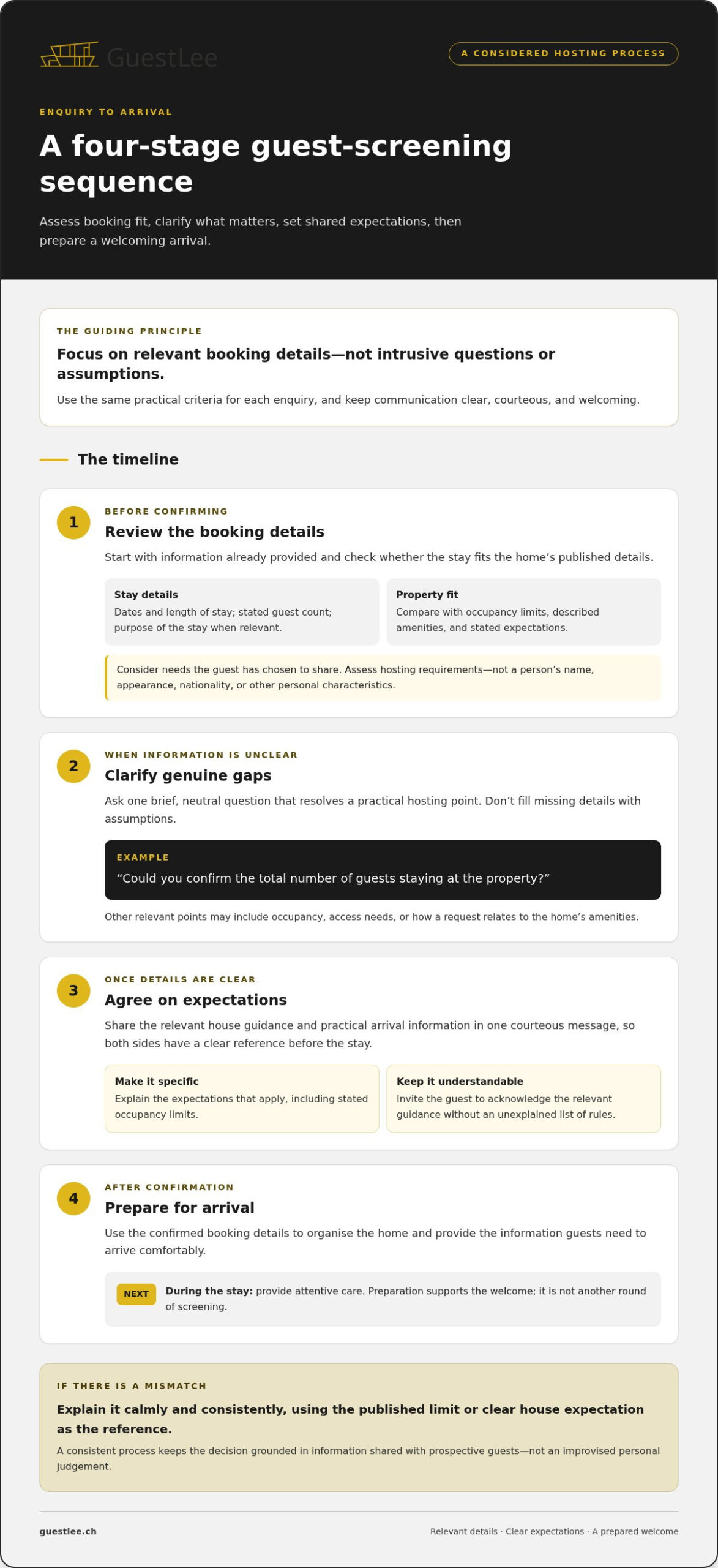
A consistent sequence makes booking decisions easier to explain and repeat. It also shows guests what happens next, without turning an ordinary enquiry into an interrogation. Focus the review on details that affect the stay: whether the dates, party size, planned use, and stated needs align with the property’s published information.
Review the request, clarify genuine gaps, agree on expectations, and prepare the home and arrival details. These four stages create a practical rhythm for screening luxury vacation rental guests, from the first enquiry through to the welcome.
Review the booking details and planned stay
Begin with the information already provided: travel dates, stated guest count, and the purpose of the stay when it’s relevant to the property. Compare the request with the home’s published occupancy limit and described amenities. If, for example, a guest mentions a need that depends on a particular feature, make sure the listing and request align before moving forward.
Apply the same criteria to each enquiry. A name, appearance, nationality, or other personal characteristic isn’t a sound basis for deciding whether a booking fits. Assess the practical requirements of hosting, not an impression of who the guest is.
Clarify expectations before confirming the stay
If essential details are missing or inconsistent, ask a brief, neutral question. “Could you confirm the total number of guests staying at the property?” is more useful than a broad request for personal information. Questions should resolve a genuine hosting point, such as occupancy, access needs, or how a request relates to the home’s amenities.
Once the details are clear, share the relevant house expectations and practical arrival information in one courteous message. Explain what guests need to know, including any stated occupancy limits and how arrival is arranged. Clear wording helps guests make an informed decision and gives both sides a shared reference before the stay.
Then follow the remaining stages in order:
- Agree expectations. Invite the guest to acknowledge the house guidance that applies to their stay. Keep it specific and easy to understand, rather than sending a long list of rules without context.
- Prepare for arrival. Use the confirmed booking details to organise the home and share the information the guest needs to arrive comfortably. This is preparation, not another round of screening.
If the guest’s request doesn’t align with a published limit or clear house expectation, explain the mismatch calmly and consistently. A well-managed process makes that conversation easier because the decision is grounded in information presented to every prospective guest, not an improvised judgement.
Thoughtful communication is one part of broader property management services, where guest correspondence and property readiness support a coherent stay. Owners exploring the wider operational picture can also consult The Definitive Guide to Property Management Services in Switzerland for 2026.
Which booking signals matter, and which screening habits can undermine trust?
A useful booking signal helps answer a practical hosting question. It doesn’t reveal a person’s character or guarantee how a stay will unfold. Screening luxury vacation rental guests should focus on information tied to the reservation and the home. Treat uncertainty as a reason to clarify, not as proof of bad intent.
A brief message, an unusual arrival time, or a request for extra information may warrant a courteous follow-up if it affects the booking. None, on its own, establishes that a guest intends to disregard house expectations. Consistent criteria help owners protect a property without making genuine guests feel under suspicion.
Relevant details versus unreliable assumptions
Keep the assessment anchored to the stay itself. Consider whether the guest count and dates fit the property’s stated limits, whether the request aligns with the home’s described amenities, and whether the guest understands the relevant house expectations. These are details that can be checked and discussed in neutral terms, giving the owner a clear basis for a hosting decision.
- Relevant: stated guest count compared with published capacity.
- Relevant: requested dates and the home’s availability.
- Relevant: a stated need that relates to described amenities or access.
- Relevant: acknowledgement of applicable house expectations.
By contrast, don’t treat a name, appearance, nationality, writing style, or short message as evidence of a guest’s intentions. A concise enquiry may simply be a concise enquiry. If it leaves a genuine logistical question unanswered, ask that question directly and use the same approach for comparable bookings.
Consistent criteria also make decisions easier to explain. If occupancy is the issue, for example, refer to the home’s published capacity rather than offering a personal impression of the group. Neutral language keeps the exchange focused on the property and gives guests a clear opportunity to clarify their request.
How to avoid unnecessary friction and privacy concerns
Before requesting a detail, ask yourself what hosting decision it will inform. If there’s no clear connection to the reservation, the property, or an arrival need, leave it out. A concise explanation can reassure guests: “We ask about the number of people staying so we can confirm the booking fits the home’s stated capacity.”
Keep messages discreet and purposeful. Avoid collecting extra personal information simply because it might be available, and don’t make guests repeat details they’ve already provided. This keeps the process proportionate and maintains the calm, considered tone expected of a luxury stay.
For Switzerland, treat this as practical hosting guidance, not a statement of legal requirements. Privacy obligations depend on the circumstances and the information involved, so consult current official Swiss privacy guidance before setting a policy for collecting, using, or retaining personal data. Avoid drawing legal conclusions based on assumptions.

How to handle unclear enquiries, special requests, and potential mismatches
An incomplete enquiry doesn’t automatically mean a booking is unsuitable. It may simply leave a practical detail unresolved. A calm response gives the guest a fair opportunity to explain and helps the owner decide whether the request fits the property as described. Keep the process simple: identify the gap, ask one focused question, then reassess the answer against the home’s stated terms.
Responding when an enquiry raises questions
Address only the point that needs clarification. If the guest count is unclear, ask, “Could you confirm how many people will be staying?” If a guest mentions mobility needs, ask what access information would help them assess the property. Warm, direct wording invites a useful reply without turning the exchange into a broad interrogation.
Different questions call for different clarifications:
- Occupancy: Confirm the number of overnight guests if it differs between the enquiry and booking details.
- Property access: Share accurate information about entry arrangements or relevant access features, so the guest can judge whether the home suits their needs.
- Special requests: Clarify what the guest is asking for and whether it relates to an amenity or arrangement described for the stay.
- House expectations: If a reply suggests a rule may have been misunderstood, restate the relevant term plainly and invite the guest to confirm they understand it.
After the exchange, note the practical reason for the decision, such as “party size exceeds published capacity” or “access request not aligned with described features.” Keep the record focused on the booking rationale rather than retaining unrelated personal details. Consistent notes help owners apply the same criteria to comparable enquiries.
Managing mismatches without damaging the guest experience
Sometimes accurate information resolves an apparent mismatch. A guest may have misunderstood an amenity, arrival arrangement, or house expectation. Correct the detail without blame, then give them room to decide whether the property still works for their stay. Clear listing language and measured dialogue can prevent a minor uncertainty from becoming an unnecessary conflict.
If expectations remain incompatible, respond courteously and refer to the relevant published property term. For example: “Thank you for clarifying your plans. The home’s stated occupancy limit is lower than the number of guests in your request, so we’re unable to proceed with this booking.” This keeps the explanation specific and avoids speculation about the guest’s motives.
Screening luxury vacation rental guests can support a considered hosting decision, but it can’t guarantee damage prevention or predict how someone will behave. Its value lies in identifying practical fit, communicating boundaries, and giving both sides a clear basis for their decision.
GuestLee’s property management services bring guest communication together with attentive property oversight.
How professional property management supports a considered guest journey
Thoughtful guest screening works best as part of a well-managed stay, not as an isolated checkpoint. Accurate listing information helps set expectations from the outset. Guest communication can clarify the booking and prepare visitors for arrival, while property maintenance and post-stay management support the home throughout the rental cycle.
For owners, coordinating these responsibilities can reduce the need to handle the same details repeatedly. It creates a more consistent process, from presenting the property to communicating with guests and preparing the home between stays. It can’t guarantee a particular guest experience or prevent every issue, but it provides a considered foundation for caring for the property and welcoming visitors.
What a managed guest journey can take off an owner’s plate
Coordinated marketing, guest communication, maintenance, and management from property setup through guest departure bring connected responsibilities together. Clear listing details support booking-fit decisions; thoughtful correspondence helps guests understand the stay; and property care keeps readiness in view. This joined-up approach supports owners while preserving the polished, personal character guests expect from a luxury rental.
Screening luxury vacation rental guests then becomes one part of attentive property stewardship, not an extra task detached from hospitality. Consistent communication helps owners explain expectations, address relevant questions, and keep the arrival experience aligned with what the listing describes.
GuestLee brings luxury short-term rentals and property management together, including guest communication and property maintenance within its management services. Owners considering the broader role of professional oversight can explore GuestLee Switzerland: The Premier Standard in Luxury Property Management & Rentals for more context on the relationship between a refined stay and careful property management.
Practical next steps for owners
Before the next enquiry arrives, write down the property’s capacity, key house expectations, and the booking details that genuinely affect fit. Review the listing for clear descriptions of amenities and access. Then use calm, consistent messages to confirm relevant details, explain expectations, and prepare guests for arrival.
This foundation makes decisions easier to apply consistently and gives guests a clearer picture of the stay. GuestLee’s property management services coordinate guest communication and property care for luxury rentals.
Make a considered approach part of your hosting standard
Turn your hosting principles into a clear routine: decide which booking details matter, make the property’s expectations easy to understand, and keep each guest interaction calm and consistent. A thoughtful approach to screening luxury vacation rental guests can protect the home’s character while helping visitors feel welcome from their first enquiry.
For owners, professional support can bring greater continuity to the experience without making hospitality feel procedural. GuestLee specialises in luxury short-term rentals and has operated since 2016, with property management shaped around the needs of owners and their homes.
If you’re ready to coordinate guest communication and property care for your rental, explore GuestLee’s luxury property management services. A well-managed home can offer owners greater peace of mind and give guests room to enjoy a stay that feels personal, polished, and thoughtfully prepared.
Frequently Asked Questions
How do you screen guests for a luxury vacation rental?
Use a repeatable booking-fit review, then let any unresolved point guide a concise follow-up. For example, if an enquiry names four guests but the reservation details list two, ask the guest to confirm the final party size before deciding. When screening luxury vacation rental guests, record the booking-related reason for your decision in brief, neutral terms. This makes it easier to handle a similar enquiry consistently later.
What questions should I ask a vacation rental guest before booking?
Ask only questions that help you understand the planned stay, such as the final guest count, expected arrival needs, or a request connected to a particular property feature. Keep each question focused: “Will you need step-free access during your stay?” is more useful than asking for broad personal information. A clear, considerate question also gives the guest a chance to decide whether the property suits their needs.
Is guest screening legal for vacation rentals in Switzerland?
Whether a particular screening practice is appropriate can depend on the information collected and how it is handled. This article isn’t legal advice and doesn’t interpret specific Swiss legal duties. Before collecting or retaining personal information, consult current official Swiss privacy guidance. As a cautious starting point, request only booking-relevant details, explain why you need them, and consider whether you need to keep them after the booking decision.
Can a host refuse a vacation rental booking after screening?
A host may decide not to proceed when a booking conflicts with the property’s stated capacity or terms, but the decision should rest on relevant details and be applied consistently. For example, if a guest’s confirmed party size exceeds the published occupancy limit, explain the mismatch plainly and courteously. Follow the booking platform’s applicable process and the terms presented to the guest, rather than relying on assumptions about identity or character.
What are warning signs when reviewing a vacation rental enquiry?
No single message or personal characteristic proves that a guest will cause a problem. Look instead for specific inconsistencies that affect the reservation, such as different guest counts in the enquiry and booking details, or plans that appear incompatible with a clearly stated property term. Treat these as prompts to clarify the facts. If the mismatch remains after a respectful exchange, assess it against the same criteria used for other bookings.
How can I screen guests without making them feel unwelcome?
Make the process feel like helpful preparation, not an investigation. Share relevant property information early, explain the purpose of any necessary question, and use warm, neutral wording. For instance, you might say, “We’re confirming the arrival arrangements so we can prepare the home for your visit.” Consistency matters, too: applying the same booking criteria to each enquiry helps guests understand that the process is professional rather than personal.

Article by
Giacomo Esposito