
Swiss Property Capital Gains Tax: A 2026 Sale Guide
Could two Swiss homeowners sell for the same gain and face different property tax bills? Yes. The capital gains tax on swiss property sales depends on the canton, and ownership duration can also affect the amount due. A strong sale price alone won’t reveal your final liability.
The calculation starts with more than the sale price. In broad terms, it considers the sale proceeds alongside the acquisition amount, qualifying value-adding investments and transaction costs recognized under the applicable rules. Property gains tax is handled at cantonal, and sometimes municipal, level rather than federally, and it is separate from income tax. The precise treatment can vary by location.
This guide explains the main calculation components, how canton-specific rules and holding periods shape an estimate, and which purchase, renovation and sale records to gather. It also provides a practical sequence for preparing questions about the property’s canton. With an organized record of the home’s history, you can make a more informed property decision and discuss the tax implications with qualified guidance.

Key Takeaways
- Understand what the capital gains tax on swiss property sales generally measures, and why the calculation depends on the property’s history and canton.
- Use the purchase contract to trace the acquisition amount, then identify which investment and transaction costs may be recognized.
- See why ownership duration and local rules can change an estimate, and which canton-specific details need current verification.
- Build a sale-ready record set by organizing acquisition, ownership, improvement, sale and transaction documents by date.
- Bring the details together in a practical sequence, while treating an early estimate as a planning aid rather than a guaranteed final assessment.
What Is Capital Gains Tax on Swiss Property Sales?
Selling a property for more than you paid doesn’t automatically make the difference your taxable gain. Swiss property gains tax concerns the profit realized when real estate is sold, but the amount assessed depends on how the applicable rules treat the sale proceeds and the property’s investment value. The headline sale price is only one part of the calculation, and the rules are not identical across Switzerland.
In plain language, property gains tax is a canton-administered tax on the profit recognized when real estate is sold, with sale proceeds considered against the property’s investment value under the applicable local rules. The seller is generally responsible for the tax. When estimating capital gains tax on swiss property sales, first distinguish this sale-related charge from taxes that arise simply from owning or transferring property.

Which Property Sale Tax Is This?
This guide focuses on tax associated with profit from a real-estate sale. It is distinct from recurring property or wealth taxes, which relate to ownership, and imputed-rental-value taxation, which concerns the tax treatment of living in an owner-occupied home. Transfer-related taxes or charges are another category. They may arise because ownership changes hands, rather than because the seller has realized a profit.
These distinctions help keep your sale estimate clear. Several tax concepts can arise around the same transaction, but they do not all measure the same thing or follow the same rules. Switzerland’s broader system includes federal, cantonal and municipal taxes. The overview of Taxation in Switzerland provides context for these different levels of administration.
Why the Relevant Canton Matters
Property gains tax is handled at cantonal level, and local rules can affect how investment value and recognized costs are treated. The authority responsible for the property’s location is therefore central to understanding the calculation. A national overview can explain the concepts, but it cannot resolve every property-specific question.
Before relying on an estimate, identify the canton and review its current rules with the tax authority or a qualified Swiss tax professional. Focus on how the sale proceeds are assessed, which costs may be recognized and what process applies to the seller. Avoid assuming that an explanation or calculation prepared for another canton applies unchanged.
This section is a starting point, not individual tax advice. Understanding the tax category first helps you gather the right records and ask focused questions before making decisions about timing or proceeds.
How Is the Taxable Gain on a Swiss Property Sale Calculated?
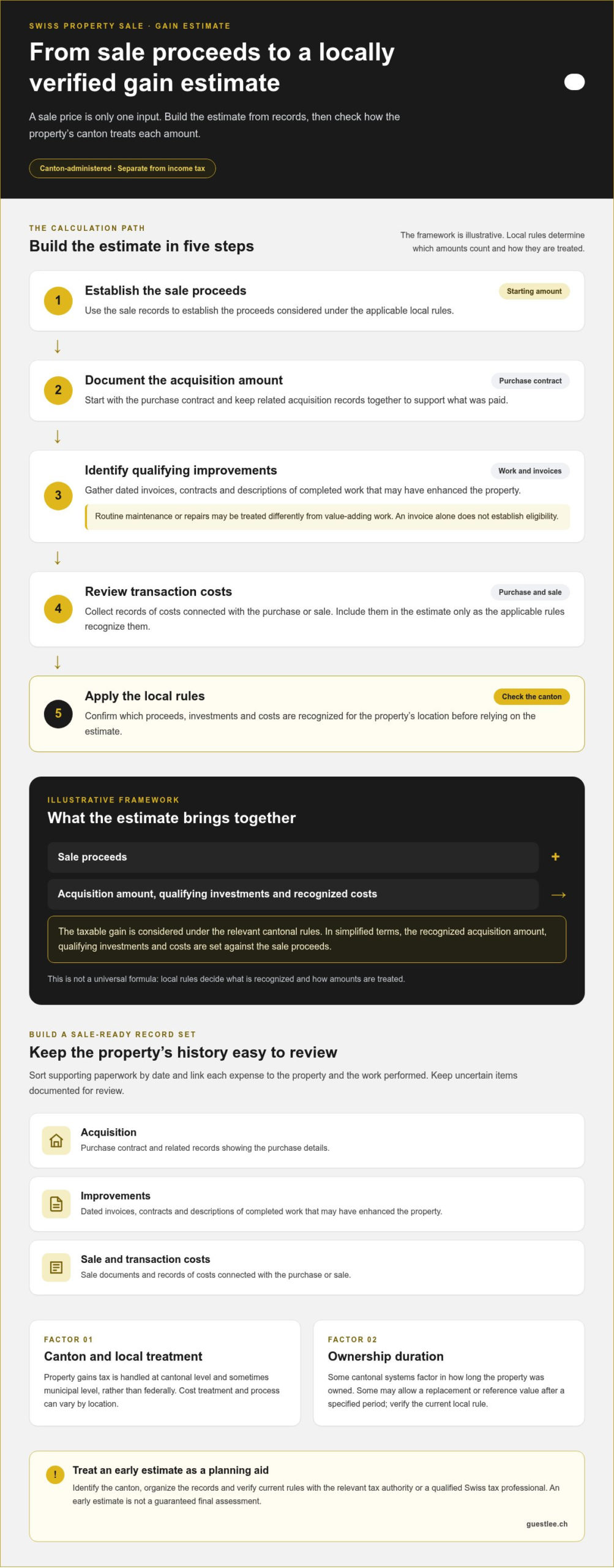
Start by comparing the sale proceeds with the property’s investment value, then account for costs recognized under the applicable cantonal rules. In simplified terms, the taxable gain may be viewed as sale proceeds minus the acquisition amount, qualifying value-enhancing investments and recognized costs. This is an illustrative framework, not a universal formula. Local rules determine which amounts count and how they are treated.
The main inputs are the sale proceeds, the documented acquisition amount, qualifying improvements and transaction costs recognized under the relevant canton’s rules. The original purchase contract is a useful starting document because it records the agreed acquisition amount. Keep related acquisition records together to support what was paid and clarify which expenses relate to the property.
For example, a completed extension may be treated differently from routine repairs, even though both involve work on the home. An invoice is not automatically deductible. The nature of the work, the supporting documentation and the canton’s treatment all matter when estimating capital gains tax on swiss property sales.

What Records Help Establish the Investment Value?
Build the calculation from documents rather than memory. Gather the purchase agreement and acquisition records, then sort invoices and evidence for completed improvement projects. Include records of related project costs and sale transactions. A timeline that links each expense to the property and the work performed makes the documents easier to review.
- Acquisition: Purchase contract and related records showing the purchase details.
- Improvements: Dated invoices, contracts and descriptions of completed work that may have enhanced the property.
- Sale and transaction costs: Sale documents and records of costs connected with the purchase or sale.
Keep routine maintenance and repairs separate from improvement projects. Their tax treatment can differ, and eligibility should be checked against the rules for the property’s canton. Retain the supporting paperwork even when the classification is uncertain. A qualified Swiss tax professional can help assess whether an item is recognized.
How Can Long Ownership Affect the Calculation?
Ownership duration can influence the tax calculation in some cantonal systems, so the purchase date matters beyond establishing the original acquisition amount. Some cantons may also allow a replacement or reference value after a specified ownership period. Neither the threshold nor the method is universal, so verify the current rule locally before relying on it.
For a more dependable estimate, record the acquisition date and assemble the supporting evidence before modelling different sale scenarios. A well-documented property history gives the calculation a firmer foundation, but only the applicable cantonal rules determine the accepted inputs and final assessment. As you coordinate the wider sale, Swiss property sale services can support the real-estate side of your decision.
Why Do Swiss Cantonal Rules and Holding Periods Change the Estimate?
Two sales with similar proceeds and documented costs can still produce different estimates if the properties are in different cantons. The relevant rules may affect which investment amounts or costs are recognized, how ownership duration influences the calculation, and how the tax is assessed or paid. A headline rate alone cannot capture those details and should not be treated as a reliable forecast of the final liability.
An estimate is useful only when it reflects the property’s location, sale details, ownership history and supporting records. Use the comparison below to identify questions, not as a statement of uniform Swiss rules. Check each point against current official cantonal information before relying on it for a sale estimate.
| Rule area | What to compare | Why it matters |
|---|---|---|
| Investment-value approach | How the canton treats acquisition amounts, improvements and transaction costs. | The accepted inputs affect the taxable gain. |
| Ownership duration | Whether and how the holding period changes the calculation or tax treatment. | The ownership timeline may affect the estimate. |
| Authority and procedure | Which authority handles the matter and what filing, payment or other requirements apply. | The required process and transaction implications can vary. |
What Should Sellers Compare Across Cantonal Rules?
Start with the basis used to establish investment value, then check whether ownership duration changes the calculation. Next, look for allowances, exceptions or conditions that may affect the sale’s treatment. Do not assume a rule applies simply because it appears in a general guide or an example for another location. Use current official information to identify the responsible authority and the process relevant to the property.
Keep the comparison practical: record what is confirmed, what still needs verification and which documents support each point. That makes it easier to separate a working assumption from a rule checked for the specific sale.
Why Is a Single Swiss-Wide Estimate Misleading?
A generic online example can show how sale proceeds and investment-related inputs interact, but it cannot predict an individual bill. The same sale facts may be handled differently under different cantonal rules, and a rate viewed in isolation may omit other parts of the calculation. A national average would conceal those differences rather than resolve them.
For capital gains tax on swiss property sales, treat an early figure as a planning estimate until the property details, records and current local treatment have been reviewed. That clarity can inform decisions about timing and sale strategy. GuestLee’s Swiss property sale services support the real-estate side of planning, while canton-specific tax treatment should be established with qualified guidance.
What Should You Prepare Before Selling Swiss Property?
A well-organized file makes a property sale easier to review and helps you prepare for a more informed tax discussion. Bring together records showing how the property was acquired, what changed during ownership and what happened when it was sold. Arrange them by date, and connect each expense to a property-related document, such as an invoice, contract or project description.
Complete, well-linked records support a more reliable tax review, but keeping a document does not guarantee that its cost will be recognized. Treatment depends on the applicable cantonal rules and the nature of the expense. For capital gains tax on swiss property sales, careful organization helps establish the facts; it does not determine the final assessment.

A Sale-Readiness Document Checklist
Start with a folder for each stage of the property’s history. Keep digital copies in a consistent structure and retain original documents where available. An index can note the date, expense or event, related property work and the file that supports it.
- Acquisition: Purchase agreement, completion statement and records showing the acquisition date and amount.
- Ownership: Documents that clarify changes in ownership or the ownership timeline, plus relevant correspondence with tax authorities or advisers.
- Improvements: Invoices, payment evidence, permits and descriptions of completed work. Link each item to the project it relates to instead of filing receipts without context.
- Sale: Sale agreement, completion statement and correspondence or supporting documents connected with the transaction.
- Transaction expenses: Invoices and payment records for costs associated with the purchase, improvement projects or sale, kept separate by date and category.
Distinguish work that may have enhanced the property from routine maintenance, and label the documents accordingly. This makes review more efficient, but it does not decide tax eligibility. Confirm the treatment under the rules for the property’s canton before including a cost in an estimate.
When to Get Property-Specific Tax Guidance
Seek qualified Swiss tax guidance if records are incomplete, the ownership history is complex or you are unsure how a particular expense should be treated. Before relying on a sale estimate, ask for a current canton-specific review of the relevant records and circumstances. A general explanation can help you prepare, but it cannot replace a review of the property’s details.
Keep the roles distinct. Tax guidance addresses the applicable calculation and assessment; brokerage, property management and sale marketing address other parts of the property decision. Coordinating these workstreams can help you plan with a clearer view of both the documentation and the sale process.
Once your records are in order, plan your Swiss property sale with GuestLee’s real-estate team as part of a considered sale strategy.
How Can Property Sale Planning Bring the Tax Picture Together?
A considered sale plan brings tax questions into the wider decision without treating an early estimate as a settled result. For capital gains tax on swiss property sales, use a clear sequence: establish which canton’s rules apply, assemble the property records, obtain a current estimate based on those details, then plan the sale with any remaining uncertainties in view.
A tax estimate can help you compare scenarios and prepare for the financial implications of a sale. It does not guarantee the final assessment. The accepted calculation depends on the applicable rules and the facts and documents considered by the relevant authority.
A Practical Sequence for Sale Decisions
Move from the property’s location to the sale decision in a deliberate order. This keeps general assumptions separate from points that need confirmation and gives each discussion a sound documentary basis.
- Identify the canton and ownership history. Establish where the property is located and assemble the dates and records showing how it was acquired and held.
- Bring the supporting documents together. Collect acquisition, improvement, transaction and sale records, and organize them so each item can be matched to the property and its timeline.
- Obtain a current, property-specific estimate. Use the documented sale details and verify how current cantonal rules treat the relevant inputs. An online example can illustrate concepts, but it cannot replace this review.
- Plan the sale with qualified guidance. Consider timing and financial assumptions with appropriately qualified advisers, keeping the estimate’s limitations clear as you weigh the next steps.
This sequence turns an uncertain tax question into a manageable planning task. If a key document is missing or the ownership history has several stages, address that uncertainty before relying on an estimate or making decisions based on it.
Where Property Sale and Management Support Fits
Tax guidance and property services play distinct roles in a sale. GuestLee supports the acquisition and sale of luxury Swiss homes, as well as management of high-value real estate. Property management can help owners coordinate the property as an asset; it is not a tax calculation or legal opinion, and it does not determine how an authority will assess a gain.
Once you have clarified the canton-specific tax questions with qualified guidance, consider the sale alongside the property’s broader management and future. Keeping these workstreams distinct supports a coordinated decision, with tax assumptions addressed separately from the practical real-estate plan.
For support with the property side of that decision, explore Swiss property sale and management services.
Make Your Next Property Decision with Confidence
A sale can be a natural point to reassess what you want from a property, not only what it may return. Use your preparation around capital gains tax on swiss property sales to inform a broader decision: whether to proceed, how to position the home and what role the asset should play in your plans. Keep tax guidance focused on the relevant rules, and consider the property strategy separately.
GuestLee brings together acquisition and sale services for luxury Swiss homes with full-service management for high-value real estate. Its approach draws on data-backed revenue projections and more than 45 years of combined finance and luxury hospitality experience, supporting owners as they consider a property’s wider potential. These services complement, but do not replace, tax or legal advice.
When you’re ready to shape the real-estate side of your next step, explore GuestLee’s Swiss property sale and management services. Thoughtful preparation and the right expertise for each decision can help you move forward with greater clarity.
Frequently Asked Questions
Is capital gains tax payable on every Swiss property sale?
No. The tax generally concerns a profit from selling real estate, not simply the transfer of ownership. If the sale proceeds do not exceed the investment value recognized under the applicable rules, the sale may not produce a taxable gain on that basis. Do not assume the outcome from the sale price alone. The canton’s rules and the seller’s circumstances matter, so review current local guidance before treating a general estimate as conclusive.
How is capital gains tax on Swiss property sales calculated?
A starting point is to compare the sale proceeds with the investment value recognized for the property. The review may consider its purchase price, qualifying value-enhancing work and certain transaction costs. An extension and routine repainting, for example, may not be treated alike. Which inputs count, and whether ownership duration affects the result, depends on the canton. Use a basic calculation to frame questions, not as a confirmed figure for your sale.
Who pays property gains tax when a Swiss property is sold?
The seller is generally responsible for property gains tax on a taxable profit. The practical steps, timing and treatment depend on the rules for the property’s canton, so the transaction documents and current official guidance should be reviewed before completion. A qualified Swiss tax professional can address circumstances that are not clear from the documents.
Does the canton affect tax on a Swiss property sale?
Yes. Cantons administer property gains tax, and their approaches can differ, including how they calculate the gain and account for ownership duration. A national guide can explain the terms, but it cannot predict the assessment for a specific property. Start with the canton where the property is located and compare your facts with its current official guidance. If the treatment remains unclear, seek advice from a qualified Swiss tax professional.
Can renovation costs reduce property gains tax in Switzerland?
Some value-enhancing investments may affect the investment value used in the calculation, but not every renovation expense will qualify. Keep documentation that distinguishes an improvement project from routine upkeep, such as repair work. Save itemized invoices and evidence of payment, and note what work was completed. Before including an expense in an estimate, have its treatment reviewed under the rules for the property’s canton.
Does owning a Swiss property for longer change the tax on its sale?
It can. Ownership duration affects the treatment in some cantonal systems, and some cantons may provide a replacement-value approach after a specified period. There is no single Swiss-wide threshold or method. Keep reliable records that establish when ownership began, such as acquisition documents, and use the relevant canton’s current guidance to understand how the period is counted before relying on an estimate.
What documents should I keep when selling Swiss property?
Keep records that let someone follow the property’s history from purchase to sale: agreements, documents showing ownership dates, improvement invoices, payment evidence and transaction-expense records. If an invoice is brief, add a note identifying the work and the part of the property involved. This context makes later review clearer. Retaining a document does not mean its cost will be accepted for tax purposes, so confirm its treatment with a qualified adviser.

Article by
Giacomo Esposito