Swiss tourism trends show how visitor demand varies by region
A strong Swiss summer does not lift every destination equally. Swiss tourism trends affecting rental demand vary by region: during summer, domestic tourism supported Graubünden and Zermatt, while Geneva and Interlaken felt the absence of Arab and Asian middle-class visitors. For property owners, the source of visitor demand can matter as much as the national picture.
It is therefore worth looking beyond headline growth in overnight stays when assessing a rental’s prospects. Visitor markets shift, and the balance between domestic and international guests can affect demand differently in cities, mountain resorts and other destinations.
This article explores how changing visitor markets and overnight-stay forecasts may influence rental demand across Switzerland. It explains why regional differences matter when assessing a property’s place in the holiday-rental market, and how considered property management can help owners respond to changing guest patterns.
Key Takeaways
- Track shifts in visitor markets, since weaker demand from one group can affect destinations differently from national tourism totals.
- Compare domestic, European and American demand to understand which guest markets may support different types of Swiss destinations.
- Read overnight-stay forecasts alongside their season and comparison period to distinguish short-term recovery from broader demand patterns.
- Use regional and accommodation-type differences to assess how a property’s location may shape its rental prospects.
Declining Gulf and Asian visitor markets
During summer, visitor numbers from Gulf countries and Asia fell in Switzerland. Geneva and Interlaken felt the absence of Arab and Asian middle-class visitors, showing how a national tourism picture can conceal local pressure on bookings. Owners should consider whether a property’s location and season depend on these guests. A city-centre home and a mountain retreat may have different exposure to this shift.
A decline in one visitor segment can affect enquiry volumes, booking timing and date availability. The impact depends on location, season, property size, access to attractions and the purpose of guests’ trips. A Geneva apartment near business venues may serve a different travel purpose than a resort villa. This distinction helps owners separate leisure demand from work-related demand, and assess which dates rely on long-haul leisure visitors and which may appeal to other guests.
Business tourism adds a separate consideration for Swiss cities. BAK Economics expected around 15% of business tourism in Swiss cities to disappear permanently because of structural adjustments. Urban accommodation demand may reflect broader changes as well as seasonal shifts in Gulf and Asian travel. Accommodation demand tied to work trips should therefore be considered alongside leisure demand. The balance may differ between city properties and holiday destinations.
Swiss short-term rental rules and tourist taxes can vary by canton and municipality. Do not assume a rule or visitor levy that applies in one municipality also applies elsewhere. For a property-specific assessment, start with its exact municipality, then review short-term rental requirements separately from local tourist-tax arrangements. This location-by-location approach helps distinguish changing guest demand from operating obligations, without treating Switzerland as one uniform rental market.
Domestic, European and American visitor demand
Swiss residents’ tourism demand was expected to keep increasing in 2023 and 2024, but at a reduced scale. During June to August, demand for summer holidays in Switzerland increased among Swiss, European and American guests. These patterns point to several visitor markets supporting summer travel, rather than demand resting on one international segment. For rental owners, guest origin is useful context, but it should be read alongside destination and accommodation type.
Domestic demand supported Graubünden and Zermatt during summer, a useful signal for properties positioned around mountain scenery, outdoor activities and seasonal escapes. A rental’s appeal depends partly on how clearly it suits the reason guests choose a destination. A home designed for family breaks, for example, may serve a different purpose from a city stay focused on cultural visits. European and American summer interest adds variety to the visitor mix, but does not make every region or property equally attractive.
Accommodation figures also show why visitor demand needs a careful reading. In 2024, arrivals in Swiss holiday homes decreased by 62.8%, while arrivals in collective accommodation increased by 20.3%. These figures describe different accommodation categories, not a direct comparison of individual rental properties. They suggest owners should consider the lodging format behind a trend, rather than treating total visitor interest as a proxy for demand for every rental.
Which traveler trends, such as longer stays, remote work and wellness tourism, are driving rental demand? These are useful ways to assess a property’s fit: longer visits make flexibility relevant, remote work makes a practical workspace appealing, and wellness-led travel can favour quiet settings or access to nature. The Swiss market figures here describe visitor origins, seasons and accommodation types, not the measured effect of these preferences. Read them alongside destination-specific signals to understand which guest needs a rental can serve.
Forecast growth in Swiss overnight stays
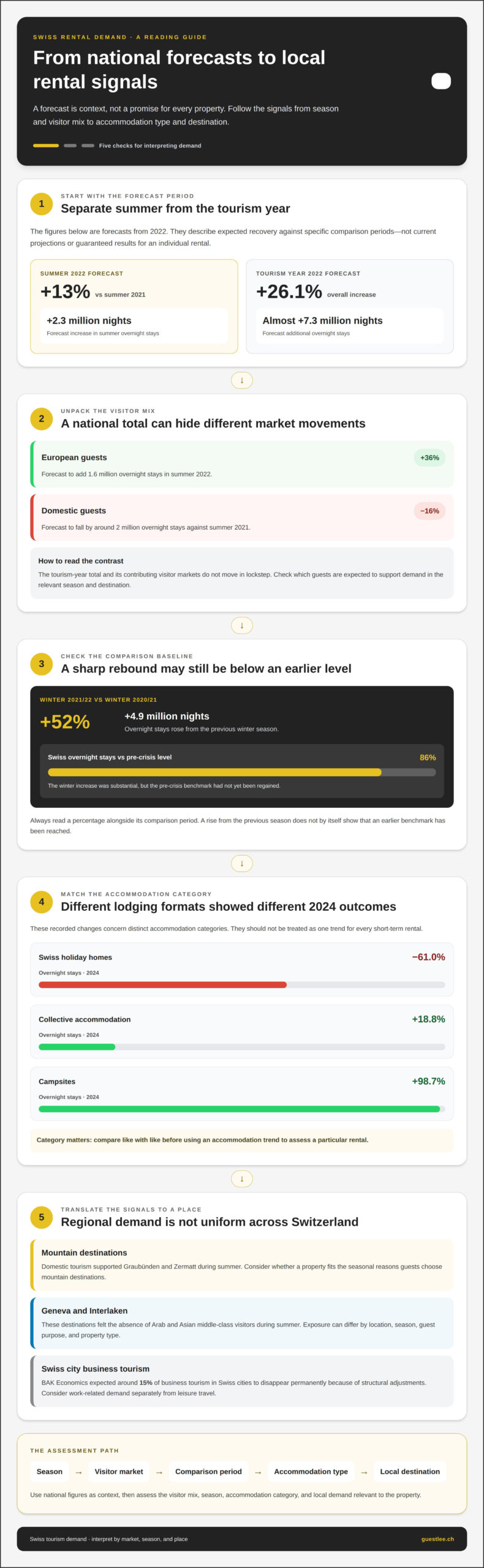
Swiss overnight-stay forecasts from 2022 describe recovery expectations, not current projections. Summer stays were forecast to rise by 13% against summer 2021, adding 2.3 million nights. For rental demand, that national estimate offered context, but not a guarantee for every location. A property in a city, alpine resort, or lakeside destination could respond differently, depending on visitor mix and season.
The tourism-year forecast anticipated almost 7.3 million additional overnight stays, a 26.1% increase in 2022. European guests were forecast to add 1.6 million nights, up 36% in summer 2022. By contrast, domestic overnight stays were forecast to fall by around 2 million, or 16%, against summer 2021. These differences show why owners should read a total alongside the markets expected to contribute to it.
Winter figures also showed a sharp rebound from the previous season. Overnight stays rose by 52% in winter 2021/22 compared with winter 2020/21, an increase of 4.9 million nights. Yet Swiss overnight stays in that winter reached 86% of the pre-crisis level. A substantial seasonal gain therefore did not mean the earlier benchmark had already been regained. For rental planning, the comparison period matters as much as the percentage change.
Later figures highlight why forecasts and recorded outcomes need separate treatment. Overnight stays in Swiss holiday homes decreased by 61.0% in 2024, while collective accommodation increased by 18.8%. Campsites recorded a 98.7% rise in overnight stays that year. Those movements concern distinct accommodation categories; they should not be read as a single trend for every short-term rental. Compare the relevant category, season, visitor market, and destination before drawing conclusions about a property’s prospects. A nationwide forecast can frame expectations, while local demand determines how closely an individual rental follows it.
Regional differences in tourism demand
Swiss tourism trends affecting rental demand vary by destination because visitors travel for different reasons. Zurich and Geneva attract urban and business visitors, while Lucerne draws guests interested in lake and cultural experiences. Interlaken and Alpine destinations appeal to visitors exploring mountain landscapes. A property’s likely demand depends on its location, guest profile and season, so national trends alone offer limited guidance.
How do tourism-driven rental yields compare across Swiss regions and property types? Compare potential rental income with operating costs and turnover requirements over the same period and for the same property type. A city apartment and an Alpine chalet differ in capacity, seasonal appeal, maintenance needs and booking patterns. These factors shape net returns, so a useful comparison accounts for the property as well as the region.
How does tourism affect long-term residential rents and housing availability in Swiss hotspots? When homes are used for short stays, fewer may remain available to long-term residents. The effect depends on local housing supply and how much accommodation serves each market. A destination with a strong visitor economy, for example, may have a different balance between holiday rentals and residential homes than a less tourism-focused area.
What are the current short-term rental prices and occupancy rates in Zurich, Geneva, Lucerne, Interlaken, and the Alps? They vary with dates, location, property size, amenities, and season. Compare similar homes over matching periods, rather than applying one rate or occupancy figure across different destinations. A useful way to interpret Swiss tourism trends affecting rental demand is to separate city patterns from resort patterns, then consider how each property fits its local market. Swiss urban areas were not expected to regain their pre-crisis level of overnight stays until after 2024. Assess a property’s regional rental potential with its location, guest profile, and operating costs in view.
Tourism-driven rental yields depend on local visitor demand and each property’s capacity, seasonal appeal, maintenance needs and booking patterns. Compare net returns over matching periods for similar property types, rather than assuming one region or property type will outperform another.
GuestLee: Luxury Villa Rentals
GuestLee helps property owners respond to changing visitor demand through Property Management Services and Luxury Villa Rentals. For homes suited to short stays, considered management can align presentation and rental strategy with the property’s location, guest profile and seasonal patterns. This is especially relevant when national tourism forecasts differ from demand signals in a particular destination.
For owners weighing a property decision, GuestLee also offers Real Estate Sales. The right next step depends on whether the priority is managing an existing asset, welcoming guests, or considering a sale. Contact GuestLee to discuss your property and its role in Switzerland’s evolving visitor market.
Shape your next property decision with clarity
Understanding the Swiss tourism trends affecting rental demand is most useful when translated into a property-specific decision. Consider which guests a home is best suited to welcome, how its location shapes seasonal appeal, and whether its rental approach still fits those patterns. This perspective can help owners plan thoughtfully, whether refining an existing property strategy or weighing a future move.
GuestLee can help you consider the rental outlook for your property in the context of Switzerland’s changing visitor market. Discuss your property’s rental demand with GuestLee, and take your next step with a clearer view of its potential.
Frequently Asked Questions
How have Swiss overnight stays and tourism arrivals changed in recent years?
Swiss overnight stays and arrivals have shifted unevenly by period and accommodation type. An August comparison showed overnight stays falling 2.1% against the same period of the previous year; campsite arrivals rose 96.9% in 2024. These contrasting indicators show why total visitor arrivals alone can obscure where people stay and whether a broader tourism shift translates into demand for a particular rental.
Which Swiss regions and cities are seeing the fastest tourism growth?
There is no single regional leader across every season and measure. During summer, domestic tourism provided stronger support in Graubünden and Zermatt, while Geneva and Interlaken felt the absence of some international visitor groups. These are different regional demand profiles, not a definitive current ranking. Compare the same season and visitor market before concluding that one destination is growing faster than another.
How do seasonality and winter versus summer tourism affect rental demand in Switzerland?
Seasonality changes both who books and what guests seek. Winter demand in Alpine areas can centre on mountain holidays, while summer stays may appeal to visitors interested in lakes, hiking or regional itineraries. A mountain home and a lakeside property may therefore have different peak periods. Review each property’s calendar by season rather than assuming bookings or demand are evenly distributed throughout the year.
How are hotel occupancy, short-term rental bookings, and average daily rates changing in Switzerland?
Hotel occupancy, short-term rental bookings and average daily rates measure different aspects of accommodation demand, so they may move in different directions. Occupancy concerns capacity sold, booking pace tracks reservations over a selected period, and average daily rate reflects the average nightly price. For a Zurich apartment, compare equivalent dates and property types, then consider booked nights alongside rate changes rather than relying on one measure alone.
What risks could weaken Swiss tourism rental demand, including exchange rates, climate change, and regulation?
Exchange-rate movements can change the effective cost of a Swiss stay for overseas guests, potentially influencing destination choices or trip length. Climate change may affect snow-dependent seasons and shift when visitors travel. Rental rules can also affect permitted use and operating obligations, which vary by canton and municipality. Consider these factors alongside a property’s location, seasonality and likely guest mix when assessing its exposure.
Which traveler trends, such as longer stays, remote work, and wellness tourism, are driving rental demand?
Longer stays make flexibility relevant, remote work makes a practical workspace appealing, and wellness-led travel can favour quiet settings or access to nature. The market figures describe visitor origins, seasons and accommodation types, not the measured effect of these preferences.

Article by
Giacomo Esposito