Tax deductions for Swiss rental property owners explained
A rental property can generate taxable income even when no owner lives in it, while a home kept for personal use is treated differently. The tax deductions for Swiss rental property owners depend first on this distinction: rental income is taxable, while owner-occupied property generally has an imputed rental value set at 60 to 70% of market rent under current rules through tax year 2028.
That difference can shape which expenses reduce your taxable income, and whether holding a property privately or through a real estate company changes the calculation. The rules also matter for mortgage interest, secondary residences and the shift scheduled for 2029.
This guide explains how imputed rental value is calculated, which mortgage interest and property costs may be deductible, and how rental income is treated when a property is owned by a company. A Zurich example illustrates the figures and helps explain the tax framework behind a property’s returns.
Key Takeaways
- Choose between actual eligible maintenance expenses and the lump-sum deduction based on which better reflects the property’s costs for that tax year.
- Assess mortgage interest alongside rental income and the ownership structure, since the deductible amount can affect the property’s taxable result.
- Factor in the possibility of a cantonal property tax on a secondary residence after the imputed-rental-value reform takes effect.
- Consider how private ownership versus a real estate company changes the way rental income and property expenses are treated.
Sample calculation: how is imputed rental value calculated?
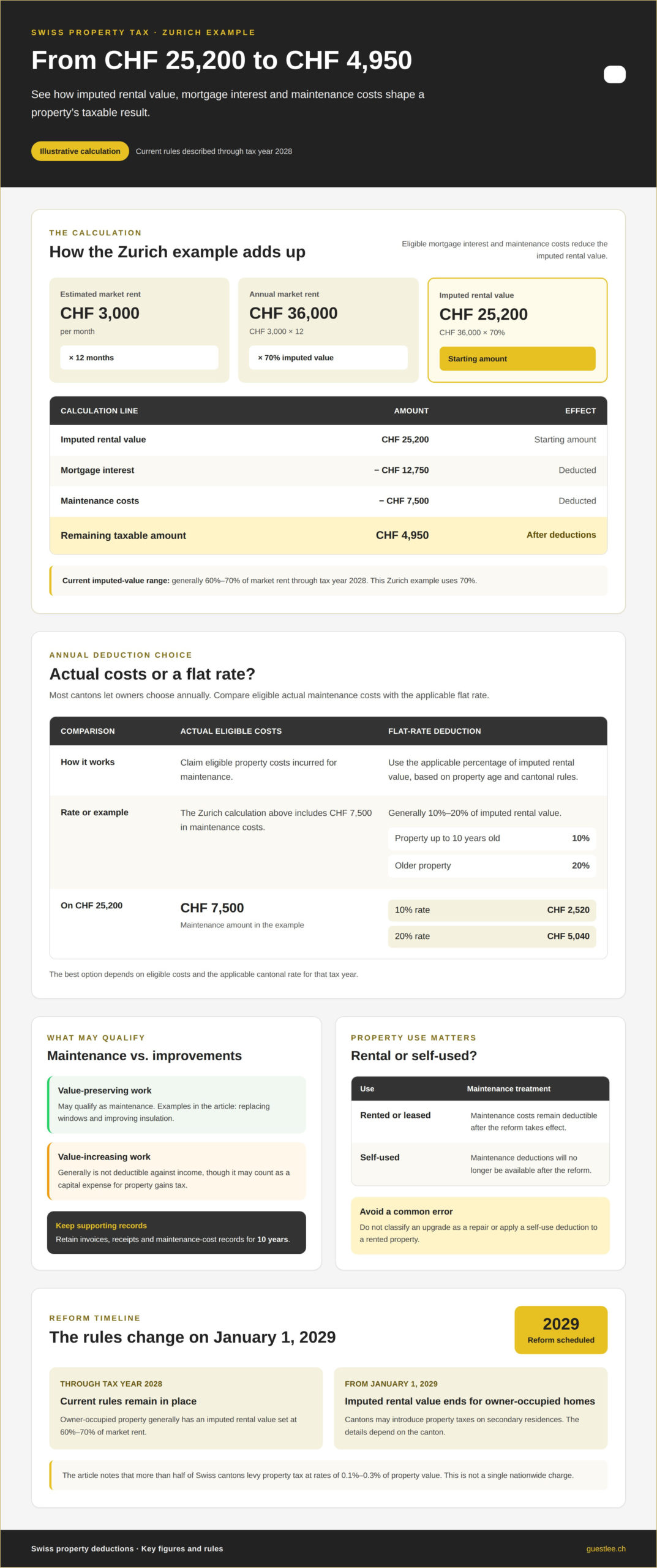
For a Zurich home with estimated market rent of CHF 3,000 per month, annual market rent is CHF 36,000. At 70%, its imputed rental value is CHF 25,200. Current rules generally place this value between 60% and 70% of market rent through tax year 2028.
Eligible mortgage interest and maintenance costs may reduce that amount. In this example, CHF 12,750 interest and CHF 7,500 maintenance bring CHF 25,200 down to CHF 4,950. The calculation shows why the property’s use and the nature of each expense matter.
Most cantons let owners choose annually between actual property costs and a flat-rate deduction. The flat rate is generally between 10% and 20% of imputed rental value, depending on property age and cantonal rules. In the described schedule, properties up to 10 years old use 10%, while older properties use 20%. Compare eligible actual maintenance costs with the applicable flat rate before completing the tax return.
Value-preserving work, such as replacing windows or improving insulation, may qualify as maintenance. Value-increasing work generally isn’t deductible against income, although it may count as a capital expense for property gains tax. Keep invoices, receipts and maintenance-cost records for 10 years to support the expenses claimed.
A common mistake is to claim an upgrade as a repair or apply a self-use deduction to a rented property. For rented or leased properties, maintenance costs remain deductible after the reform takes effect. For self-used properties, maintenance deductions will no longer be available after the reform.
This makes timing relevant. Current property-tax rules remain unchanged through tax year 2028, and the reform is scheduled for January 1, 2029. For maintenance planning, distinguish necessary upkeep from value-adding improvements, and keep each project’s records separate. Rental income and property use affect how costs are treated for tax purposes.
Mortgage interest deductions
Mortgage interest can reduce taxable income, but the calculation depends on how the property is used and who owns it. Planning tax deductions for Swiss rental property owners also means accounting for reform changes and how debt relates to each property.
Mortgage Interest After the Reform
After the reform takes effect, debt-interest deductions will be limited in proportion to Swiss properties that aren’t owner-occupied. This matters if your portfolio includes both rented and personally used homes. Under current federal direct-tax rules through tax year 2028, mortgage interest is deductible up to CHF 50,000 above taxable wealth income. A separate limited deduction may remain for eligible first-time buyers. The home must be used permanently and exclusively by its owner for 10 years. In the first year, eligible married buyers can deduct up to CHF 10,000, and eligible single buyers up to CHF 5,000. The maximum decreases each year.
Allocating Mortgage Debt and Interest
Debt and its related interest may need allocation between countries when a taxpayer owns property across borders. This can affect the interest amount deducted from Swiss taxable income. For tax deductions for Swiss rental property owners with international holdings, the property’s location and related income help determine the allocation. In one example, two-thirds of a CHF 600,000 mortgage, or CHF 400,000, is allocated to Germany. Two-thirds of interest, CHF 800, is allocated there too. Switzerland receives the remaining one-third: CHF 200,000 in debt and CHF 400 in interest as an income deduction.
Interest Rates and Deduction Amounts
A higher interest rate increases the interest paid on the same mortgage balance, potentially increasing the deduction. The effect on income tax also depends on taxable income and applicable limits. One example states that property deductions exceed tax on imputed rental value only when mortgage interest is above 2% and the loan-to-value ratio is at least 60%. This is a relationship between interest, debt and imputed rental value, not a universal outcome.
An early mortgage repayment penalty is generally treated as interest for Swiss tax purposes and is generally deductible. Ownership structure also changes the calculation: an example of a Swiss real estate company shows CHF 10,000 taxable profit after CHF 35,000 interest and CHF 15,000 maintenance costs are deducted from CHF 60,000 rental income. This differs from an individual income-tax calculation.
Possible cantonal property taxes on secondary residences
From January 1, 2029, Switzerland will stop taxing imputed rental value on owner-occupied primary and secondary residences. After the reform takes effect, cantons may introduce property taxes on secondary residences to replace lost revenue. For owners, this could change the tax burden attached to a holiday home, even as imputed rental value disappears. Planning tax deductions for Swiss rental property owners therefore also means considering possible new cantonal charges.
The details will depend on the canton. More than half of Swiss cantons levy property tax at rates of 0.1% to 0.3% of property value. That range illustrates why a second home’s location matters: the applicable rate and taxable valuation can shape the annual bill. It isn’t a single nationwide charge, so tax deductions for Swiss rental property owners should be considered alongside the property’s location and use.
Valuation methods already differ between cantons. Lucerne sets imputed rental value at 70% of market rent, while Thurgau uses 60% of indexed rental value for self-occupied properties. Solothurn calculates it at 8% to 11% of cadastral value for buildings of average construction. These examples show why identical residences can face different tax calculations across Switzerland.
Zurich illustrates another valuation change. Since 2026, new property tax values there have been approximately 48% higher on average. A higher valuation can affect a property-tax calculation where the canton bases its charge on property value. For a secondary residence, location and assessed value are important planning considerations, alongside rental use and ownership.
Energy renovations add another layer. After the reform, federal deductions for energy-efficient renovation costs will end, while cantons may decide whether to continue allowing them. Costs for historical monuments will remain deductible for federal direct tax. When planning renovations, distinguish these rules from any new cantonal tax on second homes.
For a holiday apartment, assess the reform in two parts: the end of imputed rental value taxation, then any property tax adopted by the canton. Keep the property’s location, assessed value and renovation records together when reviewing its tax position. These details help clarify how cantonal taxation may affect the property and its ongoing costs.
How are vacancies, unpaid rent, and property insurance premiums treated for Swiss tax deductions?
A vacant period and unpaid rent are different entries in a rental account. Vacancy means no tenant occupied the property for a period; unpaid rent means a tenant’s payment remained outstanding. Record these separately in your accounts and tax return so the figures show what was earned, invoiced and received.
For example, if a property stands empty between tenancies, record the dates and rent-free period separately from any later tenant’s unpaid invoice. Keep the tenancy agreement, rent statements, correspondence and payment records together. These documents clarify whether an amount reflects a period without rental activity or rent that was due but not collected, and make year-end figures easier to reconcile.
Don’t treat missed rent as a maintenance cost. A repair invoice documents work on the building; an unpaid rent entry documents a payment issue. Keep each in its own category to avoid presenting lost income as a deductible property expense. The tax treatment of a vacancy or unpaid amount can depend on the canton and the property’s circumstances.
Building insurance costs are deductible from imputed rental value. Keep the insurer’s annual statement and proof of payment with the property’s other expense records. Separate building cover from personal contents cover, and note the insured property and coverage period. This makes the nature of the claimed premium clear.
Before filing, reconcile rental statements with bank receipts, then list unpaid invoices and vacant periods separately. Match insurance premiums to the relevant property and tax year. For a property with several tenancy periods, a simple monthly ledger can show when rent was due, received or outstanding. Keep supporting documents for the required retention period, and distinguish deductible insurance costs from income shortfalls.
If managing occupancy, rent records and property paperwork takes time, explore rental property management support for your Swiss property.
GuestLee: Luxury Villa Rentals
GuestLee provides Property Management Services for owners preparing a Swiss property for rental, as well as Luxury Villa Rentals for guests seeking a considered stay. If your tax review has prompted you to weigh rental use against personal use, property management can oversee the rental process, from property setup through guest departure. It does not replace tax advice, but it can support the practical work of operating a rental property as you consider income, expenses and ownership structure.
For owners assessing how a property fits their wider real estate plans, GuestLee also offers Real Estate Sales. The right next step depends on whether you plan to rent, retain or sell the property. Contact GuestLee to discuss your property needs.
Plan your property’s next chapter
Property decisions unfold over years, while tax returns capture one period at a time. A considered approach to tax deductions for Swiss rental property owners starts by connecting each tax-year decision with the property’s intended role: an income-producing asset, a privately enjoyed residence or part of a longer-term portfolio. This perspective can make future choices more deliberate, especially if ownership or use may change.
Before making a change, define what you want the property to contribute and which responsibilities you prefer to retain. Your priorities can help determine whether you continue overseeing rental activity, arrange property management or explore a sale. Tax planning then becomes one part of a broader property strategy, rather than the sole measure of value.
For a conversation about your Swiss property plans, contact GuestLee about Swiss property taxes. A clear next step can help you approach the property’s future with purpose and confidence.
Frequently Asked Questions
Are renovations still deductible?
Some renovation costs remain deductible, depending on the work and how the property is used. Work that preserves value, such as replacing worn components, can qualify; value-increasing improvements generally do not reduce income tax, though they may count as capital expenses for property gains tax. Qualifying energy-saving, environmental-protection and replacement-building demolition costs may be carried forward for two tax periods if they cannot be fully deducted in the investment period. After the reform, federal energy deductions will end, while cantons may continue to allow them.
How can you reduce your tax bill?
Claim eligible property expenses accurately, and compare actual costs with the applicable flat-rate deduction each tax year. The right option depends on your documented expenses and cantonal rules. A year with substantial eligible repairs may favour actual costs, while a quieter year may suit the flat rate. Keep invoices, insurance statements and interest records together, and separate repairs from upgrades before preparing your return.
What is Eigenmietwert?
Eigenmietwert is the taxable rental value assigned to a home an owner can use personally, even without receiving rent. It treats the benefit of living in your own property as income for tax purposes. Under current rules, the concept applies to owner-occupied homes, including second residences. The system is scheduled to end for owner-occupied primary and secondary residences from 2029, changing how those homes are treated.
Which rental property expenses are tax-deductible in Switzerland?
Potentially deductible expenses include mortgage interest, value-preserving maintenance, eligible building insurance and qualifying property-management costs. Treatment depends on property use, expense type and cantonal rules. Keep separate records for each property, particularly if one is rented and another is available for personal use. This helps distinguish costs linked to rental income from personal expenses and makes your tax return easier to support.
Can Swiss landlords deduct mortgage interest and property management fees?
Mortgage interest is generally deductible from taxable income, subject to applicable rules and limits. Management expenses may also qualify as property-related costs, but their treatment depends on the canton and ownership arrangement. Zurich, for example, allows actual maintenance and management costs for commercially used properties. For company-owned property, income and expenses form part of the company’s taxable result rather than an individual’s personal deductions.
How are maintenance and renovation costs treated for Swiss rental property taxes?
Tax treatment depends on whether work maintains the property or increases its value. Repairs and replacements that preserve value can generally qualify against income; improvements that add value generally do not, though they may count toward property gains tax when the property is sold. Permanently installed appliances, such as a stove, refrigerator or washing machine, are listed as deductible costs against imputed rental value. Keep invoices that describe the work performed.

Article by
Giacomo Esposito