
How to Get a Rental Valuation for Your Property
An online estimate can be a useful starting point, but it cannot assess every detail that affects your property’s rental potential. If you’re wondering how to get a rental valuation for your property, a professional assessment considers comparable rentals alongside the home’s location, condition, size and features to produce a considered estimate.

It’s natural to want a clear figure before making decisions about your property. Online rental valuations provide a convenient initial indication, but their accuracy depends on the quality of the information provided and how closely the comparison homes reflect current conditions in your part of Switzerland.

This guide explains how online valuations are calculated, which property details and market trends influence the result, and how a professional can assess a suitable rent. You’ll also learn what information helps make a valuation more precise, where automated estimates fall short, and when tailored property management may be a practical next step.


Key Takeaways
- Online estimates use public property data and local rental trends, so treat them as a starting point rather than a complete assessment.
- Accurate property details help refine an estimate; features, condition and location can all influence the likely rent.
- A professional valuation considers how your property compares with relevant local rentals and the current market.
- For a clearer rental strategy in Switzerland, understand how the intended use of your property shapes the assessment.
How are online rental valuations calculated?
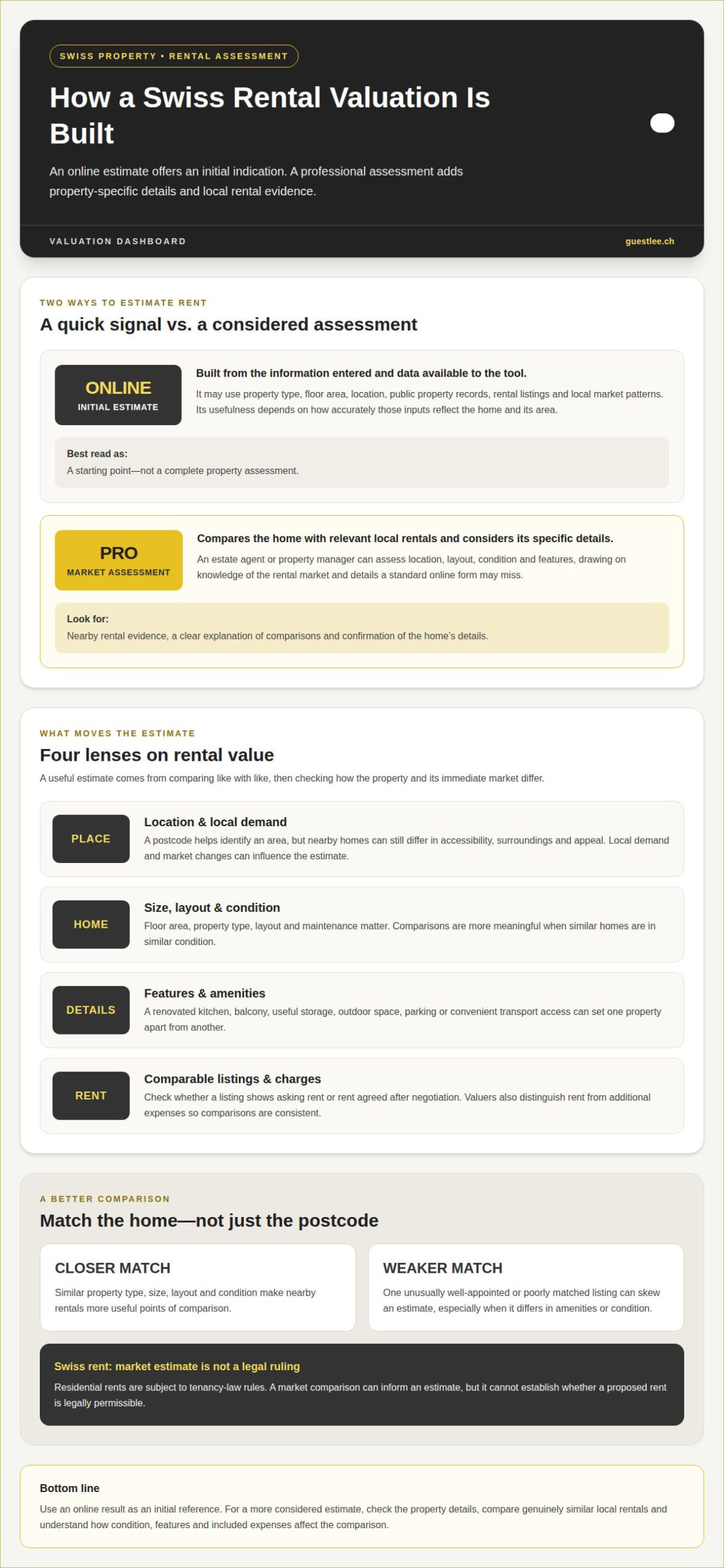
An online estimate combines property details with public information and local rental-market signals. Its usefulness depends on how accurately those inputs reflect the home and its location.
Public data and local market trends
Valuation tools analyse details such as property type, floor area, location and available public property records. They compare these inputs with rental listings and local market patterns to estimate a plausible rent. Changes in demand or in the mix of available homes can affect the result, so an estimate reflects the data available when the analysis is run.
For Swiss homes, floor area is generally more useful than an isolated square-footage figure. Check whether comparable listings describe similar layouts, condition and amenities, rather than relying only on an average for a wider area.
Postcode and nearby rental listings
A postcode helps an online tool identify an area and select nearby rental listings for comparison. In Switzerland, the relevant location may be a town or neighbourhood, since homes within one postcode can still differ in accessibility, surroundings and appeal. Comparisons are most useful when the listings resemble the property in size, type and condition.
Check whether a listing shows the asking rent or a rent agreed after negotiation. Several similar listings can provide context, but one unusually well-appointed or poorly matched home can skew the estimate.
Instant estimates and professional appraisals
An instant estimate processes the details you enter and available records without a property visit. Estate agents and property managers assess local comparisons alongside the home’s condition, layout and features, drawing on their knowledge of the rental market. Their analysis can account for details a standard online form may miss.
Swiss residential rents are subject to tenancy-law rules, so a market estimate alone cannot establish whether a rent is legally permissible. A professional valuation is an informed market assessment, not a legal ruling.
Use an online result as an initial reference, then consider whether its comparable listings genuinely match your property. A professional can explain how location, condition and competing homes affect the estimate, and identify details that may need closer assessment.
Information used to calculate rental values
A professional estimate combines property records with details about the home and its immediate market. To calculate a useful figure, the valuer considers location, property type, floor area, layout, condition and rents for comparable homes. For example, a renovated apartment with a balcony may not be comparable to a nearby apartment with an older interior, even if they have similar living space.
Condition and amenities can affect a property’s appeal and the rent it may support. A well-maintained kitchen, useful storage, outdoor space, parking or convenient transport access can set one listing apart. The valuer also considers which expenses are included in the stated rent, as advertised figures may treat additional charges differently. A clear description of the home makes these comparisons more meaningful.
Online rental valuation tools in Switzerland are generally available on property-platform and real estate agency websites. Their features and charges vary, so one tool may offer a free estimate while another charges a fee. A calculator can provide an initial indication based on the details entered, but may not capture the property’s precise condition or distinctive amenities.
When choosing a professional, look for a valuation based on nearby rental evidence and a clear explanation of the comparison properties. The valuer should account for the local market, distinguish rent from additional expenses, and explain how the home’s features affect the result. They can confirm key details with you, such as floor area, included facilities and current condition, before finalising an estimate. This gives you a more considered basis for rental decisions than a headline figure alone.
Professional Rental Valuation: How Much Rent Can Your House Earn?
A professional estimates rent by comparing the property’s details with similar homes and current market conditions. The resulting figure should reflect both the home’s appeal and the rent supported by comparable properties.
Explain how a professional uses property details to estimate rent.
The valuer considers location, floor area, layout, condition and amenities, then compares these details with similar properties. For example, a home with an updated kitchen and private outdoor space may differ from a nearby property with the same number of rooms but fewer features. Close comparisons help the professional estimate rent without relying on an average across unlike homes.
Factors for setting rent
Setting rent involves weighing comparable listings, local demand, property features and market changes. The professional also separates rent from expenses or additional charges, so the figures being compared are consistent. Swiss tenancy rules apply to residential rents, and market comparisons alone do not determine whether a proposed rent is permissible.
Any recommendation to raise or lower the rent should be based on evidence, not an arbitrary adjustment. A renovated bathroom, improved energy performance or stronger demand for similar homes may support a higher estimate. Dated fittings, maintenance needs or competing properties with more attractive amenities may weaken the case for the same rent. The valuer explains which factors shape the recommendation.
If a property attracts little interest at its proposed rent, lowering the figure is not the only option. An owner might improve the presentation, address visible maintenance issues or highlight useful features such as storage and transport access. A professional can assess whether these changes help the home stand out from competing listings before recommending a revised rent.
The gross rent multiplier offers another way to interpret rental performance: divide a property’s sale price by its annual gross rent. It is a comparison measure, not a direct rule for setting rent. A professional can consider it alongside comparable rental evidence, the property’s condition, local demand and expected expenses. This broader analysis keeps the suggested rent relevant to the home and its market.
How can a professional estimate the rental value of my property in Switzerland?
A professional starts by defining the property and intended rental arrangement. They assess its municipality, neighbourhood, property type, living area, room layout, condition and distinctive features. A home should be compared with relevant local properties, not a broad national average. Location sets the comparison area, while the home’s details determine which comparisons are useful.
Next, the valuer reviews evidence for similar properties in the local rental market. They consider asking rents, property descriptions and how closely each listing matches the home being assessed. A furnished residence, a family apartment and a villa may attract different tenant expectations, so combining unlike examples can produce a misleading estimate. The professional explains which comparisons matter most.
The assessment also considers presentation and condition. A recent kitchen renovation, outdoor space, parking or convenient public transport access may strengthen a property’s appeal. Dated fixtures or visible maintenance needs, by contrast, can affect how prospective tenants view the home. The valuer considers these features together instead of assigning an unsupported amount to each improvement.
For a more precise review, provide clear property information, including floor area, room count, furnishings, amenities and known maintenance issues. The professional can clarify details that affect comparisons, such as whether the advertised rent includes additional charges. This keeps the estimate aligned with the property’s actual offering and makes the reasoning easier to understand.
A Swiss rental valuation is a market assessment, not a substitute for advice on tenancy-law questions. Ask the professional to distinguish the estimated market rent from any legal assessment and explain the local comparisons behind the figure. This distinction matters before setting a rent or planning property changes.
For a tailored next step, explore your property options and consider how a considered rental strategy fits your plans.
GuestLee: Luxury Villa Rentals
GuestLee provides Property Management Services for owners considering how to manage a rental property. If you want support with the rental process and your property’s performance, management can be a natural next step after reviewing a valuation. The right approach depends on the home and your plans, so a valuation can help clarify your options.
For owners considering a different direction, GuestLee also offers Luxury Villa Rentals and Real Estate Sales. These services suit distinct property goals, from welcoming guests to considering a sale. A considered valuation gives you a useful starting point for discussing which path aligns with your property and priorities.
If you’d like to discuss your property’s next step, contact GuestLee.
Make Your Property’s Next Move With Confidence
A rental estimate is most useful when it informs a clear decision. Consider what you want your property to achieve, how involved you wish to be in its management, and whether renting or selling better suits your plans. These priorities give the valuation practical meaning beyond the figure itself.
If you’re still weighing how to get a rental valuation for my property, focus on finding an assessment that supports your next step, not simply the highest possible estimate. A thoughtful conversation about your property and plans can help you decide what to do next.
GuestLee offers property management, luxury villa rentals and real estate sales, giving property owners distinct options. Choose the path that reflects your goals and the experience you want your property to provide.
Contact GuestLee to discuss your property plans, and take the next step with clarity.
Frequently Asked Questions
What is the rental value of my home, and how can a professional assess it?
Your home’s rental value is the rent a professional considers appropriate for its rental arrangement and characteristics. If you’re wondering how to get a rental valuation for your property, explain the intended use, whether it will be furnished, and any restrictions affecting occupancy. The assessment can help you decide whether to prepare the property for tenants, retain it as an asset or explore another plan.
How can a professional help me set the right rent?
A professional can recommend a rent that reflects your property and priorities as an owner. For example, if your preferred tenant profile differs from the audience suggested by comparable listings, the professional can explain the trade-offs. You can then weigh rental income, the property’s presentation and your preferred occupancy plan before deciding how to proceed.
What documents and details are needed for a rental valuation?
Useful materials include a floor plan, property description, details of furnishings, and records of renovations or significant maintenance. If the home is already rented, the current lease and a breakdown of included charges can clarify the arrangement. You can also share details about storage, parking and shared facilities, giving the professional a fuller picture than a basic listing description.
How does a professional compare similar rental properties in my area?
A professional narrows the comparison to properties with relevant characteristics, then assesses how closely each one matches yours. For instance, a furnished apartment may be a weaker comparison for an unfurnished home, even in the same building. The valuer can distinguish an advertised asking rent from other listing details, helping you understand why some examples carry more weight than others.
How accurate are online rental valuations, and when should I get a professional appraisal?
An online valuation is an initial indication based on information its system can process, rather than a detailed review of your home. If you’re deciding how to get a rental valuation for your property after a renovation, before changing its rental arrangement, or for a home with unusual features, a professional appraisal can help. It gives you a chance to discuss the estimate’s assumptions and how they affect your decision.

Article by
Giacomo Esposito