Selling a luxury Swiss property to foreign buyers: resale rules
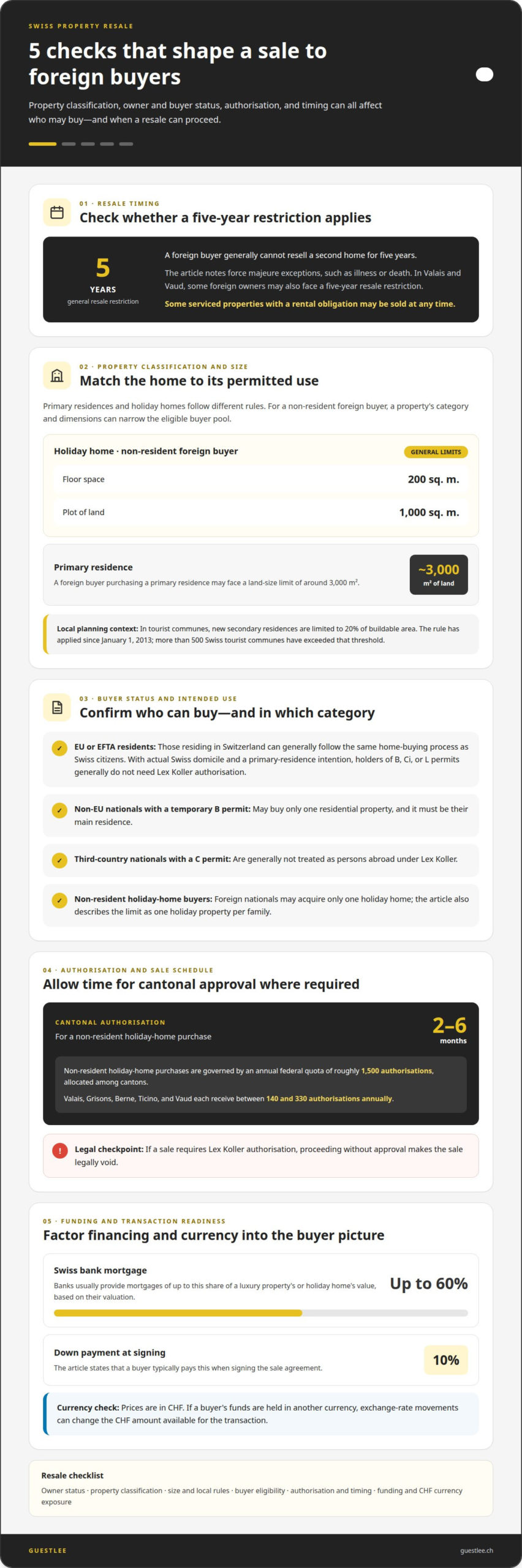
A foreign buyer’s Swiss second home generally cannot be resold for five years, except in cases of force majeure, such as illness or death. That restriction is one reason selling a luxury Swiss property to foreign buyers takes more than a polished presentation: the property’s classification and the buyer’s residence status can determine whether the sale is permitted.
It is easy to assume an owner can resell a property whenever they choose. In Switzerland, the answer depends on the rules applying to the property and its owner, and some sales require authorisation under Lex Koller. Understanding the conditions early helps set realistic expectations for the transaction.
This article explains how resale restrictions, residence classifications, property-size limits and sale timelines can shape a sale to an international buyer. It outlines rules that may apply to primary residences and holiday homes, and why the canton and buyer’s status matter.
Key Takeaways
- Resale eligibility can depend on the owner’s residence status, the property’s classification and any Lex Koller authorisation attached to the transaction.
- For non-resident foreign buyers, holiday-home limits generally include 200 sq. m. of floor space and 1,000 sq. m. of land.
- Primary residences and holiday homes follow different rules; a buyer’s permit and intended use can affect whether authorisation is needed.
- Build a realistic sale schedule around the buyer’s authorisation process, which can take two to six months depending on the canton.
Are there restrictions on reselling a property in Switzerland?
Yes. Switzerland’s Federal Act on the Acquisition of Real Estate by Persons Abroad, known as BewG or LFAIE, sets restrictions under Lex Koller. Whether a sale is permitted can depend on the owner’s residence status, the property’s use and the buyer’s status.
Foreign Owner Resale Restrictions
Resale restrictions limit when some foreign owners can transfer Swiss property. A foreign buyer generally cannot resell a second home for five years, except in cases of force majeure, such as illness or death. This matters when setting expectations: ownership alone does not mean an immediate resale is permitted. A Swiss company can also be treated as a person abroad if non-residents hold the majority of its capital or voting rights. A sale requiring Lex Koller authorisation is legally void if it proceeds without approval.
Residential Investment and Secondary-Residence Limits
Lex Koller restricts foreign acquisition of residential property, including investment purchases. Non-EU citizens with a temporary B permit may buy only one residential property, and it must be their main residence. Third-country nationals holding a C permit are generally not treated as persons abroad under Lex Koller. New secondary residences face a separate planning restriction: tourist communes may allow them across no more than 20% of buildable area, a limit in force since January 1st, 2013. More than 500 Swiss tourist communes have exceeded that threshold.
Prices per square metre vary across Switzerland and from one property to another. Location, condition, layout, views and amenities all influence valuation, so a single figure cannot represent every luxury apartment or home in Switzerland.
Foreign buyers should account for mortgage limits, CHF pricing, and cross-border currency conversion. Swiss banks usually provide mortgages of up to 60% of a luxury property’s or holiday home’s value, based on their valuation. A buyer typically pays a 10% down payment when signing the sale agreement. If funds are held in another currency, exchange-rate movements can change the CHF amount available for the transaction.
Primary residences and property-size limits
Swiss residence classifications affect which properties a foreign buyer can acquire and their permitted size. For a sale, the distinction between a primary residence and a holiday home can shape the pool of eligible buyers.
For non-resident foreign buyers, a holiday home is generally limited to 200 sq. m. of floor space and a plot of 1,000 sq. m. These limits matter when marketing a large chalet or apartment: the property’s dimensions may narrow which overseas buyers can purchase it. A foreign buyer purchasing a primary residence may face a land-size limit of around 3,000 m². The intended use and the buyer’s residence status therefore influence whether a property fits the relevant category.
In tourist areas, the Lex Weber secondary-residence rules limit new secondary residences to 20% of a commune’s buildable area. The limit has applied since January 1st, 2013. More than 500 Swiss tourist communes have exceeded it, restricting the scope for new holiday-home development. For an existing property, this planning context can shape the potential for new secondary residences in the commune, rather than changing the home’s measured floor area.
Resale timing can also vary by canton. In Valais and Vaud, some foreign property owners may be prohibited from reselling for five years after purchase. Some serviced properties with a rental obligation are exempt from this restriction and may be sold at any time. This distinction can affect both timing and how the property is presented to buyers seeking personal holiday use or rental-linked ownership.
For a transaction involving an unusually large plot or a holiday home, these boundaries deserve attention before buyer targeting begins. A property’s classification, dimensions, local secondary-residence status, and any rental obligation all help define the suitable audience. For Swiss property sales support, those factors can inform a more precise sales approach.
Primary, secondary, and holiday residence classifications
Swiss property permissions depend on the buyer’s nationality, domicile, permit status and intended use. A primary residence is the buyer’s main home; a secondary or holiday residence serves another purpose. These classifications help determine whether a foreign buyer can acquire the property and whether cantonal authorisation applies. For a sale, they clarify which buyers may proceed and what approval the transaction requires.
EU or EFTA nationals residing in Switzerland can generally follow the same home-buying process as Swiss citizens. With actual Swiss domicile and the intention to use the property as a primary residence, they generally do not need Lex Koller authorisation if they hold a B, Ci or L permit. For non-EU nationals residing in Switzerland, eligibility to acquire a primary residence depends on their residence status and how they intend to use the property. Holding a residence permit alone does not replace the requirement to live there.
For non-residents, holiday-home purchases are governed by an annual federal quota of roughly 1,500 authorisations. The quota is allocated among cantons. Valais, Grisons, Berne, Ticino, and Vaud each receive between 140 and 330 authorisations annually. Foreign nationals may acquire only one holiday home, with the limit also described as one holiday property per family. Cantonal authorisation can take between two and six months, affecting the timing of a buyer’s offer and closing.
Residence status can also intersect with tax arrangements. Beneficiaries of the described residence-permit privilege must live in Switzerland for at least six months a year. Separately, lump-sum taxation for real estate with relatively low tax value requires a minimum tax burden of CHF 400,000. These conditions matter to investors weighing residence, property use, and ongoing tax obligations.
For sellers, the practical distinction is clear: primary-home buyers and holiday-home buyers follow different eligibility routes. Confirming the property’s classification and the buyer’s residence status early helps establish whether authorisation is needed and how it may affect the transaction timeline.
Sale timelines and marketing to foreign buyers
Selling a luxury Swiss property to foreign buyers calls for a strategy that considers both the property’s appeal and the buyer’s eligibility. Marketing, due diligence, financing and notarial steps should be planned around the likely transaction schedule.
Geneva, Zurich, Verbier, and St. Moritz are among the locations international luxury buyers may consider. A property’s setting, classification, and permitted use help show how it may suit each buyer.
Property Sale Timelines and Holding Periods
A sale timeline runs from agreement to registration, while cantonal rules may affect when ownership can transfer. A standard residential sale may take eight to twelve weeks from signature to closing; a holiday-home sale requiring Lex Koller authorisation often takes four to six months. Some cantons require a minimum holding period, typically five years. Berne and Obwalden allow immediate resale, although capital gains tax may be higher during the first five years. These differences can shape the timing and positioning of a sale.
Documents and Steps for Overseas Sales
The sale file brings together property and buyer information for due diligence, the notary, and any authorisation application. A professional coordinates ownership records and property details, then aligns the sale agreement with the buyer’s financing and permit process. If Lex Koller authorisation is required, the agreement should be conditional on approval. A buyer typically pays a 10% down payment when signing. Clear documentation helps the parties move through the transaction in an orderly way.
Tax and legal exposure depend on the canton, gain, ownership duration, and buyer eligibility. Swiss property capital gains tax is described as varying from approximately 10% to 50%, depending on gain and holding period. The short holding period that may trigger anti-speculation tax also varies by canton. A sale requiring Lex Koller authorisation is legally void if it proceeds without approval. These factors make due diligence central to selling a luxury Swiss property to foreign buyers.
For a coordinated approach to Swiss property sales, align buyer qualification, marketing, and transaction timing from the outset.
GuestLee: Luxury Villa Rentals
GuestLee offers Real Estate Sales for owners preparing a Swiss property for the market. Residence rules, buyer eligibility and cantonal authorisation requirements can shape how a sale is presented and timed. A considered sales approach helps align the property’s classification with the audience it can serve.
For owners retaining a property rather than selling immediately, GuestLee’s Property Management Services provide ongoing asset care. GuestLee also offers Luxury Villa Rentals, bringing its real estate and hospitality expertise together around high-end homes.
If you’re considering a sale or property management, contact GuestLee to discuss your property.
Set your sale strategy with confidence
A successful sale begins with clarity about your priorities: timing, buyer suitability or how the property is positioned. Decide how these priorities should guide the process, then keep them central from preparation through negotiations. This gives each decision a purpose and helps keep the transaction aligned with your goals.
Selling a luxury Swiss property to foreign buyers ultimately means matching the property’s story with a suitable buyer and a well-managed process. A considered strategy can make complex decisions more orderly while preserving the qualities that make your home distinctive.
When you’re ready to discuss the next step, Contact GuestLee to discuss your sale. A conversation can help you frame your priorities and move forward with greater clarity.
Frequently Asked Questions
What are the notary fees for selling my Swiss Property?
Swiss notary fees generally range from 0.1% to 1% of the purchase price. For a seller, the amount affects net proceeds, so include it when estimating the transaction’s financial outcome. The applicable fee depends on the notarial process and canton. This is separate from any real estate agency fee, which is traditionally paid by the seller unless agreed otherwise or a buyer has signed a search mandate.
What taxes will I need to pay if I resell my Swiss property?
Property capital gains tax is a key consideration when reselling, and rates are described as varying from approximately 10% to 50%, depending on the gain and holding period. The canton also matters: rules and any short-holding-period anti-speculation tax vary. For example, a property sold soon after purchase may face a different tax treatment from one held longer. The taxable gain and ownership history shape the assessment.
Can foreigners buy residential property in Switzerland under Lex Koller?
Yes, some foreign buyers can acquire residential property, but Lex Koller restricts purchases according to nationality, residence, permit and intended use. EU or EFTA nationals domiciled in Switzerland and buying a primary residence generally do not need authorisation with a B, Ci or L permit. Non-EU nationals with a C permit are generally not treated as persons abroad. A temporary B permit allows a non-EU buyer to acquire only one main residence.
Which Swiss cantons restrict foreign property purchases, and what exemptions apply?
Foreign-buyer rules operate under the federal Lex Koller framework, with holiday-home authorisations administered through cantonal quotas. Valais, Grisons, Berne, Ticino, and Vaud each receive between 140 and 330 authorisations annually. Exemptions depend on buyer status and use: EU or EFTA residents buying a primary residence generally don’t need authorisation with a B, Ci, or L permit. Third-country nationals holding a C permit are generally not treated as persons abroad.
What permits, quotas, and ownership limits apply to foreign buyers of Swiss vacation homes?
Non-residents buying a Swiss holiday home may need cantonal authorisation under an annual federal quota of roughly 1,500 authorisations. A foreign buyer may acquire only one holiday property per family. The authorisation process takes between two and six months, depending on the canton. The home must be for private use, although periodic rental is permitted for up to six months per year.
How does selling a Swiss property to a foreign buyer differ from selling to a Swiss resident?
The main difference is whether the buyer’s status and intended use require Lex Koller authorisation. If approval is required, the purchase agreement should be conditional on receiving it; proceeding without approval makes the sale legally void. This can extend the transaction timeline and affect completion planning. A Swiss-resident buyer may not need the same foreign-buyer authorisation, but the property’s classification and the buyer’s permit status still matter.

Article by
Giacomo Esposito