Turnkey investment properties in Switzerland: costs and financing
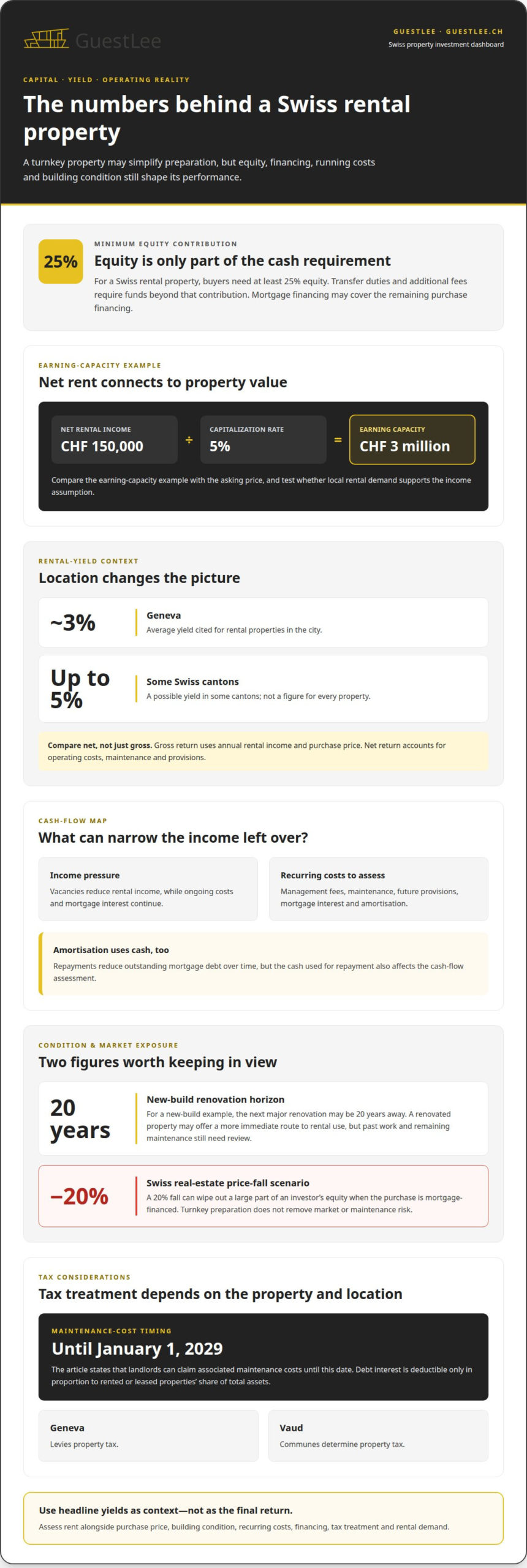
Turnkey doesn’t mean a Swiss rental property is financed entirely by a mortgage. Buyers need a minimum equity contribution of 25% for a rental property in Switzerland, so the decision is about how purchase capital, financing and ongoing costs fit together. For investors considering turnkey investment properties in Switzerland, understanding that full picture is essential before committing.
It’s reasonable to expect a turnkey purchase to simplify the path to ownership. The property may be ready for rental use, but financing, maintenance and operating costs still shape its financial performance. Foreign buyers also need to account for the rules that apply to their circumstances.
This guide explains what turnkey investment properties involve, how equity and mortgage financing affect your budget, and which costs to plan for beyond the purchase. It also covers key considerations for foreign buyers, helping you assess the practical and financial steps involved in a Swiss property investment.
Key Takeaways
- Compare a renovated property’s near-term maintenance needs with a new build’s longer renovation horizon before assessing its appeal as a rental investment.
- Use net rental income and the capitalization rate to understand how a property’s earning capacity relates to its asking price.
- Build operating costs, future provisions, mortgage interest and amortisation into your cash-flow assessment, not just the purchase budget.
- Establish how your residency status and intended use affect the purchase process before pursuing a Swiss property as a foreign buyer.
What is Investment Property in Switzerland?
A Swiss investment property is real estate held to generate rental income or support a broader portfolio strategy.
A turnkey package can coordinate acquisition, renovation supervision and rental management; its services and fees depend on the agreed scope. Investors can find such properties through real estate sales firms and property managers, then compare the property’s condition and management arrangements.
Renovated and New-Build Options
A renovated apartment may offer a more immediate route to rental use, but the quality and extent of past work matter. Review completed work alongside remaining maintenance needs. A new-build property offers a different planning horizon: the next major renovation may be 20 years away. For either example, assess expected annual costs against rental demand and your portfolio strategy.
The building’s age and condition help shape a realistic renovation plan. An older property may need substantial work sooner, while a newer one may defer that expense. Review its condition, planned upgrades and likely timing before estimating long-term viability. This helps distinguish a sustainable operating plan from one that relies on postponing necessary work.
Turnkey Investment Risks
The main risks include overlooked defects, renovation costs that exceed the available budget, weaker rental demand and changes in property value. A 20% fall in Swiss real-estate prices can wipe out a large part of an investor’s equity when the purchase is mortgage-financed. Assess rental assumptions alongside the building’s condition, rather than treating turnkey preparation as protection from market or maintenance risk.
Renovation and development plans are constrained by the property’s condition and applicable planning requirements. Before work begins, define the scope, sequence and supervision responsibilities. Separate essential repairs from optional upgrades, then track progress against the agreed plan. Clear decisions help connect the finished property with its intended rental strategy.
Should You Consider Buy-to-Let Properties in Geneva and Lausanne?
Swiss residential returns are best compared with European markets using net yield after costs and tax, rather than gross yield alone. Geneva and Lausanne offer distinct price and rental-income profiles, so location and purchase price shape the assessment.
Rental Income and Capitalization Rate
Capitalization rate connects a property’s net rental income with its earning value. For example, a Swiss property with CHF 150,000 in net rental income and a 5% capitalization rate has an earning capacity of CHF 3 million. Compare that figure with the purchase price, then assess whether local rental demand supports the income assumption.
Rental properties in Geneva yield around 3% on average; some Swiss cantons can reach 5%. These figures offer city-level context, not a complete yield for every canton or property.
Gross and Net Rental Returns
Calculate gross return by dividing annual rental income by the purchase price, then multiplying by 100. Net return subtracts operating costs, maintenance and provisions before comparing income with the property’s value. The difference matters: a strong gross figure can narrow once administration, repairs and future expenses enter the calculation.
Due diligence should test the rent assumption against comparable residential demand, review the building’s condition, and account for vacancies and recurring costs. Tenant selection and consistent rental management also affect income continuity. A structured rental-management approach can connect tenant oversight with property operations.
Tax and Rental-Yield Effects
Tax treatment changes the income retained after expenses. Until January 1, 2029, landlords can claim associated maintenance costs, while debt interest is deductible only in proportion to rented or leased properties’ share of total assets. Geneva levies property tax; in Vaud, communes determine it.
Include the relevant canton or commune in your return calculation. A 3% gross yield in Geneva is not equivalent to net income after maintenance, financing and applicable property tax. Separate each cost before deciding whether the projected rental income supports the purchase price.
Benefits of Rental Property Investment
A residential rental can provide recurring income and add real estate exposure to an investment portfolio. Its economic benefit depends on the relationship between rent, purchase price, upkeep and financing, not simply the city’s headline yield. Geneva’s rental market and Lausanne’s pricing each call for property-specific analysis.
Before buying, document expected rent, building condition, operating expenses, tax treatment and tenant-management arrangements. Compare the resulting net return with your investment strategy and intended holding period. This shows whether the property’s income profile supports your objectives, rather than relying on gross yield alone.
Equity, operating costs, mortgages and amortisation
For a Swiss rental property, the minimum equity contribution is 25%. The remaining purchase financing may come from a mortgage, while transfer duties and additional fees require funds beyond the equity contribution. Include those acquisition costs in the capital structure from the outset, rather than treating the down payment as the full cash requirement.
This stress-test figure shows how interest rates can affect cash flow. Even an attractive rental forecast must cover financing and operating expenses.
Operating costs reduce the income left after rent is collected. Budget separately for management fees and maintenance. Vacancies reduce rental income, while ongoing costs and mortgage interest continue.
Amortisation repays mortgage debt over time. Each repayment reduces outstanding borrowing but also uses cash that could otherwise support reserves or property improvements. Model the repayment schedule alongside rental income, maintenance, provisions and interest, so the financing structure reflects both current cash flow and gradual debt reduction.
Run a second scenario with lower rental income and higher operating costs. For example, test whether the property remains cash-flow positive during a vacancy while repairs and interest are still due. A 25% equity minimum is only the starting point: available capital must also accommodate purchase duties, additional fees and prudent reserves. This fuller calculation clarifies how management costs, vacancy periods, mortgage payments and future works influence net returns.
Foreign buyers and purchase restrictions
In Switzerland, eligibility to buy depends on residence status, property use and location. EU/EFTA nationals living in Switzerland and holders of a Swiss C permit can buy property freely under the rules described here. Non-EU/EFTA nationals with a Swiss B permit can buy their main residence without authorisation if they live in it and do not rent it out.
For buyers living abroad, authorisation is required to purchase Swiss property. Under the rules described here, foreign buyers can purchase commercial, professional or industrial property without authorisation. First establish your residence status and intended use: a main residence, rental investment, holiday home and commercial property follow different pathways. That distinction determines whether the property can serve your investment strategy.
Holiday homes have additional limits. Sales of holiday homes to foreign buyers are capped at 1,500 units per year nationwide, and vacation properties have been limited to 20% of available living space. These restrictions make location and property classification important parts of the purchase decision, not details to resolve after committing capital.
The Federal Council consulted on a draft of proposed Swiss restrictions on foreign property purchases from 15 April to 15 July 2026; the draft was not yet in force. Separate from that proposal, the existing rules described above distinguish buyers by residency and intended property use. Before considering renovation or development, establish which purchase category applies and how it affects ownership and future use.
For a considered next step, explore Swiss real estate opportunities suited to your investment plans.
GuestLee
GuestLee connects property acquisition with the practical work of managing an asset. Its Real Estate Sales offering supports buyers exploring Swiss property, while Property Management Services cover the ongoing needs of ownership and rental operations.
These services are a natural next step once you have considered financing, purchase restrictions and long-term costs, and want support with acquisition or management. GuestLee also offers luxury villa, chalet and apartment rentals, alongside a hospitality perspective on property use and guest stays. The right support depends on your investment plans and the role you want the property to play.
Contact GuestLee to discuss your Swiss property plans.
Shape Your Next Property Decision
Turn your investment criteria into a clear brief: define the property’s intended role, how involved you want to be, and the priorities that will guide your search. With these choices established, you can assess opportunities consistently and keep your ownership plan aligned with your longer-term objectives.
For investors exploring turnkey investment properties in Switzerland, the property itself is only part of the decision. Acquisition, maintenance and management should also fit your plans. Contact GuestLee to discuss property sales or management and clarify a practical direction for your investment.
Contact GuestLee about your Swiss property plans, and take the next step with confidence.
Frequently Asked Questions
How much equity do I need to invest?
Plan for a minimum equity contribution of 25% for a Swiss rental property, then budget separately for transfer duties and additional purchase fees. If your available capital only covers the required equity, transaction costs may still leave a funding gap. Reserve funds for renovations, maintenance and periods without rent instead of allocating every available franc to the purchase.
Will it still be worth renting out property in the future?
Swiss investment properties can produce annual returns of 2% to 5%, a more realistic range than returns reaching 8%, which are not the norm. Whether a property suits your plans depends on its rental income after operating costs, financing and tax. Assess the building’s condition and rental demand alongside projected returns, rather than relying on gross yield alone.
What does turnkey investment property mean in Switzerland?
A turnkey investment property is prepared for ownership and rental operation, with acquisition coordination and relevant renovation or management work organised as part of the process. The package and fees depend on the agreed scope. Clarify which tasks are included, who supervises renovation work, and whether ongoing rental management is part of the arrangement.
Can foreign non-residents buy investment property in Switzerland under Lex Koller?
People living abroad need authorisation to purchase property in Switzerland under the rules described here. Property use matters: foreign buyers can purchase commercial, professional or industrial property without authorisation under those rules. Holiday homes have separate restrictions, including a nationwide cap of 1,500 sales to foreign buyers per year. A residential rental investment should not be treated like a commercial purchase.
What are the taxes on Swiss rental property, including income tax, wealth tax, and property gains tax?
Tax exposure depends on the property’s canton and your circumstances. Property tax varies by canton; Zurich, Schwyz, Glarus, Zug, Solothurn, Basel-Landschaft and Aargau levy none. Until January 1, 2029, landlords can claim associated maintenance costs, while debt-interest deductions are limited in proportion to rented or leased property’s share of total assets. Include income, wealth and gains taxation in your ownership projections.
What financing and mortgage requirements apply to buy-to-let properties in Switzerland?
Swiss rental properties require at least 25% equity, with the remaining purchase financing structured around a mortgage and the property’s income. Build mortgage interest, repayments and ongoing expenses into the cash-flow model. Amortisation reduces outstanding debt over time but also draws on available cash. Vacation properties have a different equity range, from 30% to 50%.

Article by
Giacomo Esposito